Acciona Agua has activated a new intelligent hydrometric sector in Almodóvar del Campo, a municipality in Spain’s Castilla-La Mancha region, marking a significant milestone in a €1.013 million water digitalization initiative funded through the European Union’s NextGenerationEU recovery mechanism. The deployment, part of the D-ACUA project under Spain’s Strategic Project for Economic Recovery and Transformation (PERTE) for water cycle digitalization, transitions the municipality from reactive maintenance to a data-driven, predictive management model covering 110 kilometers of water distribution and 60 kilometers of sewer infrastructure.
Real-Time Monitoring Replaces Manual Oversight
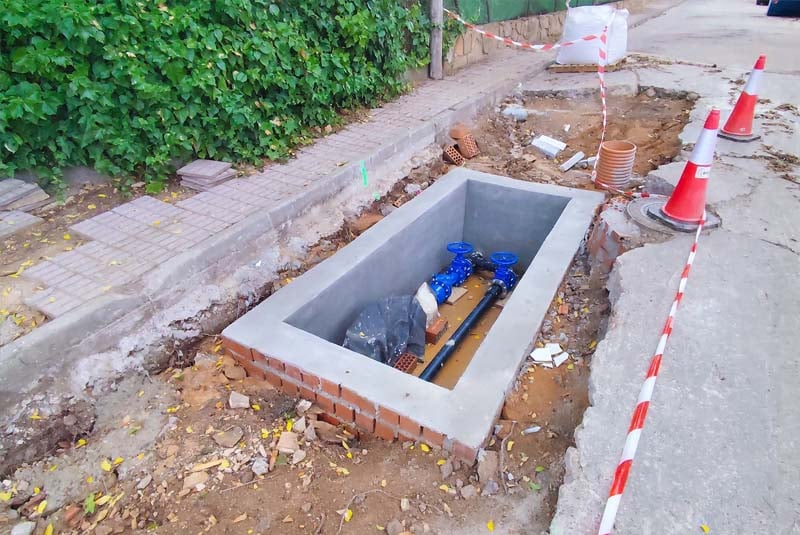
The newly operational San Antón sector, which entered service in October 2025, covers the northeastern urban core bounded by Carretera de Puertollano, Calle San Antón, Carretera de Villamayor, and Calle Carlos Morales. Infrastructure installed in an underground chamber on Calle Guadalquivir includes a DN80 valve assembly comprising four isolation valves, a filtration unit, a high-precision meter, and a pressure-reducing valve designed to stabilize pipe stress and minimize leak formation.
Telecontrol equipment integrated into the chamber transmits continuous flow and pressure readings to a centralized control facility, alongside water quality parameters such as chlorine levels, turbidity, and pH values. This continuous monitoring capability represents the operational core of the D-ACUA project, which aims to eliminate fragmented data management previously spread across paper records, CAD drawings, and geographic information systems.
Project Execution Exceeds Halfway Mark
According to the Municipality of Almodóvar del Campo, more than 52% of the D-ACUA budget has been executed, corresponding to approximately €451,000 in completed works since the project commenced in 2022. The initiative encompasses the main urban center as well as surrounding rural hamlets within one of Spain’s largest municipal territories by area, spanning over 1,200 square kilometers.
Completed and ongoing actions include comprehensive GIS digitalization of supply and sewage networks, modernized telecontrol across six water storage facilities, active leak detection campaigns that have already eliminated significant hydraulic losses, and the deployment of approximately 550 smart meters using LoRaWAN wireless infrastructure supported by up to three gateways. The municipality maintains a service footprint exceeding 5,000 connection points serving a population of approximately 5,800 residents.
Technology Stack Combines Analytics and IoT Connectivity
The project employs Baseform business intelligence software, a cloud-based analytics platform used by water utilities in multiple countries, to optimize network management and develop a structured leak-reduction plan. Baseform’s SaaS platform enables real-time water balance calculations, predictive maintenance analytics, and data-driven capital planning, aligning with the PERTE program’s emphasis on digital transformation.
LoRaWAN technology underpins the telemetering infrastructure, enabling long-range, low-power communication between smart meters and central servers. Spain has emerged as a leading market for LoRaWAN water metering, with industry estimates suggesting over 650,000 such meters deployed nationally and projections to double that figure within two years. The technology allows multiple municipal applications—including air quality monitoring, smart parking, and irrigation automation—to share the same gateway infrastructure, maximizing return on telecommunications investment.
Non-Revenue Water Reduction Central to Project Goals
The D-ACUA initiative targets a 19% reduction in non-revenue water (NRW)—the portion of distributed water that does not generate revenue due to physical losses, metering inaccuracies, or unauthorized consumption. For Almodóvar del Campo, this goal translates to an estimated annual savings of 0.41 cubic hectometers (410,000 cubic meters), contributing to aquifer recharge and reduced environmental impact from treatment processes.
Industry-wide, Spain faces NRW rates estimated between 25% and 33% in many distribution networks, making digitalization investments critical for resource conservation amid ongoing drought conditions affecting much of the Iberian Peninsula. The PERTE program’s national scope—coordinated by the Ministry for the Ecological Transition and the Demographic Challenge—has mobilized approximately €3.5 billion in public and private investment for water digitalization since its 2022 approval.
Investment Breakdown by Category
Budget allocations across the D-ACUA project reveal the distributed nature of smart water network modernization:
The €90,000 GIS digitalization component has inventoried substantially all water supply and sewage networks, establishing a precise geographic database. A €20,000 investment in the Baseform analytics platform supports structural leak planning currently under parameterization. Reservoir modernization, budgeted at €110,000, has upgraded telecontrol at the main Almodóvar del Campo facility and the Veredas spring source, adding water quality monitoring panels.
Supply network improvements totaling €246,000 include telecontrol installations and operational upgrades such as manganese filtration at the Retamar deposit, with plans to extend similar treatment to other hamlets. Leak detection campaigns under the €78,000 non-revenue water budget have achieved measurable loss reductions. The €90,000 telemetering investment covers LoRaWAN infrastructure deployment supporting the 550 planned smart meters. Wastewater and overflow management allocations of €22,000 and €180,000 respectively fund strategic discharge monitoring and relief point installations.
Public-Private Collaboration Drives Implementation
The partnership between Acciona Agua—which has managed water services in the municipality alongside neighboring Yuncos (Toledo) and Villarrubia de los Ojos (Ciudad Real) since 2013—and the local government demonstrates the collaborative framework underlying PERTE implementation. These three Castilla-La Mancha municipalities collectively serve over 28,000 residents.
Acciona manages water services for more than 15 million inhabitants across Spain and holds one of the geographically most dispersed PERTE portfolios, according to company statements. The D-ACUA project specifically addresses the challenge of applying uniform digital standards to rural and small-town water systems that historically lacked investment capital for modernization.
National Context: Spain’s Water Digitalization Acceleration
The Almodóvar del Campo deployment occurs amid intensified Spanish investment in water infrastructure digitalization. Spain’s water PERTE, approved in March 2022, represents one of the country’s 12 strategic recovery projects, with total funding reaching approximately €3.5 billion following a 2023 addendum approved by the European Commission. The program finances smart metering, sensor networks, digital twins, and analytics platforms across irrigation, industrial, and urban water applications.
Private operators have competed aggressively for PERTE funding, with Veolia’s Spanish subsidiary Agbar securing approximately €76 million across 17 projects—roughly 40% of grants awarded to private entities—reaching over 6.2 million inhabitants. Acciona’s D-ACUA initiative, while smaller in absolute terms, exemplifies the program’s reach into municipalities that would otherwise lack resources for comprehensive digital transformation.
For additional reporting on Spain’s water digitalization efforts, see previous coverage on Veolia securing 40% of PERTE funding and Soria Province’s €22.6 million rural water sensor deployment.