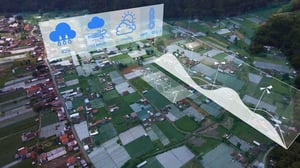
The Ayuntamiento de Nerja has begun installing an AI-driven traffic monitoring and mobility management platform across multiple high-traffic intersections in the Costa del Sol municipality. The deployment represents an expansion of the town’s broader Nerja Smart City initiative, which has been co-financed through European Regional Development Fund (ERDF) allocations.
Initial Installation Sites Target Tourism and Commercial Zones
The first wave of intelligent monitoring devices has been positioned at three strategically selected locations. Municipal officials selected these sites based on their characteristic blend of pedestrian foot traffic, vehicle circulation, retail activity, and tourist movement patterns.
Nerja’s population of approximately 22,000 residents swells significantly during peak tourism seasons, creating complex traffic dynamics in the town’s narrow historic streets.
Technical Capabilities Combine Computer Vision With Regulatory Functions
The platform employs artificial intelligence-based video analytics to process continuous data streams from traffic monitoring infrastructure. Core functional capabilities include detection of unauthorized roadway crossings by pedestrians, identification of individuals on active carriageways, recognition of abandoned objects within monitored zones, and automatic number plate recognition (ANPR) for enforcing vehicle access restrictions in designated areas.
These capabilities align with broader trends in Spanish municipal technology adoption. AI-equipped traffic cameras have been deployed across more than 80 municipalities throughout Spain, with enforcement functions ranging from mobile phone usage detection to pedestrian right-of-way compliance monitoring. The Dirección General de Tráfico (DGT) has incorporated such systems into its 2022–2026 Road Safety Plan, with funding supported through EU recovery mechanisms.
Centralized Data Platform Enables Future Service Integration
The system architecture centers on a unified platform that aggregates and analyzes sensor data in real time. According to municipal planning documents, subsequent implementation phases will extend integration to additional urban services including public lighting networks, traffic signal systems, environmental quality monitoring, energy efficiency management, and expanded security functions.
This modular approach mirrors deployment strategies adopted by larger Spanish cities. Barcelona has pursued similar AI-powered traffic optimization initiatives, including sensor-based congestion detection and camera systems designed to reduce vehicle wait times and emissions. Valencia has integrated presence detection sensors and photocell controllers into its smart lighting infrastructure, demonstrating the interoperability potential of such platforms.
European Funding Supports Andalusian Smart City Development
The Nerja Smart City program operates under ERDF co-financing arrangements that have channeled substantial investment into Spanish municipal digitalization efforts. A 2022 European Commission mobility funding announcement allocated €500,000 specifically to Nerja for bicycle lane implementation, while neighboring Axarquía municipalities received parallel investments for traffic calming measures and public transport enhancements.
Spain’s broader ERDF allocation for the 2021–2027 programming period totals €23.4 billion, with smart city and urban digitalization projects representing a significant portion of infrastructure modernization spending across Andalusia. The region received 13.6 million international tourist arrivals in 2024, underscoring the economic importance of efficient urban management systems in tourism-dependent municipalities.
Deployment Addresses Pedestrian Safety in Mixed-Use Environments
The installation prioritization reflects documented safety considerations at locations where pedestrian and vehicular flows converge intensively. Video analytics systems capable of detecting unauthorized crossings and identifying pedestrians in traffic lanes have demonstrated value in reducing collision risks in comparable European deployments.
Municipal authorities indicated that the technology provides local police with enhanced incident prevention capabilities while supporting overall public safety objectives. The system’s real-time monitoring functions enable rapid response coordination when anomalies are detected within the covered surveillance zones.