ABB Electrification Ventures has made a strategic investment in Portuguese startup Enline, targeting the acceleration of AI-powered digital twin technology for electricity networks. The deal positions both companies to address mounting pressure on grid operators worldwide to expand transmission capacity without proportional increases in physical infrastructure.
Why Grid Intelligence Is Now a Boardroom Priority
The investment arrives as electricity networks face a convergence of stressors that static management approaches can no longer absorb. Surging demand from AI data centers, accelerating electrification of transport and heating, and the rapid integration of variable renewable generation are all compounding grid complexity. The International Energy Agency has projected that U.S. electricity demand alone will grow by over 2% annually through 2026, driven in large part by data center expansion.
At the same time, regulatory momentum is pushing utilities toward more dynamic grid management. In the United States, FERC Order 881 mandated the adoption of ambient-adjusted line ratings by July 2025, with further rulemaking under way to explore requirements for real-time dynamic line ratings. These regulatory shifts are creating an urgent commercial need for the kind of predictive grid intelligence that digital twin platforms can provide.
How Enline’s Multi-Physics Platform Works
Founded in 2018 and headquartered in Mirandela, Portugal, Enline has built a cloud-based platform that generates engineering-grade virtual replicas of grid assets and their operating environments. Unlike conventional monitoring systems that depend heavily on physical sensors and hardware installations, Enline’s approach is primarily software-based, requiring minimal additional instrumentation.
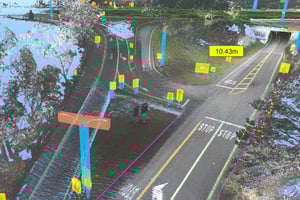
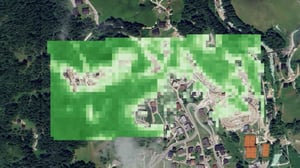
The platform integrates electrical, mechanical, thermal, weather, and vegetation data to construct a continuously updated multi-physics model of transmission and distribution infrastructure. This model enables real-time monitoring of conductor temperatures, line sag, and structural loading, along with predictive forecasts extending up to seven days for operational parameters and up to a year for vegetation encroachment and landslide risk.
Enline claims its technology can increase transmission capacity by up to 50%, reduce outage risk by up to 40%, and cut operational expenditures by as much as 35%, though these figures have not been independently verified. The company operates across five continents and serves transmission system operators, distribution system operators, power generators, and industrial clients.
ABB’s Growing Grid Technology Bet
The investment comes through ABB Electrification Ventures, the venture capital arm of ABB’s Electrification business area. Financial terms were not disclosed, which is consistent with ABB’s approach to its venture investments. As of its most recent public disclosures, ABB Electrification Ventures had invested approximately €85 million across 16 startups since 2021, spanning smart power, smart distribution, e-mobility, and smart cities.
The broader ABB Ventures framework, established in 2009, has deployed around $500 million into more than 100 startups across electrification, automation, robotics, and related sectors. Recent investments have included DG Matrix, a solid-state power electronics firm focused on AI data centers, and energy storage specialist HESStec, signaling a clear strategic priority around grid modernization and intelligent energy infrastructure.
For Enline, the ABB partnership adds significant commercial reach. The startup had previously raised approximately $5.2 million in funding, including a $3.8 million Series A round in January 2024 led by Criteria Venture Tech with participation from EIT InnoEnergy and Santander Asset Management. Enline was also recognized as the 2024 EIT Venture Awards winner and has participated in accelerators run by Google for Startups and ABB’s own Startup Challenge program.
A Competitive Market for Grid Digital Twins
Enline enters an increasingly active competitive field. Digital twin technology for grid applications has moved from pilot-stage experimentation to operational deployment across several major utilities globally. In the UK, National Grid launched its Triton digital twin platform in partnership with Atos, designed to model the country’s transmission network and potentially reduce infrastructure planning timelines by up to 70%, as previously reported by Kurrant. In the U.S., CenterPoint Energy deployed Neara‘s 3D digital twin across its Greater Houston service area to bolster resilience against extreme weather, a project also covered by Kurrant.
Other competitors include Heimdall Power, which has focused on sensor-driven dynamic line rating solutions, and LineVision, which has partnered with utilities on large-scale dynamic line rating deployments. Enline’s differentiation rests primarily on its sensorless, software-first approach, which enables faster deployment and lower upfront infrastructure costs compared to hardware-dependent alternatives.
For ABB, the Enline investment fits within a broader corporate strategy of using venture capital to build an ecosystem of partners developing intelligent grid technologies. Whether the partnership can translate into a scalable commercial offering that competes effectively with both established industrial players like Siemens and Schneider Electric and well-funded startups like Neara and Heimdall Power will depend on execution, interoperability, and the pace of utility procurement cycles.