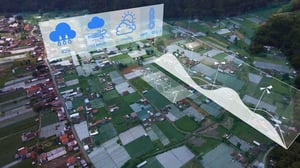
SkyFi, an Austin-based geospatial technology startup, has secured $12.7 million in an oversubscribed Series A funding round aimed at expanding its artificial intelligence-driven Earth observation platform. The investment will support product development, new satellite operator partnerships, and expanded analytics capabilities targeting both commercial and government markets.
Dual-Use Investment Thesis Attracts Climate Tech and Defense-Focused Backers
The financing round was co-led by Buoyant Ventures, a Chicago-based climate tech investor, and IronGate Capital Advisors, a New York-headquartered firm specializing in dual-use national security technologies. Additional participation came from DNV Ventures, the corporate venture arm of Norwegian assurance company DNV, alongside TFX Ventures, Beyond Earth Ventures, and Nova Threshold. Existing backers RSquared VC and J2 Ventures also returned for the round.
The capital injection positions SkyFi to pursue aggressive expansion of its data aggregation network and AI-enabled analytical capabilities. The company plans to use the funds to enhance its platform interface, develop new analytical tools, and forge partnerships with additional satellite operators to broaden its on-demand imagery coverage.
Platform Aggregates Data From Over 50 Geospatial Partners
Founded in 2021 by Luke Fischer and Bill Perkins, SkyFi operates a self-service platform that aggregates geospatial data from more than 50 partners, providing access to optical, synthetic aperture radar (SAR), hyperspectral, and aerial imagery. The platform serves customers across defense, energy, finance, infrastructure, agriculture, insurance, and environmental monitoring sectors through its web application, mobile app, and API integrations.
The company has positioned itself as a marketplace solution that eliminates traditional barriers to accessing satellite data, including specialized GIS expertise requirements and lengthy contract negotiations. Users can task satellites, access archived imagery, and run built-in analytics without maintaining in-house technical teams.
Strategic Partnerships With Major Satellite Operators Signal Market Traction
Throughout 2025, SkyFi launched custom platforms for several major satellite providers, demonstrating traction with key upstream data suppliers. The company integrated Vantor (formerly Maxar Intelligence), the leading provider of high-resolution commercial satellite imagery, to deliver on-demand access to spatial content products. Additional partnerships with ICEYE US, a synthetic aperture radar specialist operating the world’s largest commercial SAR constellation, and Planet Labs, which operates hundreds of imaging satellites, further expanded the platform’s sensor coverage.
These integrations allow SkyFi users to access diverse data types, from high-resolution optical imagery to all-weather radar sensing, through a unified interface, addressing customer demand for consolidated geospatial intelligence sourcing.
NATO Selection Enhances Defense and Security Positioning
SkyFi was selected for NATO’s Defence Innovation Accelerator for the North Atlantic (DIANA) 2026 Challenge Programme, emerging from a competitive field of 3,600 applications submitted across 24 NATO member countries. The selection places the company among 150 innovators chosen to develop dual-use technologies addressing critical defense and security challenges.
Beginning in January 2026, selected companies receive contractual funding and gain access to DIANA’s network of 16 accelerator sites and more than 200 test centers across the 32 NATO nations. The program connects participating companies with military end-users, mentors, and investors, potentially accelerating adoption across alliance defense markets.
Market Opportunity Anchored in Projected Earth Observation Growth
The investment arrives amid substantial projected growth in the Earth observation sector. A 2024 report from the World Economic Forum in collaboration with Deloitte estimated that Earth observation data could generate over $700 billion in annual economic value by 2030, with cumulative contributions potentially reaching $3.8 trillion between 2023 and 2030.