The City of Santa Monica is expanding its partnership with Hayden AI to install vision AI technology on seven municipal parking enforcement vehicles, marking the company’s first deployment beyond transit buses and establishing a new model for citywide bike lane protection.
Citywide Bike Lane Coverage Beyond Bus Routes
The contract expansion builds on Santa Monica’s existing bus-mounted enforcement programme and addresses a critical gap in bike lane monitoring. Traditional bus-based systems can only detect violations along fixed transit corridors, leaving most of the city’s network of over 100 miles of bikeways without automated oversight.
By mounting the same AI-powered camera systems on parking enforcement vehicles that patrol throughout the municipality, Santa Monica can now monitor bike lane compliance across its entire street network. The seven vehicles will supplement existing enforcement on the Big Blue Bus fleet, which began issuing citations in September 2025 following a 60-day warning period.
California Legislation Enables Parking Vehicle Deployment
The deployment is authorised under California Assembly Bill 361, signed into law in October 2023. The legislation permits local agencies to install forward-facing cameras on city-owned parking enforcement vehicles specifically for photographing bike lane violations through January 2030.
The Santa Monica programme will be funded through Measure K, with approximately $200,000 allocated for the first year and $186,000 annually thereafter. The city’s contract modification with Hayden AI totals $944,000 for the expansion.
Pilot Data Revealed Scope of Violation Problem
Santa Monica’s decision to pursue automated enforcement stems from a 2024 pilot programme that documented the extent of illegal parking in bike lanes. Over six weeks in mid-2024, the system detected 1,679 violations across limited test routes, averaging 7.7 violations per bus per day. Of these, 263 were classified as significant obstructions where vehicles partially or fully blocked cycling infrastructure.
Research cited by municipal officials indicates that when vehicles park in bike lanes, cyclists must merge into motor vehicle traffic, substantially increasing collision risk. National data shows that approximately 87% of cyclists encountering blocked bike lanes deviate into travel lanes to navigate around obstructions.
Expansion Follows Company’s European and US Growth
The Santa Monica deployment comes amid broader expansion for Hayden AI, which secured $90 million in growth equity financing earlier this year to scale its vision AI platform across major US cities. The company’s systems currently operate on transit fleets in Los Angeles, Culver City, West Hollywood, Oakland, and Sacramento, with national deployments spanning New York City, Washington DC, and Philadelphia.
Internationally, the company has been expanding into European markets. Barcelona recently launched a six-month pilot using Hayden AI cameras on four buses operating the H12 and D20 routes, marking one of the largest automated bus lane enforcement trials in Europe.
In Washington DC, where automated enforcement began in 2023, officials documented a 32% reduction in bus stop parking violations within one year. New York City transit data shows bus speeds increased by up to 40% and collisions decreased by as much as 34% on routes using the camera systems.
How the Technology Works
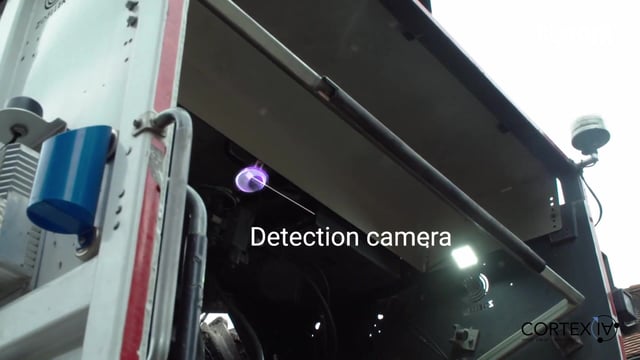
Hayden AI’s platform combines vehicle-mounted cameras with onboard edge computing to detect potential violations in real time. The system uses computer vision and machine learning to identify illegally parked vehicles and capture photographic evidence while the enforcement vehicle is in motion.
Captured images are uploaded to a secure portal where designated city employees review potential violations before citations are issued. Under California law, notices must be sent to registered vehicle owners within 15 calendar days of the violation. The photographic records are treated as confidential and available only to public agencies for enforcement purposes.