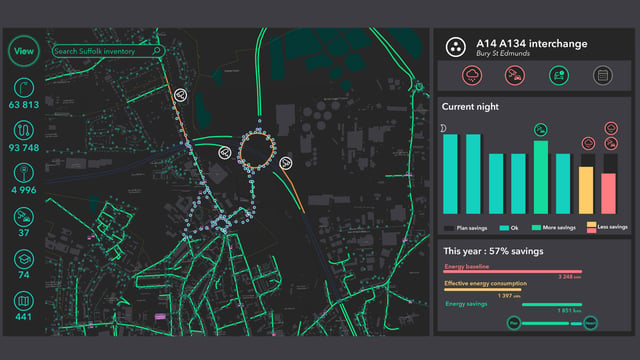
National Grid has launched Triton, a digital twin and data visualization platform developed in collaboration with Atos, aimed at overhauling how the UK’s electricity transmission operator plans and prioritizes infrastructure investments across England and Wales.
The platform generates a virtual replica of the country’s physical transmission network and draws on thousands of datasets from distribution network operators and transmission owners to model future electricity demand at grid supply points and substations. According to the partners, the tool could cut the time needed to evaluate and approve network reinforcements by as much as 70 percent.
Eliminating a Decade-Long Planning Backlog
Before Triton’s development, National Grid Electricity Transmission (NGET), the subsidiary that owns and maintains the high-voltage network in England and Wales, relied heavily on manual modelling methods for infrastructure planning. According to Atos this approach had created a data backlog so severe it would have taken roughly ten years to clear using conventional methods.
Triton has already demonstrated measurable impact. The platform has reduced that backlog by 53 percent, while area reviews that previously required approximately six months can now be completed in just over a month, representing a 76 percent acceleration. Atos also reports the tool has eliminated the need for roughly 30 additional staff members who would otherwise have been required to manage data processing manually, delivering what the company describes as substantial cost avoidance.
How Triton Works Under the Hood
Triton operates by consolidating large volumes of operational data into a single visual interface, enabling planners to map projected electricity demand growth across the network. The platform automates complex analytical processes and supports scenario modelling, allowing engineers to test multiple reinforcement options against local and regional capacity constraints.
The tool integrates directly with National Grid’s existing monitoring and engineering systems, enabling faster configuration of network models and stress-testing of upgrade scenarios. It can also assess future connection requests, including from data centres and embedded generation projects, against available grid capacity, an increasingly critical function as electricity demand is forecast to grow by around 50 percent over the coming decade.
Real-time data consolidation across the platform ensures that planning decisions are based on current and accurate information, while concurrent working capabilities allow multiple teams to collaborate on scenarios simultaneously.
A Critical Tool for The Great Grid Upgrade
Triton arrives at a pivotal moment for UK energy infrastructure. National Grid’s Great Grid Upgrade, described as the largest overhaul of the electricity transmission network in generations, requires delivering five times more infrastructure over the next six years than was constructed in the previous three decades.
The programme is underpinned by a £9 billion supply chain framework and forms part of a broader £16 billion investment cycle running from 2021 to 2026. Its primary goal is to connect 50 GW of offshore wind generation by 2030, supporting the UK government’s Clean Power 2030 ambition. The initiative is expected to support over 55,000 jobs and contribute an estimated £14.5 billion annually to the UK economy by the end of the decade.
With infrastructure projects of this scale and pace, tools like Triton that can compress planning timelines and enable data-driven decision-making become essential to keeping the programme on track.
Digital Twins Gaining Traction Across Grid Operators Globally
National Grid is not alone in turning to digital twin technology for grid modernization. In April 2025, PJM Interconnection, the largest regional transmission operator in North America serving 67 million people across 13 US states, entered a multi-year partnership with Google and Tapestry, an Alphabet-incubated project powered by Google Cloud and Google DeepMind. The initiative aims to build AI-powered tools that unify PJM’s fragmented planning databases into a single grid model, with the goal of dramatically accelerating how new generation sources are connected to the network.
In the US utility sector, CenterPoint Energy partnered with Sydney-based Neara to deploy a 3D digital twin across its Greater Houston service area, using AI and predictive modelling to strengthen grid resilience against extreme weather events. That deployment, covered previously by Kurrant, followed the $1.7 billion in damages caused by Hurricane Beryl in 2024.
Atos Expands Its Energy Sector Footprint
Atos has been building out its digital twin capabilities across multiple sectors, including manufacturing, energy, and logistics. Its partnership with National Grid represents one of the most high-profile deployments of the technology in the European energy sector to date.