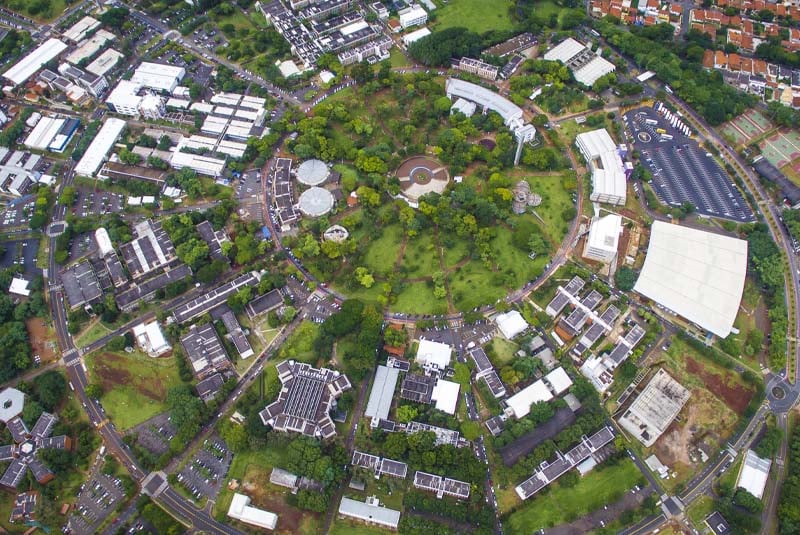
The State University of Campinas (Unicamp), one of Latin America’s top-ranked research institutions, has launched a large-scale IoT-enabled street lighting modernization across its main campus in Barão Geraldo, Campinas. The R$ 5 million (€800,000) initiative, funded through Brazil’s national energy conservation program, will replace the university’s entire outdoor lighting infrastructure with over 2,600 remotely managed LED luminaires, targeting a 70% reduction in electricity consumption.
The deployment represents TIM Brasil‘s first smart lighting contract with an educational institution and adds to the telecom operator’s rapidly expanding utility-sector footprint, which now exceeds 470,000 smart lighting points sold nationwide.
Federal Energy Program Backs the Campus Overhaul
The project is financed through an agreement with ENBpar (Empresa Brasileira de Participações em Energia Nuclear e Binacional), which administers PROCEL, Brazil’s National Electricity Conservation Program established in 1985 under the Ministry of Mines and Energy. Specifically, the funds originate from PROCEL’s Resource Application Plan, which channels federal investment into LED retrofit and public lighting efficiency projects across municipalities and public institutions.
PROCEL’s RELUZ subprogram has historically been the country’s largest dedicated funding mechanism for municipal lighting upgrades. The program has supported the replacement of more than 2.3 million lighting points since 2000, and ENBpar recently announced plans to allocate over R$ 150 million (€24.2 million) in a forthcoming public call for additional LED modernization projects.
How the TIM Smart Lighting System Works
The chosen technology platform is TIM Smart Lighting, a solution co-developed by TIM Brasil and its hardware partner M2M Telemetria, a Brazilian IoT specialist founded in 2003 with deep expertise in smart grid and smart city infrastructure.
The system comprises 2,615 NB-IoT sensors installed on LED luminaires and connected through TIM’s 4G narrowband IoT network, the largest IoT network in Brazil. Each fixture can be individually controlled and monitored through the cloud-based NOX Manager Platform, developed by M2M Telemetria. The platform enables real-time energy consumption measurement, scheduled dimming profiles, remote on/off switching, and predictive maintenance alerts based on electrical parameters such as voltage, current, and power factor.
Installation work is expected to be completed by the end of February 2026, with a formal inauguration planned for March. The accompanying 10-year service contract with TIM covers cloud communication, software licensing, firmware updates, and continuous data storage.
Environmental Sensors Transform Campus Into a Living Laboratory
Beyond illumination, the deployment introduces a suite of smart city sensors supplied by Liveable Cities, a Canadian manufacturer of wireless streetlight controllers and urban micro-sensors that operates as a division of LED Roadway Lighting Ltd. M2M Telemetria is responsible for integrating these devices into the campus network.
The donated sensor package includes five traffic radars for vehicle counting at campus entry gates, one high-definition surveillance camera, one air quality monitor, and one noise level sensor. These instruments will feed data into Unicamp’s renewable energy and energy efficiency research laboratories, enabling faculty and students to study real-world urban monitoring scenarios. The infrastructure is also designed to support future expansion with additional cameras, traffic management tools, and gunshot detection capabilities.
Unicamp’s Sustainable Campus Program Anchors the Strategy
The lighting modernization forms part of Unicamp’s broader Sustainable Campus initiative, now operating as a Special Projects Office. Described as the largest academic program for energy sustainability in Latin America, it encompasses 24 active sub-projects spanning energy efficiency, electric mobility, renewable generation, and energy transition research. The program already generates approximately R$ 15 million in annual savings through reduced energy costs across the university’s operations.
The project was developed and implemented through a partnership between the Sustainable Campus program and GHM Solutions, a project management firm. Institutional partnerships with the Paulista Center for Energy Transition Studies (CPTEn) and the Paulista Center for Innovation in Public Lighting (CEPIL) aim to extend the project’s findings to municipalities and inform state-level public policy.
Unicamp intends to share lessons learned annually at the São Paulo Congress on Lighting and Cities of the Future (CPIIC), an event held in Campinas that brings together municipal administrators, private-sector technology providers, and academic researchers. ENBpar representatives presented PROCEL’s public lighting initiatives at the most recent edition of the congress in June 2025.
TIM Brasil’s IoT Utilities Business Reaches Scale
For TIM Brasil, the Unicamp contract reinforces a strategic pivot toward IoT-driven enterprise services. The operator’s dedicated TIM IoT Solutions division, launched in March 2024, recently surpassed R$ 1 billion (€161 million euros) in total contracted value across its four priority verticals: agribusiness, utilities, logistics, and Industry 4.0.
In the utilities segment specifically, TIM reported selling nearly 470,000 smart lighting points as of its Q4 2025 earnings disclosure, representing 39% year-over-year growth. The company holds INMETRO certification for its smart lighting equipment and has deployed solutions for public-private partnership operators including Engie and IPSul in cities such as Porto Alegre and Curitiba.
TIM positions Brazil’s 5G expansion, where it claims coverage in over 1,000 cities, as an accelerator for future IoT deployments. The operator’s NB-IoT network, originally launched in partnership with Ericsson and Inatel, provides the low-power, wide-area connectivity layer that underpins both its smart lighting and agricultural monitoring offerings.
Replicability for Brazilian Municipalities
The campus-scale deployment is designed as a proof of concept that can potentially be adapted by small and mid-sized Brazilian municipalities, many of which lack the technical capacity and fiscal resources to independently procure smart lighting systems. According to World Bank analysis, Brazil’s public street lighting sector accounts for approximately 4% of national electricity consumption, and a nationwide LED conversion could achieve energy savings on the order of 50%, contributing meaningfully to the country’s emissions reduction commitments.