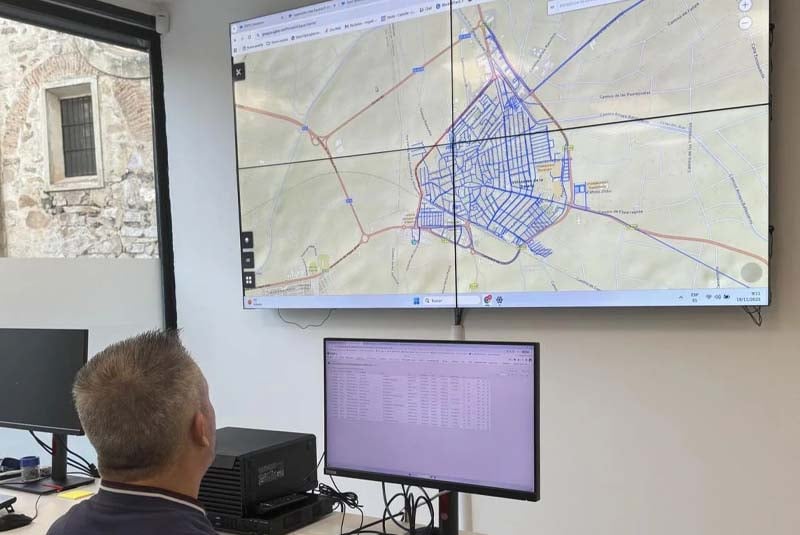
Villanueva de la Serena, a municipality of approximately 25,800 inhabitants in Spain’s Badajoz province, will gain a new hydraulic mathematical model for its water supply and sanitation networks in the coming months. Veolia, which operates in the Extremadura region under its recently unified brand (formerly Aquanex), will carry out the deployment as part of the EU-funded DigitalLasVegas project. A new master supply plan is also being developed and will extend to the surrounding municipalities grouped under the Mancomunidad de Vegas Altas.
From Reactive Operations to Data-Driven Water Planning
The mathematical model is designed to provide a full diagnostic of the water supply chain, from raw water intake through treatment and distribution to end users. By simulating network behavior under different demand and pressure scenarios, the tool aims to help operators anticipate failures, reduce non-revenue water, and lower both operational and capital planning costs.
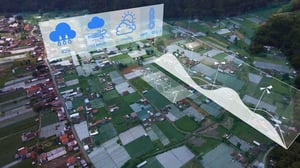
Field data collection is already underway, including topographic surveys conducted via drone flights. The model will integrate this spatial data with technical and urban planning information, network condition assessments, and real-time measurement campaigns to build a comprehensive picture of how the system performs today and where vulnerabilities may exist.
Eight-Phase Rollout With a Five-Month Timeline
The project is structured in eight sequential phases, beginning with initial data gathering and culminating in the delivery of a strategic planning document intended to guide investment priorities for the coming years. Among the final steps, municipal technical staff will receive training on operating and maintaining the model independently.
The estimated completion period is five months, suggesting the model could be operational by mid-2026. The resulting master plan is expected to define priority infrastructure interventions and serve as a long-term roadmap for supply network management across the region.
Part of a Broader EU-Funded Digitalization Push
DigitalLasVegas sits within the broader PERTE for the Digitalization of the Water Cycle, a strategic program approved by Spain’s Council of Ministers in March 2022 and financed through the European Commission‘s NextGenerationEU recovery mechanism. The project was awarded to a consortium comprising the Villanueva de la Serena municipal government, the Mancomunidad de Vegas Altas, the Consorcio Vegas Altas-La Serena, and Veolia (then Aquanex), with total funding of approximately €2.8 million and a 30-month execution window.
As of early February 2026, the DigitalLasVegas project had reportedly reached 75% completion, according to a public event held in Villanueva de la Serena where stakeholders reviewed progress. The project encompasses a range of digitalization measures beyond the mathematical model, including remote monitoring, real-time telemetry, and data-driven decision support across the water cycle.
Veolia has been the largest private-sector beneficiary of Spain’s water PERTE program nationally, securing approximately €76 million in grants spread across 17 projects that together cover 209 municipalities and more than 6.2 million inhabitants.
Veolia’s Expanding Footprint in Extremadura
The company recently completed a brand consolidation across Spain, retiring more than 100 local operating names including the Aquanex brand that had served the Extremadura region for over four decades. The transition places Veolia’s full global technology stack and operational expertise at the disposal of its Extremadura operations, which serve more than 90 municipalities across the provinces of Badajoz and Cáceres through a distribution network spanning over 1,091 kilometers and delivering approximately 39 million cubic meters of water annually.
The Spain-wide PERTE water digitalization program, managed by the Ministry for the Ecological Transition and the Demographic Challenge (MITECO), channels roughly €1.94 billion in public investment toward modernizing urban water infrastructure. The program’s national target is to reduce treated drinking water losses from approximately 23% to 10% by 2030, a goal that mathematical modeling tools like the one being deployed in Villanueva de la Serena are specifically designed to support.
What Mathematical Modeling Means for Small-City Water Management
Hydraulic mathematical models allow utilities to create virtual replicas of physical pipe networks, simulating flows, pressures, and water quality across thousands of nodes. For mid-sized Spanish municipalities like Villanueva de la Serena, such tools represent a significant operational upgrade, enabling the shift from purely reactive maintenance toward predictive asset management.
The approach is consistent with broader European trends in water digitalization, where utilities are increasingly combining sensor networks, data analytics, and simulation platforms to improve efficiency. Spain’s PERTE program has been recognized as a reference model internationally, with the World Bank citing it as a benchmark for how governments can design comprehensive digitalization frameworks for the water sector.