Mauges Communauté, an intercommunal authority of approximately 120,000 residents in Maine-et-Loire, western France, will equip a collection truck with an AI-powered camera system starting in February 2026. The technology, developed by Grenoble-based start-up Ficha, will be installed on a vehicle operated by waste collection contractor Brangeon Environnement to monitor sorting quality across household waste and recyclable packaging streams over a 12-month trial period.
Targeting the 40 Percent of Misplaced Waste in Grey Bins
The deployment responds to a persistent contamination problem. While Mauges Communauté already performs well against national benchmarks, collecting roughly 88 kilograms of residual household waste per inhabitant annually, an estimated 40 percent of what ends up in the grey (non-recyclable) bin does not belong there. That volume of misplaced recyclables and organic material represents both a lost opportunity for resource recovery and an avoidable cost burden on the territory’s waste treatment infrastructure, managed by regional syndicate Valor3e.
The AI system aims to quantify and locate those errors with a level of granularity that manual inspections cannot achieve at scale.
How the Camera System Works on the Collection Route
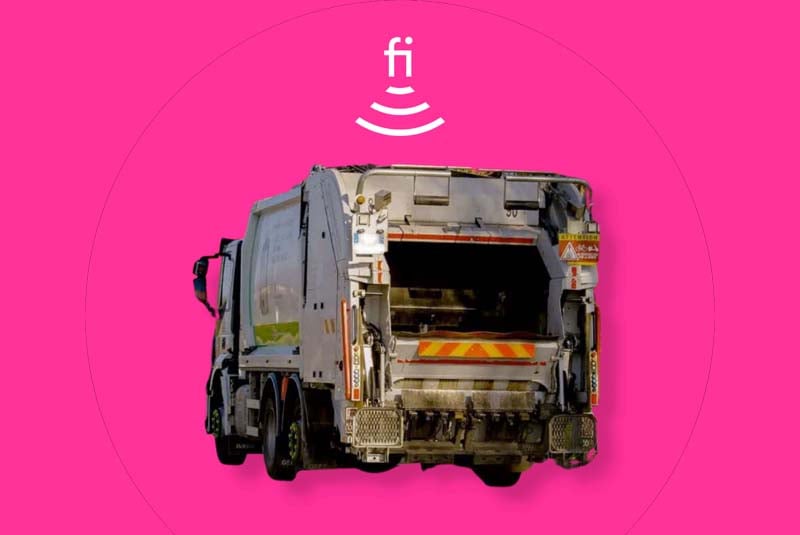
Ficha‘s technology uses a camera mounted on the hopper (trémie) of a bi-compartmented truck, a vehicle type that collects both household waste and recyclable packaging simultaneously in separate compartments. As each bin is emptied, the camera captures images of the material entering the truck, and an onboard AI algorithm analyzes the contents in real time to identify items that should not be present in a given waste stream.
For the initial phase, a single truck will follow the same route for three to four months at a time. This recurring pattern is deliberate: repeated data from the same collection circuit provides the most meaningful picture of where sorting problems are concentrated and whether they are isolated incidents or systemic issues in specific neighborhoods or streets.
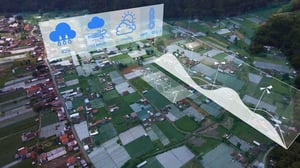
The resulting data will be aggregated and mapped geographically, giving Mauges Communauté’s waste management teams the ability to pinpoint problem areas and deploy targeted resident education campaigns.
Awareness Over Enforcement
The authority has been clear that the initiative is designed around education, not penalties. Mauges Communauté does not hold policing powers over waste compliance, and has stated that no fines or coercive measures will result from the AI monitoring. If the data reveals recurring sorting errors concentrated in a particular area, outreach teams may contact residents directly to provide guidance on correct sorting practices.
This approach aligns with France’s broader trend toward using AI-generated waste data as a diagnostic and engagement tool rather than an enforcement mechanism, a position also adopted by other municipalities including the Communauté Urbaine du Grand Reims and the Lille metropolitan area.
Brangeon Environnement Brings Operational Experience
The pilot is not Brangeon Environnement‘s first deployment of AI waste monitoring technology. The waste management firm, a subsidiary of the family-owned Groupe Brangeon founded in 1919 and headquartered in Maine-et-Loire, has already implemented similar systems on other contracts in the region. These include the 3RD’Anjou syndicate, which handles waste collection for three local authorities in the same department, and Loudéac Communauté Bretagne Centre in Côtes-d’Armor, Brittany.
Ficha: A Grenoble Start-Up Competing in a Growing Market
Ficha, founded in 2020, develops computer vision and AI-based tools for waste characterization both on collection trucks and at the bin level. The company’s technology uses image recognition algorithms capable of identifying over 20 categories of waste, detecting contaminants such as glass in recycling streams or hazardous items like gas canisters. Ficha was a laureate of the 2022 Citeo Circular Challenge, an accelerator program for circular economy innovation, and raised approximately €840,000 to support its growth and international expansion.
Ficha operates in a competitive French market alongside Lixo, which had equipped roughly 300 collection trucks by the end of 2024 and works primarily with major operators SUEZ and Veolia. Both start-ups use similar underlying technology, cameras paired with machine learning models, but have pursued different go-to-market strategies, with Lixo focusing on large-scale operator partnerships and Ficha building traction through direct work with smaller municipalities and social housing providers.
A Test Case for Rural AI Waste Monitoring
Most existing deployments of AI-equipped collection trucks in France have taken place in urban or peri-urban areas, Grand Paris Sud (six trucks, approximately €110,000 per year), Lille, Amiens, and Toulouse among them. Mauges Communauté’s territory, spanning more than 1,300 square kilometers across six predominantly rural municipalities, presents a different operating environment where collection routes are longer, housing is more dispersed, and population density is significantly lower.
The trial’s results could help determine whether AI-based waste monitoring delivers the same diagnostic value in rural settings as it has demonstrated in denser urban contexts, a question of growing relevance as France continues to push toward its recycling targets under the AGEC law. The country’s recycling rate for non-mineral, non-hazardous waste stood at 46 percent as of 2022, according to European Environment Agency data, well short of the 65 percent goal.