The Italian AI waste monitoring startup NANDO (formerly Re Learn) has closed a €3.3 million capital increase aimed at expanding its computer vision platform for municipal waste collection optimisation and food waste reduction. The Turin-headquartered company, founded in 2021, plans to use the capital to deepen its AI and data analytics capabilities across the full waste management value chain.
Who Backed the Round and Why It Matters
The investment was co-led by MAIA Ventures (Praesidium SA) through the Maia I fund — which participates in the European Investment Fund (EIF) InvestEU programme and CDP Venture Capital through its Accelerators Fund. Additional participation came from the Piemonte Next Fund, subscribed by regional financial institution FinPiemonte, alongside returning investors Club degli Investitori, La4G, and EMBA Capital Partners.
The involvement of MAIA Ventures is particularly notable. The Milan-based fund launched a €55 million vehicle in late 2025 focused on early-stage AgriFoodTech, backed by EIF and CDP Venture Capital Sgr, and targets companies developing scalable technological solutions in the food and sustainability value chain. NANDO’s food waste reduction capabilities align directly with that thesis.
How the Platform Works: Computer Vision Meets Operational Waste Data
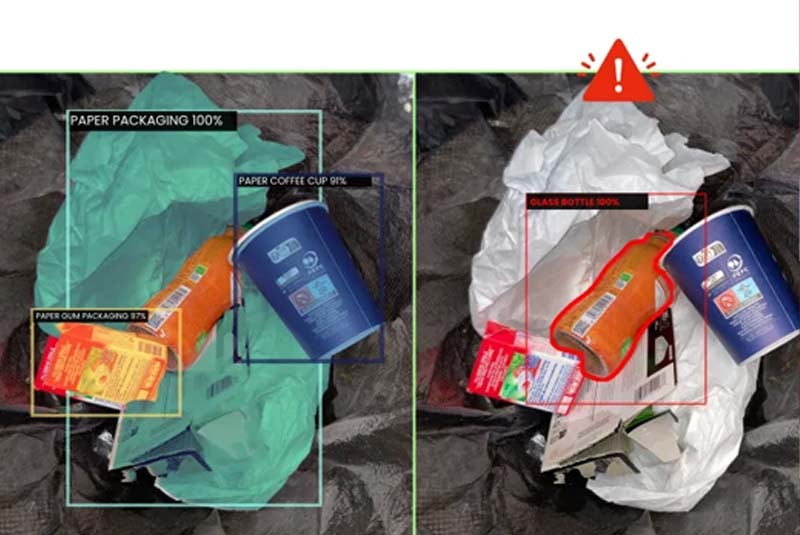
NANDO’s proprietary platform integrates artificial intelligence, machine learning, and computer vision to monitor waste in real time across office, industrial, municipal, and food service environments. The system uses sensors attached to existing bins to measure waste production and monitor segregation quality, while a display component, branded NANDO.Eye, uses AI-powered object recognition to guide users toward correct disposal based on local sorting rules.
The company currently processes more than 40,000 waste images daily across deployments spanning Japan, the United States, the UAE, Europe, and the United Kingdom. Its client base of over 80 organisations includes ISS, Narita International Airport in Tokyo, A2A, IREN, IVECO Group, Deloitte, L’Oréal Italia, Capgemini, CBRE, and Grosvenor Property UK. According to company data, the sensor system can recognise over 72 waste categories with an average accuracy of 92%, and deployments have reportedly increased waste segregation quality from around 30% to 75%.
A dedicated business unit now focuses specifically on food waste reduction in collective catering, delivering monitoring data that enables measurable reductions in overproduction and disposal costs.
From Smart Bin Startup to Multi-Sector Waste Intelligence Provider
NANDO was founded in Turin by Riccardo Leonardi, Fabrizio Custorella, Giovanni Lucifora, Federico Fedi, and Simone Cavariani. The company was accelerated through ZERO, a cleantech programme within CDP Venture Capital’s National Accelerator Network, delivered by Zest and ELIS with ENI as the main corporate partner.
The startup has evolved considerably since its early days as a smart bin manufacturer. Its platform now consolidates monitoring of multiple waste types, from food waste to industrial and municipal refuse, into a single dashboard that automates reporting, supports GRI 306-compliant sustainability disclosures, and enables audit-ready data for ESG compliance. The company holds ISO 9001:2015 certification for the design and implementation of AI solutions in waste management.
NANDO was also qualified for The Smart Deal 2024, an investment event powered by Kurrant at the Smart City Expo World Congress in Barcelona, which connects smart city and utility-focused startups with venture capital and industry partners.
Regulatory Tailwinds and Market Pressures Driving Demand
The timing of NANDO’s raise aligns with growing pressure on European corporations to measure and report their waste footprints. The EU’s Corporate Sustainability Reporting Directive (CSRD), though recently narrowed in scope through the December 2025 Omnibus reforms, still requires qualifying companies to disclose detailed environmental data including waste management practices under the European Sustainability Reporting Standards (ESRS). For entities that remain in scope — those with over 1,000 employees and €450 million in turnover, accurate, auditable waste data has become a compliance necessity rather than an optional sustainability initiative.
At the operational level, rising labour costs, raw material price increases, and chronic workforce shortages in the waste management sector are also pushing municipalities and large enterprises to seek technology-driven alternatives to manual monitoring. This dual pressure, regulatory compliance from above and operational efficiency demands from below, creates what NANDO’s leadership describes as a unique market opportunity for data-driven waste optimisation.
European WasteTech Investment Landscape Shows Sustained Momentum
NANDO’s round fits within a broader pattern of sustained European investment in digital waste management solutions during 2025 and 2026. Switzerland-based Jaipur Robotics raised approximately €886,000 across pre-seed rounds to develop AI-driven monitoring for waste-to-energy plants. In the Netherlands, Hydryx secured €2.5 million in seed funding for methane capture technology targeting landfill emissions. Italian peer Resilico raised €5 million in Series A funding for technology that converts industrial waste into secondary raw materials. In the UK, Future Greens raised approximately €569,000 to deploy on-site systems that convert brewery and food waste into energy.
At the larger end of the spectrum, US-based AMP Robotics raised $91 million in a Series D round in late 2024 to scale its AI-powered municipal solid waste sorting systems, underscoring the substantial capital flowing into AI-enabled waste infrastructure globally.
Collectively, the European rounds alone represent approximately €9 million in disclosed WasteTech funding across the 2025–2026 period, spanning waste monitoring, waste-to-energy, landfill emissions reduction, and industrial waste transformation.
Expansion Plans Target US and Asian Markets
Looking ahead, NANDO plans to consolidate its presence in Europe and the United Kingdom while accelerating expansion into the United States and Asia. The capital raised will support team growth and the development of new product lines dedicated to monitoring additional waste types, positioning data as the central element of strategies for waste reduction, operational optimisation, and decision support.
The company’s international trajectory, already spanning deployments at major airports, multinational corporate offices, and municipal waste operators across 17 countries, suggests a platform that has moved well beyond the pilot stage. Whether NANDO can successfully scale its technology into the highly competitive US waste management market, where incumbents like AMP Robotics and Rubicon operate, will be a key test of the platform’s commercial viability.