The Nashville Department of Transportation and Multimodal Infrastructure (NDOT) has activated smart traffic signal technology at 36 intersections along Lebanon Pike, marking the city’s first large-scale deployment of adaptive signal systems. The initiative, part of Nashville’s voter-approved Choose How You Move transportation program, represents an initial step toward upgrading approximately 600 traffic signals across Davidson County over the next seven years.
Adaptive Technology Replaces Decades-Old Infrastructure
The Lebanon Pike Smart Signal Project introduces traffic signals capable of selecting from multiple timing configurations based on real-time traffic conditions. Unlike conventional fixed-timing signals, the new system monitors traffic density and adjusts green light duration accordingly, prioritizing throughput during congestion while responding to crashes, special events, or other disruptions affecting traffic flow.
NDOT has installed upgraded signal cabinets with self-diagnostic capabilities and battery backup systems that can maintain operations for two to three hours during power outages. Ten major intersections along the corridor have received complete cabinet replacements, with the remaining installations featuring new controller hardware. The signal infrastructure spans from the Wilson County line through downtown Nashville.
LiDAR Integration Enables Multimodal Detection
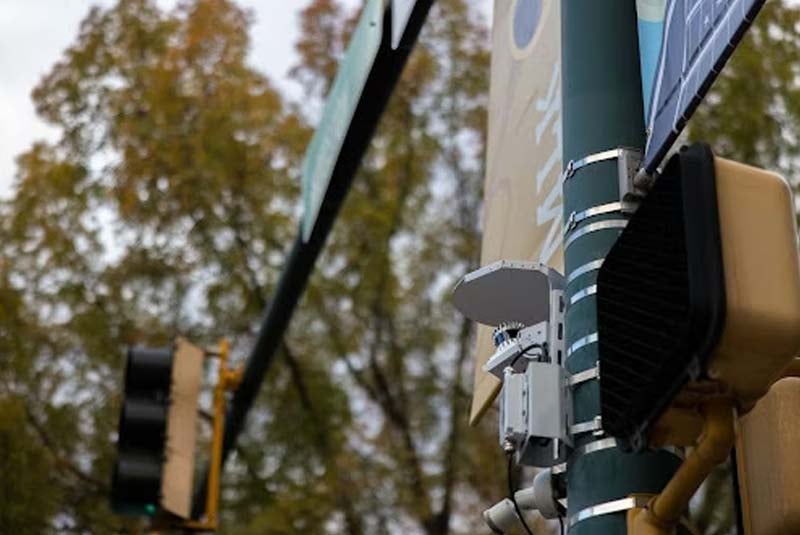
Nashville’s smart signal initiative builds on the city’s Leveraging Advanced Data to Deliver Multimodal Safety (LADDMS) program, which deploys Ouster BlueCity LiDAR sensors at key intersections. The technology uses 3D light detection and ranging to identify vehicles, buses, pedestrians, and cyclists without capturing personally identifiable information such as license plates or facial features.
According to NDOT Chief Traffic Engineer Derek Hagerty, the LiDAR-equipped signals will eliminate the need for pedestrians to press crosswalk buttons and prevent motorists from waiting at red lights when no cross traffic is present. The system processes traffic data through Vanderbilt University’s Institute for Software Integrated Systems, which analyzes near-miss incidents and movement patterns to inform safety interventions.
The city received approximately $12 million in federal SMART grants to deploy LiDAR technology across multiple corridors, with the largest allocation supporting Phase II expansion along Nolensville Pike. Nashville’s LADDMS consortium includes Tennessee State University, the University of Tennessee at Chattanooga, and the Tennessee Department of Transportation.
Citywide Expansion Funded Through Voter-Approved Sales Tax
The smart signal deployment forms part of a broader $104 million capital investment announced under Choose How You Move, a transportation improvement program Nashville voters approved in November 2024 with 66% support. The initiative implemented a half-cent sales tax surcharge that generated $68 million in its first five months of collection, exceeding initial projections.
NDOT plans to upgrade 115 intersections in the near term, with the eventual goal of connecting nearly 600 signals to the city’s Traffic Management Center, which opened in October 2024. The centralized operations facility enables staff to monitor traffic conditions across the network and remotely diagnose signal malfunctions. When issues cannot be resolved remotely, the system dispatches maintenance crews with diagnostic information already in hand.
The seven-year rollout will replace approximately 80 to 90 signals annually, with some existing infrastructure dating back nearly 80 years. Future phases will install fiber optic connections enabling fully adaptive signal coordination across corridors.
Lebanon Pike Serves as Testing Ground for Broader Deployment
The selection of Lebanon Pike for the initial deployment reflects the corridor’s status as one of Nashville’s highest-traffic routes. NDOT will evaluate traffic conditions with on-site staff adjustments over the coming months, using collected data to guide deployment strategies for subsequent corridors including Nolensville Pike, Gallatin Pike, and downtown Nashville.
WeGo Public Transit will benefit from signal priority features that enable buses to receive extended green lights or early signal changes to maintain schedule adherence. The transit agency received nearly $2 million in SMART grant funding to implement AI-powered service optimization on Murfreesboro Pike, its highest-ridership route.
Beyond vehicle throughput, the adaptive system supports Nashville’s Vision Zero initiative to eliminate traffic fatalities and serious injuries. Initial LiDAR deployments in North Nashville demonstrated a 30% reduction in high-speed driving incidents following signal timing adjustments informed by near-miss data analysis.