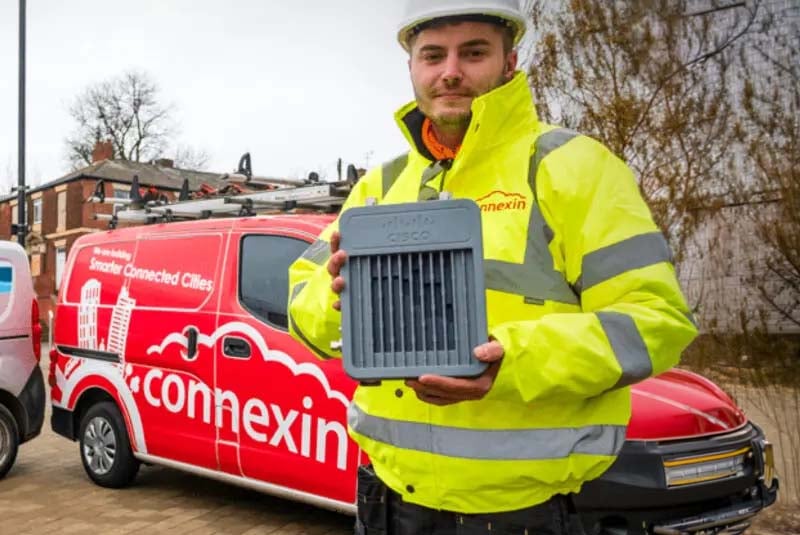
Hull-based smart infrastructure provider Connexin has begun deploying a Long Range Wide Area Network (LoRaWAN) across Northumberland County Council‘s jurisdiction, marking a new phase in the company’s ongoing campaign to establish a nationwide IoT backbone across the United Kingdom.
The rollout, which commenced in February 2026, will see wireless gateway devices installed on existing street furniture and council-owned assets throughout communities in England’s largest county by area. The network is designed to enable remote sensors and smart devices to transmit data securely across the region, with potential applications spanning energy efficiency, environmental monitoring, agricultural sensing, and traffic management.
A Low-Impact Deployment Strategy Across Rural and Urban Communities
Connexin and Northumberland County Council have adopted what they describe as a “least impact first” approach to the physical infrastructure buildout. Rather than erecting new standalone structures, the partnership is prioritising the use of existing lampposts, street furniture, and other council-owned assets as mounting points for the compact gateway devices.
The gateways themselves are low-power, fully encrypted units that contain no cameras or microphones. This distinction matters in Northumberland, where Connexin’s earlier infrastructure work in the Berwick-upon-Tweed area drew scrutiny from residents and the town council in early 2025. At that time, plans to install 12-metre poles on residential streets under permitted development rights prompted questions about the exact function of the equipment and the adequacy of public consultation. The latest deployment appears to signal a shift toward less intrusive installation methods.
Northumberland presents both an opportunity and a logistical challenge for IoT infrastructure. Spanning over 5,000 square kilometres, it is one of the most sparsely populated counties in England, with large stretches of rural terrain between its market towns and coastal settlements. LoRaWAN technology is particularly well-suited to such environments, as its low-frequency radio signals can travel several kilometres from a single gateway while consuming minimal power, making it viable for connecting battery-operated sensors in remote locations.
Connexin’s Expanding National IoT Footprint
The Northumberland deployment is part of a broader national strategy by Connexin to build one of the UK’s most extensive LoRaWAN networks. The company has secured contracts with four major water utilities, Northumbrian Water, Yorkshire Water, Severn Trent Water, and Essex & Suffolk Water, for smart water metering projects that collectively encompass over two million meters.
By August 2025, the company reported that its LoRaWAN network had connected approximately 250,000 smart water meters across the UK, with a stated ambition to achieve nationwide coverage. The Northumbrian Water contract alone envisions connectivity for over 330,000 LoRaWAN-enabled water meters by the end of 2029, scaling to more than 900,000 units over the full 15-year agreement.
Connexin has also pursued network-sharing partnerships to accelerate coverage. A 2024 agreement with NYnet, the North Yorkshire Council-owned broadband provider, saw Connexin add at least 57 additional LoRaWAN gateways to NYnet’s existing network, which already covered 85% of North Yorkshire’s geographical area. Similar gateway installations have been carried out in partnership with Southend-on-Sea City Council to support Essex & Suffolk Water’s metering programme, which targets up to 700,000 smart meters by 2035.
For Northumberland County Council, the partnership represents an opportunity to modernise service delivery without direct capital expenditure on network infrastructure. Whether the deployed network ultimately supports waste management optimisation, real-time air quality data, or agricultural monitoring will depend on follow-on investments in sensor hardware and data platforms; decisions that remain ahead.