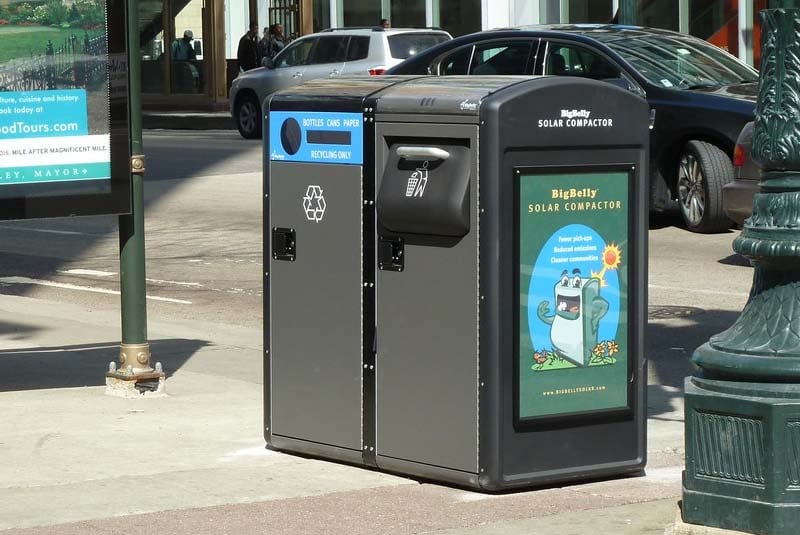
The City of St. Paul has completed a major overhaul of its downtown waste management infrastructure, investing nearly $475,000 in 162 solar-powered smart bins manufactured by Massachusetts-based Bigbelly. The deployment replaces 94 aging trash receptacles and 20 recycling containers with IoT-connected units featuring self-compacting technology and fill-level sensors.
The installation pairs 81 Bigbelly smart trash units with corresponding recycling bins, effectively quadrupling recycling access points across the downtown core.
Capacity Gains and Operational Efficiency
Each new unit can hold approximately 150 gallons of compacted material, roughly three times the 50-gallon capacity of the legacy receptacles. The solar-powered compaction mechanism enables this expanded capacity by condensing waste in real time, reducing the frequency of required collections by approximately half according to city officials.
Select units include wireless sensors that monitor fill levels and transmit status alerts to municipal workers, enabling demand-based collection rather than fixed schedules. Research from multiple smart waste deployments suggests such systems can reduce unnecessary collection trips by up to 60 percent while cutting fuel consumption and associated emissions by 30 to 40 percent.
Worker Safety and Labor Considerations
The upgrade carries ergonomic benefits for sanitation crews. Traditional bins required workers to manually lift containers onto their shoulders for truck disposal, a process that created repetitive strain risks. The new system allows waste to be either bagged or loaded mechanically using vehicle-mounted lifters, substantially reducing physical demands on collection staff.
City officials cited labor efficiency and worker safety as primary drivers behind the investment. The enclosed design also eliminates pest access to waste, addressing a common urban sanitation challenge that fully-exposed bins cannot solve.
Strategic Placement and Aesthetic Integration
St. Paul conducted foot traffic and sunlight exposure analyses to optimize bin placement throughout the downtown area, which sees an average daily population of approximately 45,000 people. Each unit requires sufficient solar exposure to power its compaction mechanism, though Bigbelly’s 12-volt battery system can operate for approximately three weeks without direct charging.
The bins feature customizable exterior panels that can display municipal messaging, local business advertising, or public art installations. Several mosaic-decorated legacy bins are being repurposed as planters rather than discarded, extending the lifecycle of the previous infrastructure. An additional shipment of smart bins is scheduled for spring 2026 to replace remaining conventional units throughout the city.
Bigbelly, headquartered in Needham, Massachusetts, has manufactured smart waste solutions since 2003. The company operates a U.S. assembly facility in Methuen, Massachusetts, along with a European production site in Stadtlohn, Germany. Its CLEAN management platform provides real-time analytics, route optimization, and operational benchmarking for municipal clients.
For additional context on smart waste management innovations watch our report with Bigbelly founders Jeff Satwicz and Jim Poss, which examines the company’s evolution from a college engineering project to a global smart city vendor.