 in Barcelona
 3 to 5 Nov 2026
This is the brain of the Big Belly. This tells us when it's full. It tells us when to run compactions. Jeff Satwitz was a freshman engineering student at Olin College when Jim Poss approached him with the idea of creating a solar-powered trash compactor. Where it's gone and where it's evolved to kind of was a pipe dream back then. A pipe dream. hype dream that you can now see in action across 54 countries. It's called a big belly, a waste bin that not only holds five times the amount of trash, but also acts as a smart city robot. There's an incredible amount of power in fleet monitoring, you know, overall health of the stations, making sure that you keep them up and running properly. It's an innovation that shaped the smart waste industry, paving the way for competitors like ecube labs and procomat, but it's a success that didn't happen over Things work, and things fail, and things break, and the details are what takes 14 years. Join us as we take a walk down memory lane. He had worked at a solar company before, and they said, no, that's not possible. You can't do that. And we said, we can do this. Something unachieved is possible, that you can do it, and the ability to bring people around you, bring people into the same process, you get something done. That's it. to get to know the founders of Big Belly. Since Jim Posse founded Big Belly, he's been recognized as a world economic forum technology pioneer. But nearly two decades earlier, he was a man without a job, recently laid off as a result of the dot-com bubble. My company went out of business. I said it's a good time to apply to business school. Babson is considered the best entrepreneurship school in the United States. The curriculum helps students construct business. models and network with the appropriate partners and customers. The story of Big Belly and PASA's innate curiosity is one that has been analyzed a lot over the years. He saw a gas -guzzling garbage truck and he decided to apply his knowledge of solar power to develop solar -powered trash receptacle. But the whole sequence started kind of seeing things from that from within that worldview. I think so and then The next step was really taking a small, making a small investment to take action. And that was, well let's build a prototype and show it to some friends of ours. He worked with a friend of his from Olin College of Engineering to get a technology solution that would work. And then they experimented. They tried it out at Vail. Vail was Big Belly's first customer and considered a huge win. After all, it's the third largest single mountain ski resort in the United States. And there was such a good... value proposition for them. I mean they would go and pick up the trash up the, you know, four miles up the trail in a snowcat, right? And that thing was high paying. It was very expensive. At the same time, the founders thought the private sector would be their go -to customer. That is until they realized their waste bin was kind of an eyesore. It was a big, ugly machine because in the beginning, you don't have molds. You can't do the $500 ,000 mold for the... sexy-shaped side skin, right? And so I was wrong about who would buy this. The company decided to focus their attention on cities where efficiency mattered more than aesthetics. But that too would be a long sales cycle. You learn the hard way how hard it is to sell an efficiency product to municipalities because they often don't really want to be efficient. And the sanitation union isn't that into- brand new technology to displace the guys, right? And so that was the challenge. One of the first big deployments would be in Queens, New York in 2005. And then the real life challenges trickled in. We put 46 some odd stations out there back in 2005. And in order to, you know, check how they were doing, make sure that they're working properly, you know, make sure that batteries were fully charged, do any sort of updates of software or firmware operations, change any settings on stations. You had to literally go station by station by station physically in New York City. First season, I found myself with big batteries in my backpack, going up to machines and secretly swapping out batteries in December and January. Solar power has huge potential, but it also comes with a number of challenges. specifically concerning the weather. In cities like Seattle, where the days are often overcast with little sunlight, maintaining a charged bin became a game of chess. To get through the winter, I'd go and pull out my laptop, I'd plug it into the machine, I'd download all the solar data, and I'd create a spreadsheet at home and calculate when the next time would be that I had to show up. The founders fixed that problem by moving the sensor's location in the bin, and ultimately, developing a dual sensor that could be remotely managed and had the ability to place the bin in winter mode and that makes us better right and so when the competitor comes out of South Korea and steals everything right violates our patent and whatnot their machines are still running out of energy and they can't sell to northern Europe because the machines fail because they don't have the software logic and they didn't haul batteries in the backpack right the new software capabilities paved the way for Big Belly to add more I functionalities into it's offering their computerized their digital they talk to us so they tell us when they're full and need to be picked up you know again this is 2008-2009 you know the iPhones had kind of just come out so this idea that a phone was more than just a thing to call and text on was was starting to become more more common originally collection staff had to physically check the lights on the bins to know when they were full or your capacity. In 2009, the firm developed a wireless capability that enabled customers to determine remotely when the bin merited a pickup. So when it sees that it's collected a certain amount of waste, it'll relay that information back into the cloud and say, hey, I've picked up now 100 gallons of waste. And the cloud then determines what that means from the fullness of the bin, whether it's ready to get picked up or not. And then if it. is ready to get picked up it'll add that to the collection list for the next time that the collection team goes out there now big belly is the leader among smart compactors which according to current research is the smallest market within smart waste in terms of the number of bins deployed but the price per unit for a smart compactor is much more than the cost for other more widely deployed smart waste solutions like filling level sensors and that could be why big belly is attracting investors like the McCarthy Capital Fund, a private equity firm that invested an undisclosed amount into Big Belly in 2019 to help the company penetrate new markets and accelerate growth into new areas like 5G. It's one of these industries that is the thing that nobody wants to see, but nobody wants to have waste around either. So as more technology gets brought into there, I think there are a lot of overall waste market efficiencies that will be. selling to the forefront. Jeff still remains at Big Belly today. He began his days engineering the product and now he's focused on the outlook of the company strategizing its next steps. As for Jim, he stepped down from Big Belly Solar in 2019 and has since founded another software company called Modify that provides a workforce management platform. For more coverage on Smart Waste and its key players stay with Current Insights and if you have a suggestion on who or what company we should profile next. be sure to submit your request with the link below.
Originals Industry leaders Waste
Founders’ Journey: Bigbelly’s Jeff Satwicz & Jim Poss
Industry leadersSmart Waste CollectionWaste
In this video
-
 Jeff Satwicz
VP, Product Strategy & Innovation, Co-Founder, Bigbelly
-
 Jim Poss
Fmr. CEO & Founder, Bigbelly
-
 Kate McKone-Sweet
Professor of Technology Operations Management, Babson College
-
 H. James Wilson
Managing Director, IT & Business Research, Accenture
About this video
Bigbelly, the innovative solution conceived by Jeff Satwicz and Jim Poss while they were students at Olin University and Babson College, aimed to revolutionize waste management.
Their primary goal was to reduce the reliance on gas-guzzling garbage trucks by introducing more efficient trash disposal methods. The result of their ingenuity was the world's first solar-powered smart compactor, a groundbreaking technology that has, nearly two decades later, found its way into cities across the globe.
This remarkable journey of innovation and its impact on urban waste management are the focus of Kurrant's latest installment in their "Get to Know" series. This episode that also features inputs from Kate Mckone-Sweet Professor of Technology Operations Management at Babson College and H. James Wilson Managing Director IT & Business Research at Accenture is a must-watch for for anyone working in waste utilities or the waste industry, city representatives, and city managers. It offers invaluable insights into how innovative ideas can lead to global solutions, making it an educational and inspiring piece for a wide audience. This is particularly relevant for professionals in waste management and city administration, as it showcases practical applications of sustainable practices in urban environments.
Read the transcript machine-generated
More from Industry leaders
See all 1:12
Paolo Nesi: Wi-Fi Vs. Cameras for People Counting
 2:39
Syliva Haack on urban resilience related to water infrastructure
 1:48
João Matos Discusses the Challenges of Wildfire Detection
 2:08
Mark Dancy on the effectiveness of a pay-as-you-throw program
 5:20
Ubiik CTO on Diversifying IoT Connectivity Technologies
 5:34
Keys to Success in Mobility and Smart City with Gianluca Longo
More in Waste
See all 4:24
Miami-Dade County Turns to Smart Solutions, AI to Improve Recycling
 4:38
AI Helps City of Basel Keep Streets Clean
 3:28
How Oxford Is Turning Canal Pollution Into a Smart City Opportunity
 4:35
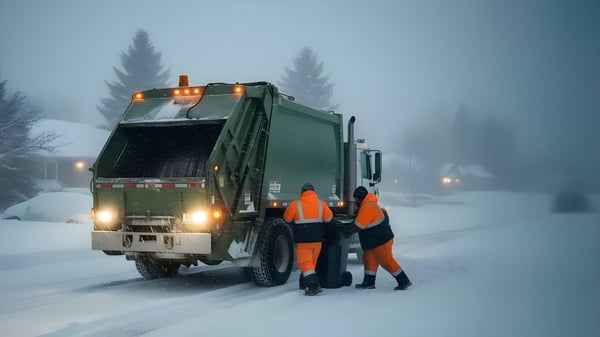
Digitalizing Waste Management in Extreme Weather: Lessons from Lethbridge
 7:59
PortsToronto Uses Wastesharks to Keep Floating Rubbish at Bay
 7:30
Facing Mandatory Residential Biowaste Separation with Smart Solutions
Latest news in waste
All news- Rematics Runs Waste-Recognition Cameras On 70+ Collection Trucks As MOBA-Backed Pilots Expand11 Nov 2026
- Chauny-Tergnier-La Fère Inverts Bin Collection And Adds AI Truck Cameras From February 20278 Nov 2026
- Sortrace Raises $800,000 Led by Almi Invest for Waste Truck Sorting Cameras in Sweden7 Nov 2026
- TrashLab Raises $12M Growth Round Led By Ventana For Waste Hauler Software31 Oct 2026
Kurrant advisory
Planning a waste project? Talk to Kurrant.
Behind these interviews is Kurrant's advisory team, working with utilities, cities and the companies that serve them.
- Strategy AdvisoryKurrant is actively involved in resolving the challenges that cities, utilities and industry players are facing.
- M&A AdvisorySmart city and utility expertise for successful deals, turning insights into strategic gains.
- Engineering & ProcurementBetter engineering and procurement decisions, by identifying and developing digital and IoT solutions across use cases.
Or write to us: contact@kurrant.com
Send us a message