Fort Lauderdale-based Ubicquia has secured $106 million in Series D financing, marking the company’s largest capital raise to date and positioning the intelligent infrastructure firm to deepen its artificial intelligence capabilities, pursue international expansion, and roll out new subscription-based service models for utilities, municipalities, and law enforcement agencies.
Who Backed the Round and Why It Matters
The round was co-led by 67 Capital, a growth-stage investor focused on energy efficiency and decarbonization, and Marunouchi Innovation Partners (MIP), a climate technology fund backed primarily by Mitsubishi Corporation. Returning investors Hamilton Lane, ClearSky, and GMS also participated, alongside strategic partner Sercomm, a Taiwan-headquartered telecommunications and IoT hardware manufacturer.
MIP’s involvement is particularly noteworthy. The fund, established in 2022 as a joint venture between Mitsubishi Corporation, MUFG Bank, and Pavilion Industries, manages a climate technology growth fund that has been raising toward a target of $800 million to $1 billion. For MIP, investing in Ubicquia aligns with a thesis around digitizing legacy grid assets as one of the most cost-effective pathways to improving energy resilience.
From 100 Cities to Over 1,000 Customers in Five Years
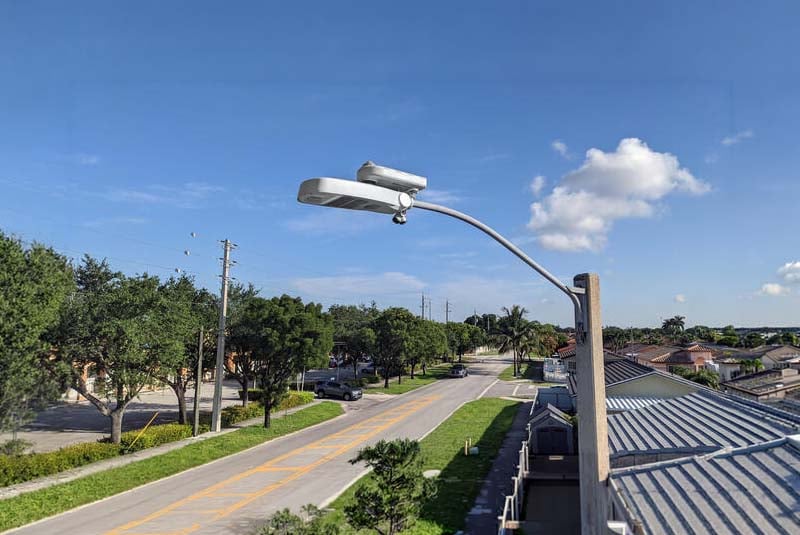
Founded in 2014 by Tre Zimmerman and led since 2017 by CEO Ian Aaron, Ubicquia has evolved from an IoT sensor startup into a platform company spanning three verticals: smart grid monitoring, intelligent lighting, and public safety. The company’s products, sensors, controllers, connectivity modules, and an analytics platform called UbiVu, are designed to retrofit existing infrastructure rather than replace it, making them compatible with what the company estimates are more than 450 million streetlights, 500 million distribution transformers, and one billion utility poles worldwide.
The growth trajectory has been notable. At the time of its $30 million Series C in September 2020, led by Fuel Venture Capital, Ubicquia was deployed in roughly 100 cities and had recently acquired GE Current’s CityIQ platform, bringing approximately 8,000 edge AI cameras into the fold. Since then, the company has expanded into large-scale municipal pilots, including Dallas’s Red Cloud smart community project, which used UbiHub technology alongside LED streetlights and air quality monitors for data-driven urban planning. By 2026, the company reports serving more than 1,000 utilities and municipalities across the United States, Latin America, Europe, and the Middle East and North Africa region, with its analytics platform processing more than 3.5 billion data points per day.
That expansion puts Ubicquia’s total disclosed funding at roughly $157 million across four rounds, according to PitchBook data. The company currently employs around 193 people.
AI at the Core of the Product Roadmap
Much of the new capital will flow into accelerating artificial intelligence development across Ubicquia’s product portfolio. The company’s UbiVu platform, which functions as an asset management system for infrastructure operators, is being expanded with machine learning capabilities designed to detect grid anomalies, diagnose power disturbances, and generate predictive maintenance insights at the distribution transformer level.
On the streetlighting side, Ubicquia recently broadened its product suite with the UbiCell Micro, described as the industry’s smallest universal streetlight controller, and UbiScout, a Zhaga Book 18-compliant smart camera accessory that enables adaptive lighting, traffic analytics, and AI-driven curb management through existing luminaires. Both products launched in late 2025.
The company’s UbiHub edge processing platform, meanwhile, targets the public safety market. It supports license plate recognition, live video streaming, and vehicle intelligence by leveraging streetlight infrastructure as network nodes. San Diego’s police department deployed 500 UbiHub units in late 2023, equipped with AXIS cameras and Flock Safety license plate readers, a project that attracted both attention and scrutiny around surveillance oversight.
Infrastructure-as-a-Service and Recurring Revenue
A significant strategic shift embedded in this funding round is Ubicquia’s move toward infrastructure-as-a-service (IaaS) models. Its power monitoring service, for instance, pairs the UbiGrid DTM+ transformer sensor with UbiVu analytics and is offered as a fully managed, white-label subscription with no upfront hardware costs. This approach gives utilities real-time, transformer-level visibility into power reliability while generating predictable recurring revenue for Ubicquia.
The subscription model reflects a broader industry pattern. As municipalities and utilities face constrained budgets and aging grid infrastructure, capital-light service models that avoid large upfront expenditures are gaining traction. For investors, recurring revenue streams also tend to command higher valuation multiples than one-time hardware sales.
The $106 million infusion and the potential for acquisitions, which company leadership has not ruled out, suggest Ubicquia intends to consolidate its position ahead of expected competition from larger industrial and technology conglomerates entering the space.