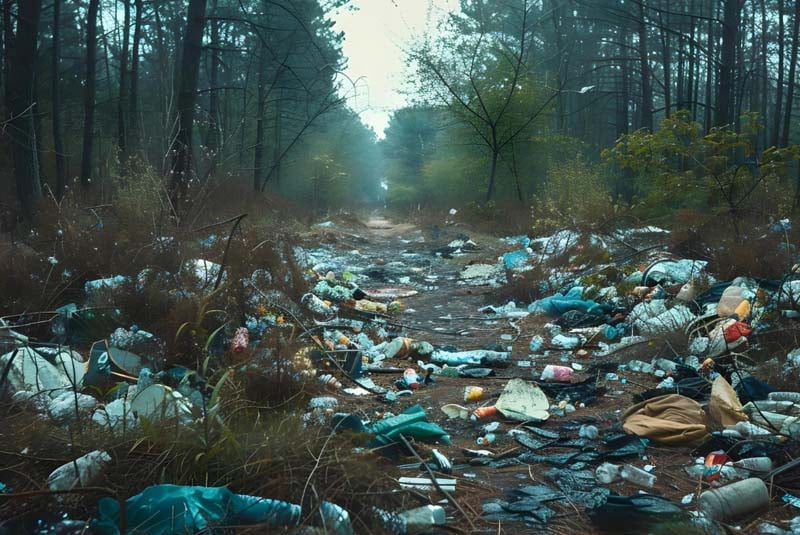
England’s environmental regulator is rolling out an aggressive new enforcement package combining aerial surveillance, automated licence screening, and expanded criminal intelligence operations to dismantle a waste crime economy estimated at £1 billion (€1.15 billion) annually.
The Environment Agency announced on 20 February 2026 that it has assembled a fleet of 33 drones operated by trained pilots and developed proprietary software that cross-references vehicle operator applications against waste permit databases flagging suspicious operators before they can begin moving materials illegally. The initiative is backed by a 50% increase in the agency’s enforcement budget, now standing at £15.6 million (€17.9 million) per year, funded by the Department for Environment, Food & Rural Affairs (Defra).
LiDAR-Equipped Drones Will Map Illegal Dump Sites for Court Evidence
At the centre of the new enforcement toolkit is the deployment of Light Detection and Ranging (LiDAR) technology on the agency’s remotely piloted aircraft. The laser-based system generates millions of data points per second, producing three-dimensional terrain models precise enough to serve as courtroom evidence documenting the exact location, volume, and extent of illegally deposited waste.
The Environment Agency previously used LiDAR primarily aboard manned aircraft for flood risk mapping. Transferring the technology to drones allows enforcement teams to survey suspected illegal waste sites at lower altitudes and with greater operational flexibility. Since July 2025, the agency’s drone fleet has logged 272 flight hours focused on waste crime detection, using high-resolution cameras to identify illegal operations from the air.
Automated Screening Links HGV Licence Applications to Waste Permits
A second component of the enforcement package targets the transportation logistics underpinning organised waste crime. The Environment Agency has developed software that automatically scans weekly reports published by the Office of the Traffic Commissioner, which lists all new applications for Heavy Goods Vehicle operator licences across Great Britain.
The screening tool cross-references these applications against the agency’s public register of waste permits and waste carrier licences. Operators who apply for HGV licences without holding the required environmental permits are flagged for investigation — potentially before any illegal waste movement takes place.
The system has already delivered results in an initial pilot. During a trial in East Anglia, the software identified a waste company that had covertly relocated its HGV operations to a new site in an apparent attempt to evade enforcement. The tool detected the new operating centre within a week, enabling officers to intervene before the licence application was approved.
Expanded Joint Unit for Waste Crime Targets Organised Networks
The enforcement expansion also includes a significant staffing increase at the Joint Unit for Waste Crime, the multi-agency taskforce established in 2020 that brings together the Environment Agency, the National Crime Agency, police forces, HMRC, and the National Fire Chiefs Council. The unit has grown from 13 to 20 specialists, with recruits including former police officers bringing criminal investigation expertise.
The unit’s expansion follows what the agency described as a record year for enforcement activity, during which 751 illegal waste sites were shut down. In the financial year through March 2025, the agency brought 221 prosecutions against waste criminals.
A Billion-Pound Criminal Market Under Scrutiny
The scale of investment reflects the growing recognition that illegal waste handling in England has become a major organised crime sector. Industry research estimates that waste crime costs the English economy approximately £1 billion (€1.15 billion) annually through evaded taxes, environmental damage, and displacement of legitimate businesses. The Environment Agency’s national survey found that roughly 18% of all waste in England, approximately 34 million tonnes, is handled illegally each year.
Recent high-profile incidents have intensified political pressure. Large-scale illegal dumps have been publicly identified in Cheshire, Cornwall, Kent, Gloucestershire, Oxfordshire, and Lancashire. A House of Lords Environment and Climate Change Committee inquiry recently characterised the agency’s previous approach to waste crime as inadequate, calling for an independent review.
The financial incentive for criminals remains substantial. Operators can reportedly earn upwards of £2,500 (€2,870) per lorry load by billing customers for legitimate landfill disposal while diverting waste to illegal dump sites, according to reporting by The Register.
What This Signals for Environmental Enforcement Technology
The Environment Agency’s technology-led approach signals a broader shift in how environmental regulators are tackling waste crime. By integrating aerial surveillance, automated data cross-referencing, and multi-agency intelligence sharing, the agency is moving toward a preventive enforcement model that aims to intercept illegal operators before they cause environmental harm, rather than responding after damage has occurred.
Whether the £15.6 million (€17.9 million) enforcement budget proves sufficient to meaningfully reduce a £1 billion (€1.15 billion) criminal market remains an open question, particularly given ongoing concerns about under-reporting. The agency acknowledges that only around 27% of waste crime incidents are believed to be reported. The coming months will reveal whether the new technological capabilities translate into measurably higher detection rates and successful prosecutions.