The City of Cannes and Agglomération Cannes Lérins are accelerating their deployment of artificial intelligence technologies across multiple municipal functions, implementing AI-powered solutions for video surveillance analysis, road condition monitoring, and waste sorting detection. The initiatives position the French Riviera municipality as a growing testbed for municipal AI adoption in France.
Orasio Platform Trial Targets Judicial Video Review Efficiency
The municipality launched a trial of Orasio‘s Citadel platform on January 23, 2025, testing the AI system’s capability to accelerate retrospective video analysis for judicial requisitions. The experimentation, provided at no cost to the city, focuses exclusively on post-event analysis of recordings from the Urban Protection Centre (CPU), in compliance with French regulations that prohibit real-time algorithmic processing of surveillance camera feeds.
An impact assessment relating to data protection (AIPD) was submitted to CNIL, France’s data protection authority, prior to the trial. The CPU selected up to 400 hours of footage recorded within the 30 days preceding the experiment, adhering to prefectural data retention limits. Through a search interface, the 22 CPU operators can enter specific criteria including vehicle type, color, model, clothing descriptions, distinctive accessories, and license plate numbers. The platform automatically identifies relevant sequences, substantially reducing the time required to review large video archives for investigative purposes.
Cannes operates one of France’s densest municipal video surveillance networks, with 1,021 cameras deployed across the territory—equivalent to one camera per 74 residents. The city previously tested AI-enhanced cameras during the 2024 Olympic and Paralympic Games and at major events including the 2024 Cannes Film Festival, NRJ Music Awards, Marathon des Alpes-Maritimes Nice–Cannes, Christmas Market, and MIPIM 2025. These trials enabled municipal police to evaluate how AI-assisted decision support tools perform during large-scale event management and security operations.
Orasio, a Paris-based startup founded in early 2025, secured €16 million in seed funding in May 2025, positioning itself as a European alternative to American, Chinese, and Israeli competitors in the video intelligence market. The company’s technology operates in compliance with both GDPR and the EU AI Act, and the system can function without internet connectivity—a feature particularly valuable for sensitive security environments.
Road Surface Monitoring Through AI-Powered Diagnostics
Municipal departments have adopted vialytics, a German road management platform, to improve pavement condition assessment. The Stuttgart-based company’s system uses smartphone-mounted cameras installed in municipal vehicles to capture images of road surfaces at regular intervals during routine driving operations.
The collected imagery is processed through AI algorithms that automatically detect and classify road damage into multiple categories, including potholes, cracks, and surface degradation. Results are displayed through a web-based platform that provides municipal road managers with detailed cartographic visualization of infrastructure conditions across the network.
vialytics serves more than 400 municipalities across Europe and North America. The company raised $10 million in Series A funding to support its expansion and has developed additional detection capabilities for manhole covers, water drains, and bicycle lane damage.
AI-Enabled Waste Sorting Monitors Collection Quality
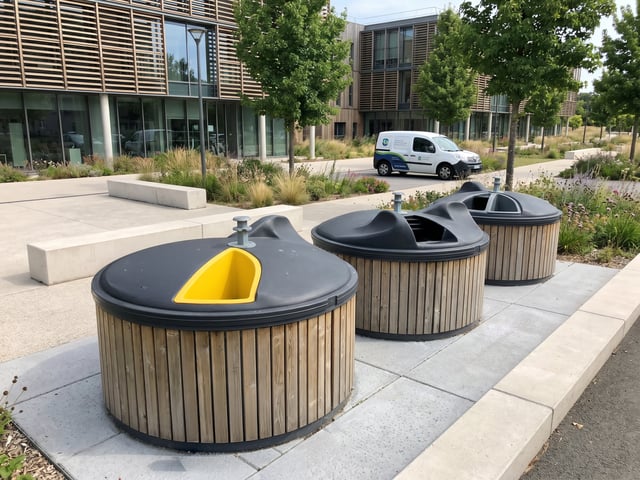
At the intermunicipal level, Agglomération Cannes Lérins has equipped garbage collection vehicles with AI waste detection technology from Lixo, a French startup specializing in image recognition for waste management applications. The system uses miniature cameras mounted on collection trucks to photograph bin contents as they are emptied, with AI algorithms analyzing the images in real time to detect sorting errors and hazardous materials.
According to the Agglomération, the implementation has prevented approximately 220 tonnes of rejected waste annually, generating savings estimated at several tens of thousands of euros per year. The detection system identifies items that should not be present in specific waste streams, including dangerous materials such as gas canisters that pose explosion risks at sorting facilities.
Lixo’s technology has been deployed by major waste operators including SUEZ and Veolia, with more than 300 trucks equipped with the company’s sensors across France, the United Kingdom, Portugal, Germany, and other European markets. The deployment reflects a growing trend of municipalities adopting AI-powered waste detection to improve sorting quality and collection efficiency.
Employee Training and Ethical Framework Development
The municipality is complementing its technology deployments with workforce development initiatives. Municipal staff receive training on AI applications through conferences and practical workshops, preparing them to work effectively with the new systems. Multiple software providers have been selected to support various use cases, including administrative document drafting, public procurement analysis, meeting transcription, document translation, and legal monitoring.
An ethical charter governing AI utilization is currently under development to establish best practices for employees and ensure transparency for residents regarding municipal AI applications.
Broader Municipal AI Adoption Context
The initiatives align with broader trends in French municipal AI adoption. According to a report by L’Ecolab under the French Ministry of Ecological Transition, approximately 200 French municipalities were expected to launch AI-based projects and experiments in 2024, up from 50 in 2023.
The city has hosted the World Artificial Intelligence Cannes Festival (WAICF) since 2022, an event initiated by Mayor David Lisnard. The fifth edition is scheduled for February 12-13, 2026, at the Palais des Festivals, with over 10,000 participants expected to attend.
The Agglomération Cannes Lérins encompasses five municipalities, Cannes, Le Cannet, Mandelieu-La Napoule, Mougins, and Théoule-sur-Mer, serving a combined population of approximately 160,000 residents across 95 square kilometers.