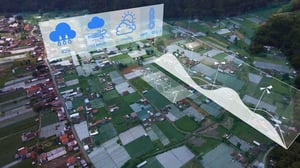
Ādaži Municipality has activated a machine vision-based traffic monitoring device developed by Latvian mobile operator LMT (Latvijas Mobilais Telefons) in its town center. The system, awarded through a public procurement process, will operate for three years and is designed to identify drivers who violate specific traffic regulations on Gaujas Street near the local Rimi supermarket. Starting in March 2026, violation records are being transferred automatically to Latvia’s Road Traffic Safety Directorate (CSDD) and the municipal police for penalty processing.
What the System Monitors in Ādaži
The device is configured to detect two specific sign violations at the Gaujas Street location: failure to follow a “straight ahead only” directive toward the Gauja river bridge and non-compliance with a “right turn only” regulation when exiting the Ādaži market square. This focused scope reflects the municipality’s effort to address recurrent confusion and rule-breaking at an intersection known locally for unclear driver behavior.
The technology relies on a GDPR-compliant video system equipped with computer vision algorithms and AI-based processing. It combines high-resolution cameras, a purpose-built mini-computer running edge-based analytics, and network equipment that transmits flagged violations over the mobile network for further review. Unlike traditional fixed-camera enforcement infrastructure, the LMT system requires no construction work and only needs an electrical connection, which significantly reduces deployment cost and time.
LMT’s Growing Municipal Enforcement Footprint
Ādaži becomes the latest municipality to adopt LMT’s Transport Monitoring Platform, joining a growing network of Latvian cities including Riga, Liepāja, Jūrmala, Salaspils, and most recently Gulbene, where two devices were installed in early 2026 for a three-month test period. The platform has also been deployed internationally in the Austrian city of Graz, and a trial was conducted in Vilnius, Lithuania, during the summer of 2024 in partnership with Lithuanian systems integrator FIMA.
In Riga, LMT won a 2025 public tender to install 26 traffic monitoring devices at major intersections over 12 months. The first cameras were placed at the intersection of Augusta Deglava Street and Ilūkstes Street, as well as at Brīvības Street’s crossings with Kr. Barona Street and Cēsu Street. That rollout covers offences including red-light violations, illegal use of public transport lanes, prohibited stopping, and failure to comply with auxiliary traffic signals.
In Liepāja, where the platform was first integrated into Latvia’s national enforcement system, LMT reported a roughly 40% reduction in traffic violations within the first two months of operation. In Gulbene, the system is being used not only for enforcement but also for urban planning analytics, collecting pedestrian flow data and turn-count statistics to inform infrastructure decisions.
How the Technology Works
The core of LMT’s platform is a plug-and-play device that mounts directly onto traffic light poles or similar infrastructure. It combines panoramic and number plate cameras with neural network-based edge computing to perform real-time analysis at the device level rather than streaming raw video to a central server. This architecture aims to minimize bandwidth requirements and enables operation over standard 4G or 5G mobile networks.
The system’s capabilities extend beyond the specific use case in Ādaži. Across different deployments, it can perform object detection and classification, vehicle trajectory tracking, automatic number plate recognition (ANPR), and traffic signal state detection. LMT has stated that the solution demonstrates 98% accuracy in red-light violation detection during testing. All data is anonymized in accordance with GDPR requirements before any transfer occurs.
Latvia’s Road Safety Context
The deployment in Ādaži aligns with broader road safety objectives at both the national and European level. The European Union’s Vision Zero framework targets the elimination of road fatalities and serious injuries by 2050, with an intermediate goal of halving deaths and injuries by 2030. Latvia recorded a 19% reduction in road fatalities in 2024 compared to the previous year, one of the strongest improvements among EU member states, according to European Commission road safety statistics.
However, intersection violations remain a persistent concern. LMT’s own data from a 2021 pilot in Riga recorded nearly 9,000 red-light violations at a single intersection over the course of one year, underscoring the scale of non-compliance that automated systems can reveal.
Ādaži, a municipality of over 24,000 residents located approximately 25 kilometers northeast of Riga along the A1/E67 highway (part of the Via Baltica corridor), experiences significant transit traffic.