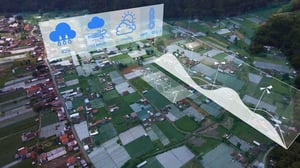
City Detect, a Tuscaloosa, Alabama-based startup using computer vision to help municipalities identify and address urban decay, has closed a $13 million Series A funding round led by Prudence, a New York-based venture capital firm specializing in AI and software for the built environment. The round also included participation from returning investors Las Olas Venture Capital, Knoll Ventures, and Atlanta Seed Company, alongside new backer Zeal Capital.
From Garbage Trucks to Data Pipelines
Founded in 2021, City Detect mounts high-resolution cameras on municipal fleet vehicles, particularly garbage trucks and street sweepers, that already traverse city streets on regular routes. As these vehicles complete their daily rounds, the onboard cameras capture images of surrounding properties and roadways. Those images are then processed through the company’s proprietary PASS AI platform, which uses computer vision models trained on millions of labelled images to flag over 100 categories of urban issues, from graffiti and illegal dumping to storm damage, overgrown lots, and deteriorating building facades.
The approach is notable for its low infrastructure overhead. Rather than requiring cities to invest in new sensor networks or dedicated monitoring equipment, City Detect piggybacks on vehicles municipalities already operate. According to the company, a single code enforcement officer can file roughly 50 reports per week; the PASS AI platform delivers thousands of data points daily.
Expanding the Municipal Footprint
City Detect currently operates in at least 17 cities across the United States, including Atlanta, Dallas, Miami, Birmingham, Stockton, Greenville, and Columbia. In mid-2025, the company announced new partnerships with Lancaster and Rancho Cordova in California, Prescott Valley in Arizona, and Cathedral City, also in California. In the Prescott Valley deployment, the platform assessed over 17,000 residential parcels in under a week, mapping more than 700 undeveloped lots and detecting over 4,000 indicators of blight to help the town meet state reporting mandates.
The fresh capital will be used to expand into additional cities, hire more engineers, advance storm-damage detection capabilities, and deepen integrations with existing municipal software platforms. CEO Gavin Baum-Blake, who co-founded the company alongside Dr. Erik Johnson, an economist and machine learning researcher from the University of Alabama, leads a fully remote team concentrated in Atlanta.
Privacy as a Persistent Challenge for Municipal AI
The deployment of AI-powered cameras on public vehicles has not gone uncontested. In July 2025, the Huntsville, Alabama City Council postponed a vote on a proposed three-year, approximately $972,000 contract with City Detect after residents and council members raised concerns about privacy, data collection practices, and budget implications. Multiple residents spoke against the proposal during public comment, with objections centring on the surveillance implications of weekly photographic sweeps of residential neighbourhoods. The council deferred the matter to align with its 2026 budget process.
City Detect has responded to such concerns by publishing a Responsible AI policy and emphasizing several safeguards: the platform does not use facial recognition, data remains under municipal control and is stored on US-based servers, the system includes face and license plate blurring capabilities, and no data is sold to third parties. The PASS AI graffiti models are also designed to distinguish between vandalism and sanctioned mural artwork. The approach mirrors broader debates across the smart city sector, where Amsterdam halted its smart traffic light programme over similar data protection and surveillance concerns raised by the Dutch Data Protection Authority.
Where City Detect Fits in the AI-for-Cities Landscape
The round positions City Detect within a growing wave of vertical AI companies applying computer vision to municipal operations. Cortexia, a Swiss startup backed by Kurrant Ventures, uses a comparable model, mounting AI-equipped cameras on street sweepers to measure and optimize urban cleanliness in cities such as Basel, Geneva, and Utrecht. Meanwhile, Automotus has deployed AI cameras on enforcement vehicles in Pittsburgh for automated parking compliance. Each company targets a different municipal pain point, but the underlying pattern is the same: computer vision mounted on existing fleet vehicles, processing images in real time, and delivering actionable data to city departments.
Prudence’s investment aligns with its broader thesis around vertical AI for the built environment. The firm’s portfolio includes companies like AI Clearing, which applies computer vision to construction progress tracking, and Uniti, which builds AI agents for commercial real estate. For Prudence, City Detect represents a direct play on the intersection of AI and municipal infrastructure management.
Market Context and the B2G Opportunity
The AI-in-smart-cities market is projected to grow from roughly $50 billion in 2025 to over $460 billion by 2034, according to industry estimates from Precedence Research, driven by tightening municipal budgets, aging infrastructure, and the need for data-driven governance. North America accounts for the largest regional share, with computer vision identified as one of the fastest-growing technology segments.
City Detect’s business-to-government model addresses a structural gap: many US municipalities still rely on complaint-driven code enforcement, where issues are only addressed after residents report them through 311 systems. By shifting to proactive, AI-driven detection, the company aims to help cities identify problems earlier, allocate field crews more efficiently, and build longitudinal data on neighbourhood conditions. The company previously raised a $2 million seed round, also backed by Las Olas Venture Capital, Knoll Ventures, and Atlanta Seed Company, reflecting an investor base with strong ties to the southeastern United States.
Whether the model can scale smoothly will depend in part on how effectively City Detect and similar companies navigate the tensions between operational efficiency and community trust around surveillance technology, a dynamic that is playing out in real time across US city councils.