Oregon’s capital city has taken a tangible step toward modernizing its public transit operations. Cherriots, the Salem Area Mass Transit District, has activated Transit Signal Priority (TSP) technology along the Lancaster Drive corridor in partnership with Silicon Valley-based LYT and local integration firm Coral Sales Company. The deployment covers 22 signalized intersections on Route 11, the agency’s highest-ridership and longest-distance route, and early operational data suggests measurable gains in schedule adherence.
Why Lancaster Drive Was the Starting Point
Lancaster Drive is one of Salem’s most congested arterials, flanked by major retail centers, medical facilities, and Chemeketa Community College, the second-largest community college in Oregon. Route 11, which runs from the Keizer Transit Center to the Marion County Jail, generates the highest boarding numbers in the Cherriots system outside of the Downtown Transit Center. With approximately 19,500 weekday riders across Cherriots’ 20-route local network, concentrating TSP on this corridor targets the greatest volume of passengers with a single deployment.
The corridor is also the agency’s designated “electric corridor.” In August 2024, Cherriots introduced a fleet of 10 battery electric buses on Route 11, funded through $22.7 million in federal Low or No Emission Vehicle grants. Adding signal priority to the same route creates a layered technology approach, electrified vehicles operating on a digitally optimized corridor, that may inform future expansion decisions.
How the Cloud-Based System Works
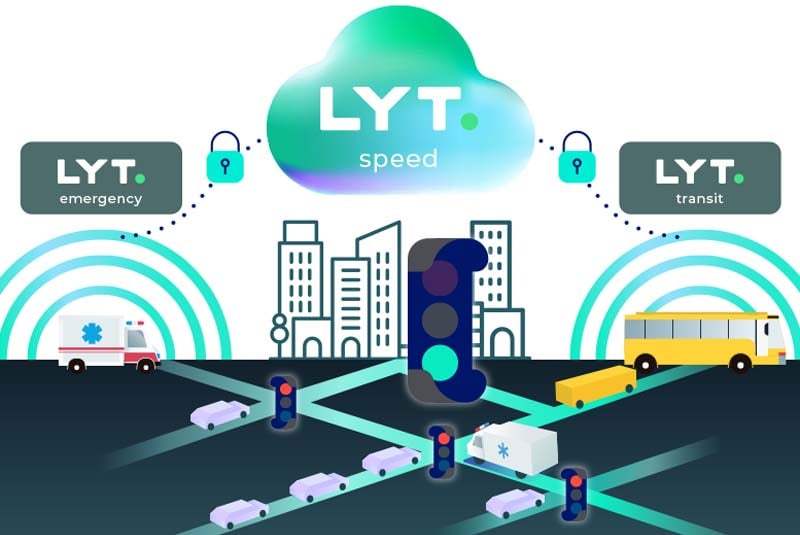
Unlike legacy TSP platforms that rely on specialized hardware mounted on each bus and at every intersection, such as optical emitters and roadside receivers, LYT’s system operates through a cloud-based Software-as-a-Service (SaaS) model. A single edge computing device installed in the city’s Traffic Management Center connects bus location data from the agency’s existing Computer-Aided Dispatch/Automatic Vehicle Location (CAD/AVL) system to Salem’s networked traffic signals via the LYT cloud platform.
When a bus is running behind schedule, the system can extend a green phase or adjust signal timing to help the vehicle pass through the intersection without stopping. The platform uses machine learning algorithms to factor in routing information, real-time traffic conditions, vehicle position, and schedule adherence before making each priority request. According to LYT, this approach eliminates the need for bus-mounted transponders or line-of-sight equipment, significantly reducing both installation timelines and infrastructure costs compared to conventional systems.
Early Performance Metrics Show Promising Results
Initial operational data from the Lancaster Drive deployment indicates the system has cut the number of late-running buses by up to 20% in both northbound and southbound directions. A survey of Cherriots bus operators who regularly drive the route provides additional perspective on the ground-level impact: 62% reported that maintaining schedule adherence has become easier, 69% said they feel less pressure to make up lost time during shifts, 56% observed a noticeable reduction in travel time, and 56% expressed satisfaction with the new system.
These figures, while self-reported by operators, align with performance benchmarks LYT has documented at other deployments. At TriMet in Portland, Oregon, where LYT’s TSP platform operates across 58 intersections on the Division Transit Project, the company has reported travel time reductions of up to 20%, fuel savings of 14%, and a 12% decrease in emissions.
A Growing National Footprint for Cloud-Based TSP
The Salem project adds to a rapidly expanding deployment map for LYT, which was named to the Inc. 5000 list of fastest-growing private companies in 2025. The company now operates TSP systems in multiple metropolitan areas, including a 90-intersection project for the Maryland Transit Administration in Baltimore covering four CityLink bus routes under a federal SMART Grant, a 54-intersection deployment with LA Metro in Inglewood, California, a 20-intersection installation in Philadelphia, and projects in Nashville, Vancouver (Washington), and Orange County, California.
Broader Context: TSP Adoption Accelerates Nationwide
The Salem deployment arrives as transit agencies across the United States increasingly view signal priority as essential infrastructure rather than an optional upgrade. RTD-Denver has deployed TSP along major corridors and recently formed a Regional TSP Working Group with the Denver Regional Council of Governments to standardize next-generation architectures across multiple jurisdictions. The U.S. Department of Transportation allocated $60 million in 2024 for vehicle-to-infrastructure projects in Arizona, Texas, and Utah that include transit signal priority and emergency vehicle preemption capabilities.
The shift toward cloud-based, software-defined systems is a significant factor in this acceleration. Traditional optical-based priority systems, first installed over five decades ago, are limited by line-of-sight requirements and sensitivity to weather conditions.
What Comes Next for Cherriots
Cherriots has indicated it will continue monitoring performance data from the Lancaster Drive corridor to evaluate whether the system delivers sustained improvements over time. For an agency operating a 64-bus fleet across a 78-square-mile service area with an annual ridership of roughly 3.4 million passengers, the project could serve as a proof of concept for expanding TSP to additional high-frequency routes.
The agency’s broader modernization trajectory, including fleet electrification, real-time passenger information through its myStop platform, and now cloud-based signal priorit, positions Salem as a mid-sized city case study for layering incremental technology investments rather than pursuing a single large-scale smart transit overhaul.