 in Barcelona
 3 to 5 Nov 2026
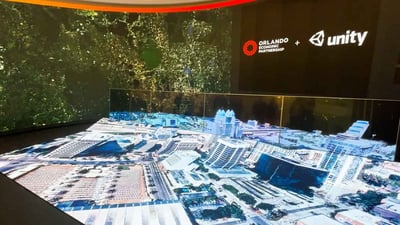
When you arrive at Orlando International Airport, one of the things you hear over the public announcement system is that Orlando is where imagination becomes reality. That became true for the not-for-profit Orlando Economic Partnership in 2022, when they inaugurated their digital twin of the Orlando region. We covered the launch during that year's edition of the Smart City Expo World Congress. The entire region was digitally duplicated, a project with game engine Unity that covered 800 square miles, had a cost of $1 million and had 80 data sets going into the twin. Now that a year and a half has gone by, we wanted to know what their experience has been like so far and whether having a digital twin has helped them reach their goals of attracting investors and encouraging companies to relocate or expand. We visited the Orlando Economic Partnership offices to talk to Tim Giuliani and find out how the solution is going. Over the last year and a half it's really been about how do we use it best. So there's been some modifications, sort of like how we present the data. We're actually, in fact, right now looking to pull some data out to make it easier to use. So I think the first year and a half has really been a lot of getting used to it incorporating it into our business operations as they currently were and improving them. And so now we're kind of ready for what's next. One of the things they've seen in the first year and a half is that they have too many data sets. Every four months it updates data that could interest investors like home prices, school ratings, per capita income, educational attainment levels, commute patterns, among other sets of data. And some, they realized, aren't necessary for their daily operations, so they're pulling that data out. But at the same time, they're looking to build partnerships that would bring other types of data in. When we spoke in November of 2022, the digital twin was in the first phase of the project. Now they're entering a second phase in which they are looking to partner with universities, cities and other organizations. They've already had talks with transportation agencies. So from a transportation perspective, there's a lot of different agencies and organizations and governments that are charged with transportation objectives. So having all that data in one place is something we're seeking to do. We've had lots of conversations at this point, and so we brought IBM into this fold to really help us serve as a consultant to advise these companies how to use the digital twin. Because what we're finding is that the digital twin technology is so new and everyone's trying to figure out how to use it. What's the ROI for them? Where do they get started? And so that's why we brought IBM into the picture to help now that we've had lots of those conversations really start to drive in home. One year and a half into the project, the Orlando Economic Partnership has already seen a return on investment. They've already had almost half of the investment back in the form of companies wanting to get more involved in their work and they think that they'll only need two or three more partners to get it all back. As they move into their second phase, they're looking to have real time data, key when having transportation in the equation. You know, we'd love for the digital twin to be real time. From a transportation perspective, we'd love to put in the future state because here in Orlando we're growing at a thousand people every week. And so there's lots of investment being made in rail, in our highways, hopefully in our bus system. And so being able to see what the community will look like once all these projects are complete and how they will impact traffic flows is one thing that we're starting to look at. After their experience, seeing the challenges, they went through, the obvious last question was: Any advice? The thing we got right, that in hindsight I'd advise anyone to do, is that what is sort of that minimally viable product? What is enough? You can't start and go to your end goal immediately. But where's a good stopping point to get to? Because, for instance, in this technology, what we found is, these conversations take a lot of time because it's a new technology. And so I love the fact that we built a product that we could actually use, but we didn't go all in so that we could allow partners the opportunity to take those steps with us. This project required a significant investment, but the quick ROI with 50% of the cost paid back only after one year and a half is proving the viability and benefits of a digital twin driven by use cases. As the twin is able to integrate more data, the tool can also become beneficial for many authorities in the city and the region beyond the Orlando Economic Partnership. An additional benefit of the digital twin is its ability to improve the appeal of the organization for visitors, but also for the staff who told me while I was there that this digital twin made their jobs much more enjoyable and attractive as they can now visually show what is happening in a more entertaining manner that isn't just a boring PowerPoint. So far, the twin has proven a win for the not-for-profit.
Orlando Digital Twin: Progress Report 1.5 Years After Launch
When you arrive at Orlando International Airport, one of the things you hear over the public announcement system is that Orlando is where imagination becomes reality. That became true for the not-for-profit Orlando Economic Partnership in 2022, when they inaugurated their digital twin of the Orlando region. We covered the launch during that year's edition of the Smart City Expo World Congress. For the project, the not-for-profit, digitally replicated 800 square miles. The tool had a cost of around one million dollars and was set to help the organization attract investors and encourage companies to relocate or expand to and in the region. A year and a half later, we visited the Orlando Economic Partnership offices to talk to its President and CEO Tim Giuliani, and find out about their experience with the digital twin so far, if the solution has helped them reach their goals, what the ROI has been like, and what the plans for the future are.
Check our initial coverage here
View transcript auto-generated






Similar Picks


📰 Latest News
🎬 Kurrant Originals
🎥 Recent Event Coverage



Featured Case Studies
Real client work behind the news. Strategy, M&A and engineering projects we've delivered for cities and utilities.

Stay in the Loop
Get smart cities and utilities insights delivered your way. Choose your channel
Join our WhatsApp Channel