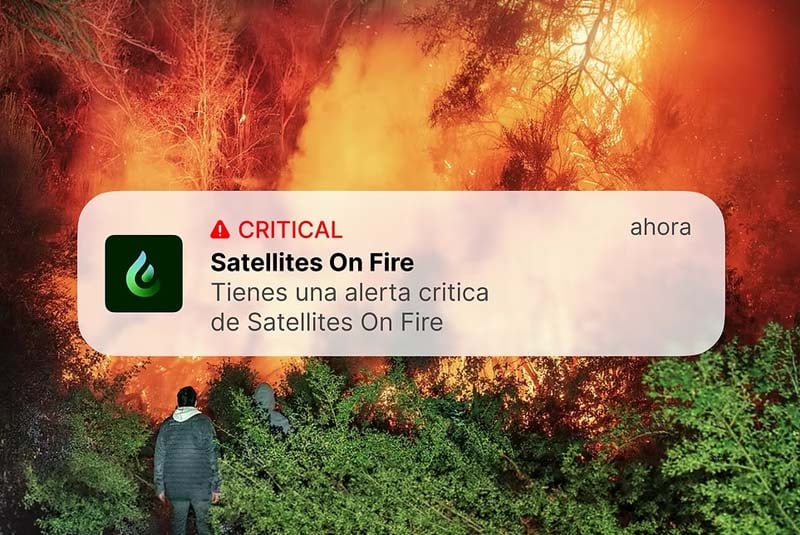
Satellites on Fire, an Argentine climate-tech startup that built its wildfire detection platform as a school project in 2020, has closed a $2.7 million seed round. The company says its software detects fires an average of 35 minutes ahead of NASA’s FIRMS service, a margin it describes as the decisive window for effective early containment.
A Platform Built on Coverage Density, Not New Hardware
The company’s core technical proposition rests on satellite aggregation rather than proprietary hardware. NASA’s FIRMS draws on a limited number of satellites with revisit cycles that can leave multi-hour gaps over Latin American territory. Satellites on Fire addresses this by pulling imagery from more than eight satellites operated by NASA, NOAA, and the European Space Agency, updated as frequently as every five minutes. Its own AI models then process these feeds to detect thermal signatures and generate spread simulations based on climate data, topography, and fuel load conditions.
The system alerts first responders via WhatsApp with precise coordinates and predictive modelling showing projected fire behaviour in the coming hours, moving well beyond the point detection that most existing tools provide. A documented case reported by Newsweek in November 2025 recorded system detection at 1:40 a.m., seven hours before a NASA FIRMS alert was issued for the same event.
The training dataset underpinning the models includes more than 20,000 field-validated fire reports, which the company describes as the largest such database in Latin America. In 2025 alone, the platform was involved in the response to more than 600 wildfires.
From School Project to 21-Country Deployment
The company was founded in 2020 by Franco Rodriguez Viau, Ulises Lopez Pacholczak, and Joaquin Chamo while they were secondary students at ORT Buenos Aires. The initial motivation was personal: family friends of Rodriguez Viau lost their homes to wildfires in Cordoba during the pandemic. The first version of the product was scrapped entirely after the founders conducted more than 80 interviews with firefighters and emergency responders who concluded it was not operationally useful. The platform was rebuilt from scratch based on that fieldwork.
Rodriguez Viau, now 22 and serving as CEO, was named among MIT Technology Review’s 35 Innovators Under 35 for Latin America in 2025. The team has expanded to include engineers with NASA backgrounds, machine learning consultants from the University of Oxford, and advisors from the European Space Agency.
The platform now monitors territory across 21 countries on four continents, with more than 55,000 registered users. Its commercial model is structured as software-as-a-service, with pricing ranging from $0.02 to $10 per hectare annually depending on service tier.
Commercial Traction Across Insurance, Forestry and Energy
The client base spans forestry companies, agricultural enterprises, energy utilities, carbon credit projects, insurers, and government agencies. The most significant institutional integration to date is with Aon, which has embedded the platform across all of its forestry insurance policies in Latin America for risk calculation and premium pricing. A parametric wildfire insurance product, to be developed jointly with Aon, is among the planned uses of the new capital.
The business case for insurers aligns with a broader industry shift: early detection reduces claims exposure by shrinking the area burned before suppression resources can be deployed. The 35-minute detection lead is, in that context, less a technical metric and more a commercial risk variable.
Syndicate Led by Dalus Capital With Silicon Valley Participation
The $2.7 million round was led by Dalus Capital, a Mexico-based international venture capital firm that backs climate innovation, inclusion, and business productivity across Latin America. The round also included participation from Draper Associates, Draper Cygnus, VitaminC, Savia Ventures, Avesta Fund, Reciprocal, Zenani Capital, Innventure, Air Capital, Gain VC, Antom VC, and Embarca Tech.
The company previously received $250,000 from Tim Draper and Adam Draper after appearing on Season 9 of Meet the Drapers, and has received earlier support and recognition from the UN, MIT, and Cornell University.
Dalus Capital managing partner Diego Serebrisky framed the investment as evidence that Latin American founders are producing globally competitive AI solutions in the climate sector.
US Market Entry via Watch Duty Partnership
A significant portion of the new capital will go toward US market expansion, where pilots are already underway. The company has established a partnership with Watch Duty, the San Francisco-based nonprofit wildfire tracking platform that reached national coverage across all 50 US states in December 2025 and sustained eight million users during the January 2025 Los Angeles fires. Watch Duty CEO John Mills, who also serves as an advisor to Satellites on Fire, said the platform’s results with existing satellite data had exceeded his team’s expectations.
The US is the most commercially consequential target market: wildfires cost the country an estimated hundreds of billions of dollars annually, a figure that has driven intensified political and private-sector attention on the detection gap. The 2025 Los Angeles fires, which exposed the limitations of government alert infrastructure at scale, have sharpened that attention considerably.
Kurrant has previously covered developments in the broader AI wildfire detection space, including SenseNet’s $14 million Series A for its ground sensor and satellite hybrid detection system, Google’s FireSat initiative in partnership with the Earth Fire Alliance, and AI camera deployments expanding across the western US. The Satellites on Fire model is differentiated by its software-only architecture: it requires no ground hardware installation, relying entirely on multi-source satellite aggregation and AI processing. OroraTech, the Munich-based firm that recently contracted with Argentina’s Río Negro province to monitor 20 million hectares of Patagonia, operates its own proprietary CubeSat constellation with onboard thermal sensors, controlling the full stack from orbit down. Satellites on Fire requires no owned infrastructure: it aggregates existing feeds from agencies that already have satellites in orbit and competes on the quality of its AI layer and alert speed.
Roadmap Includes Drone Suppression and Insurance Products
Beyond detection, Rodriguez Viau has outlined plans to eventually move into active suppression using drone technology, though no timeline or commercial structure for that phase has been announced. Near-term product development will focus on optimising AI models, completing the parametric insurance product with Aon, and building an intelligence dashboard for client protection planning.