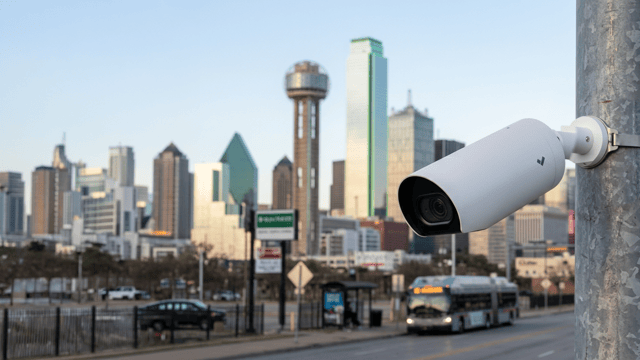
The City of Brownsville, Texas, is deepening its smart city ambitions with a new AI-driven public safety solution that brings together visual intelligence, edge computing, and GPU-accelerated analytics across the border city’s camera network.
The project, announced on March 11, extends an existing partnership between Brownsville and SHI International. The new deployment integrates Centific‘s VerityAI vision intelligence platform, NVIDIA AI frameworks, and Lenovo hardware into a unified architecture designed to give city officials real-time situational awareness from strategically placed safety cameras.
From “Worst Connected” to National Smart City Model
Brownsville’s trajectory makes the latest deployment particularly notable. In 2014, the U.S. Census Bureau’s American Community Survey ranked the city as the worst-connected metropolitan area in the country. Under the leadership of CIO Jorge Cardenas, who joined in 2022 with a background in military communications infrastructure, the city has since laid over 100 miles of middle-mile fiber, deployed a private 5G network with NTT DATA, and installed hundreds of cameras across parks, downtown corridors, and public facilities.
The private 5G network, which launched in phases beginning in mid-2024, now covers roughly three square miles of downtown and connects four public parks, the public works yard, and the city’s airport. It provides the wireless backbone for thousands of IoT sensors, 4K cameras, and connected assets that feed data into the city’s growing analytics infrastructure.
How the AI Layer Works
At the core of the new solution is Centific’s VerityAI platform, an agentic vision intelligence system that processes live and archived video feeds to detect potential incidents, summarize activities, and surface actionable insights in real time. Rather than relying on traditional rule-based alerts, VerityAI uses visual AI agents that can interpret complex scenes and respond to natural-language queries from operators.
The platform is built on NVIDIA’s Metropolis framework for video search and summarization, which enables AI agents to analyze massive volumes of video data up to 100 times faster than manual review. It also leverages NVIDIA Cosmos Reason, a reasoning vision language model originally developed for physical AI and robotics applications that has been adapted for video analytics use cases requiring spatial and temporal understanding.
Lenovo provides the AI-accelerated hardware platform, while SHI serves as the systems integrator, designing the overall architecture and coordinating deployment across on-premises, cloud, and edge computing environments.
Modular Architecture With Expansion Potential
SHI has designed the platform with a modular, iterative architecture intended to accommodate new data sources and use cases over time. The initial deployment focuses on public safety monitoring, but the city has indicated that future applications could include traffic management, fire detection, weather monitoring, and energy optimization.
This approach aligns with a broader pattern in Brownsville’s digital strategy. The city has already secured $27.8 million from the Rio Grande Valley Metropolitan Planning Organization for intelligent transportation system upgrades, including citywide signal improvements and traffic monitoring infrastructure expected to begin construction in May 2026. A planned $70 million Public Safety Complex will consolidate police, fire, EMS, and cybersecurity operations under one roof.
The municipality also recently partnered with OMNI Fiber to deliver residential broadband and has allocated $215 million for capital improvements, the largest such plan in its history.
Privacy Guardrails and Data Sovereignty
Brownsville officials have been explicit about the boundaries of the city’s surveillance capabilities. CIO Cardenas has publicly stated that the system does not use facial recognition and is focused on monitoring public spaces for safety incidents rather than tracking individuals. All data remains within city-controlled systems, a point of emphasis given that some Texas municipalities have cancelled contracts with third-party camera vendors over data-sharing concerns.
The city’s decision to build its own AI processing infrastructure, rather than rely on cloud-based third-party services, reflects a deliberate data sovereignty strategy. By keeping analytics on-premises and within the private 5G network, Brownsville retains full control over video feeds and derived intelligence.
The Vendor Ecosystem and Replicability Question
The announcement was timed to coincide with NVIDIA’s GTC 2026 conference, where SHI is exhibiting the Brownsville solution at Booth 1231. The presentation is being positioned not merely as a single-city deployment but as a replicable blueprint for mid-size American municipalities looking to integrate AI into public safety operations.
SHI’s public sector division works with state and local governments to identify funding pathways, including federal and state grants, for smart city projects. The company has positioned itself as a channel partner capable of assembling multi-vendor AI stacks for municipal clients, a role that could become more relevant as cities move from pilot-stage deployments to production-scale systems.
Centific, for its part, recently introduced Verity SLiM, a compact version of its platform built on NVIDIA’s DGX Spark, aimed at smaller agencies that want to start with limited deployments and scale up over time. The company’s government solutions are also available through Carahsoft, a public sector IT distributor.
Market Context and Competitive Landscape
Brownsville’s deployment arrives as the market for AI-powered urban video analytics is maturing rapidly. According to Guidehouse Research, smart city technology markets are projected to reach $301.2 billion by 2032. NVIDIA estimates that more than 1.5 billion enterprise-level cameras are currently deployed worldwide, generating roughly seven trillion hours of video annually, yet less than 1% is analyzed in real time.
The investment appetite for AI-enabled public safety technology is growing in parallel. In Europe, London-based Augur recently raised $15 million to build a platform that repurposes existing camera and sensor networks into real-time security intelligence systems for critical infrastructure. French startup Vizzia closed a €30 million Series B for GDPR-compliant municipal surveillance technology. In the United States, cities from Las Vegas to Chattanooga are deploying AI-enhanced camera systems at varying scales.
The key differentiator in Brownsville’s approach is integration depth. Rather than bolting AI onto legacy infrastructure, the city has built its digital foundation from the ground up, with fiber, private 5G, edge compute, and now vision AI operating as layers in a single, city-controlled stack. Whether this model proves financially and operationally replicable for other municipalities will depend on factors including available broadband infrastructure, procurement capacity, and public willingness to accept expanded camera deployments.