The Junta de Andalucía has completed the deployment of a multi-municipal smart mobility network in the Gran Vega comarca of Seville province, with close to €800,000 in regional and EU funding used to install 171 connected devices across 12 towns serving a combined population of more than 120,000 residents. The project, known as Smart Movilidad Gran Vega, is the first mobility initiative under Andalusia’s CITI Order programme to reach full completion, and it marks the region’s first integrated smart mobility rollout at a sub-regional, multi-municipality scale.
A Regional Programme Built for Small Municipalities
The project sits within the broader Order CITI, a €9.25 million incentive programme managed by the Junta’s Ministry of University, Research and Innovation, designed specifically to support digital and smart city transformation in Andalusian municipalities with fewer than 20,000 inhabitants. The programme targets 21 projects across the region, collectively benefiting 311 municipalities and approximately 1.3 million residents. Kurrant has previously covered the launch of this initiative in Andalusia to Benefit from €9.25 Million in Smart City Initiatives.
Of the total budget, the Ministry channels up to 77%, approximately €7.1 million, through the Andalucía FEDER 2021–2027 programme, which is the regional implementation framework for the European Regional Development Fund. The remaining 23%, approximately €2.15 million, is co-financed directly by participating municipalities and local entities.
Within Seville province, three CITI Order projects are currently running: Pilas Es+, the Advanced GIS System for Data Management in Arahal, and Smart Movilidad Gran Vega. Together, the three initiatives span 14 municipalities and approximately 156,000 residents, with a combined budget of €1.12 million.
Infrastructure Deployed Across the Guadalquivir Valley
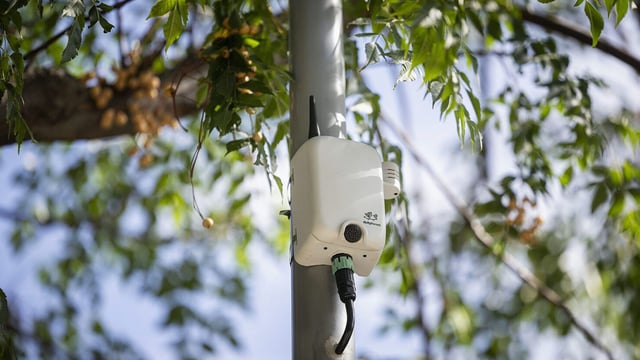
The 12 participating municipalities, are all located along the Guadalquivir valley north of Seville. The 171 devices deployed across the network break down into four functional categories. Traffic surveillance is handled by 69 cameras recording vehicle entries and exits to analyse circulation density at key access points. Crowd and parking management is addressed by 48 cameras measuring pedestrian flows and space occupancy in town centres and public areas. Environmental and weather monitoring is provided by 34 stations collecting data on temperature, humidity, atmospheric pressure, noise levels, and air quality. Finally, 20 public charging stations for electric scooters, distributed across nine of the twelve municipalities, support lower-emission last-mile mobility options.
Municipal administrators can access all device outputs through in4city, a smart city management platform developed by the project’s main technology contractor that consolidates real-time IoT data into a single dashboard. Residents are able to access a subset of this information through a dedicated mobile application, Smart Gran Vega, available for both Android and iOS, which provides live updates on air quality, traffic conditions, and scooter station availability.
Procurement Structure and Technology Vendor
Contract delivery was organised through SANDETEL (Sociedad Andaluza para el Desarrollo de las Telecomunicaciones), a public technology company of the Junta de Andalucía, which acted as the procurement intermediary on behalf of the Ministry. The contracts were split into two lots. An advisory and technical assistance contract, valued at €102,807, was awarded to the joint venture CARSA-CBT (Consultores de Automatización y Robótica). The primary implementation contract, valued at €685,260, went to Innovasur (Innovaciones Tecnológicas del Sur), an Andalusian technology firm based in Mengíbar (Jaén) that specialises in smart city infrastructure and cybersecurity for public administrations.
Innovasur brought its in4city platform to the project, which it has deployed in more than 100 Andalusian municipalities across a range of applications including traffic sensors, environmental monitoring, smart lighting, and waste management. The company has grown significantly in recent years, reporting revenues exceeding €30 million in 2023, and currently operates across multiple Spanish regions.
Completing the First CITI Order Mobility Project
The project’s closing ceremony took place on 19 March 2026 at the Teatro Cine Goya in Lora del Río, where the regional Secretary General for Research and Innovation presented the symbolic FEDER project plaque to the mayor of Lora del Río. The event also hosted the prize-giving for the Smart Movilidad Gran Vega student competition, in which secondary school and vocational training students from the participating municipalities were invited to propose improvements or new applications for the network. The inclusion of a youth innovation contest alongside the infrastructure rollout reflects a broader effort to build awareness of smart city tools at the community level.
Officials also used the event to describe the project as a reference case for other CITI Order initiatives still in progress, given that it is the first in the mobility category to reach full execution.
Toward a Regional Smart Territory Strategy
The Smart Movilidad Gran Vega completion coincides with preparations for a wider strategic framework. The Junta de Andalucía is developing the Plan Andalucía Región Inteligente 2030, which aims to create a regional ecosystem supporting data-driven intelligent solutions aligned with territorial needs. The CITI Order is considered a foundational element of that strategy, providing local governments with practical experience in deploying and operating connected infrastructure.
The successful conclusion of the Gran Vega project is also noteworthy in the context of Andalusia’s broader smart infrastructure momentum. Earlier this year, the regional government announced a €20 million smart city investment at Seville TechPark, likewise drawing on the FEDER Andalucía 2021–2027 framework, underscoring how EU cohesion funding is being used across different scales of territorial intervention, from individual technology parks to distributed rural networks.