JSC Kelių priežiūra, the Lithuanian state company responsible for maintaining the country’s national road network, said it selected Spanish technology firm Asimob in November 2025 to test computer vision based pavement and signage inspection across 1,200 kilometres of state roads. The work was carried out during the first months of 2026 using cameras and sensors mounted on ordinary vehicles rather than dedicated survey trucks. The pilot covered roughly 6 percent of the 21,000 kilometre network Kelių priežiūra maintains under contract with state infrastructure operator Via Lietuva, at a time when Lithuania’s transport ministry has flagged the broader network as badly in need of repair after years of uneven funding.
A Pilot Covering A Fraction Of Lithuania’s National Network
Via Lietuva owns and oversees Lithuania’s roughly 21,000-kilometre network of national roads, while Kelių priežiūra, a state-owned company with more than 2,000 employees, carries out day to day maintenance under contract. National roads are maintained according to a manual called the Road Maintenance Norms, or KPV PN 25, which sets quality standards for the work and its valuation. Both companies have described the 1,200 kilometre pilot as a proof of concept rather than the start of a network-wide rollout.
Computer Vision Flags Potholes, Cracking And Missing Signs
The system identified potholes, surface raveling, cracking and alligator-pattern fatigue cracking across the inspected sections, along with vertical signs that had gone missing. Asimob has said the pilot’s scope was deliberately limited to pavement defects and signage, and that capabilities covering road markings, guardrails, lighting and geometric data were not tested in this phase. The company has indicated those functions could be added later if its relationship with Kelių priežiūra continues.
Video Evidence Replaces Manual Field Notes
A central part of the deliverable was how findings were presented, through video overlaid with detection masks and virtual aerial images highlighting individual defects. Each finding came paired with data on affected area, length, width and damage type, intended to help prioritize repair work. That contrasts with the method still common across much of the network, in which maintenance crews drive assigned routes and record conditions by hand, leaving no lasting visual record of the inspection.
Asimob Expands Beyond Spain With Pilots In 17 Countries
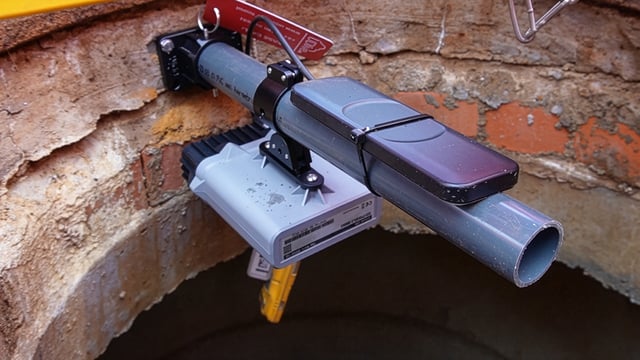
Asimob, formally Advanced Services in Mobility S.L., is based in Bilbao and was founded in 2016, reaching the market with a commercial offering in 2019. Its technology relies on cameras and sensors fitted to vehicles already in circulation, with imagery processed through machine learning models the company says it developed in-house.
“Any vehicle we equip with two devices can become a road inspector,” said Ibon Arechalde, CEO and co-founder of Asimob, in an October 2023 interview published in Spain’s Tráfico y Seguridad Vial magazine, produced by the country’s traffic authority.
The company’s public-sector references in Spain include the regional government of the Community of Madrid, the Provincial Council of Gipuzkoa and the regional government of Extremadura. According to a February 2026 interview published by SPRI, the Basque Country’s business development agency, Asimob now runs pilots in 17 countries and is working through local distributor deals, including recent exclusive agreements covering Malaysia and the Buenos Aires region of Argentina, as it tries to convert that footprint into standing public-sector contracts during 2026.
Lithuania’s Road Budget Strained By Weather And Funding Gaps
Lithuania’s 2026 state budget allocates €815.5 million to roads, and Via Lietuva is partway through a renewal push covering an estimated 170 kilometres of state highways, with more than €12 million in contracts already signed and procurement worth over €100 million underway. Transport Minister Juras Taminskas has linked the network’s deterioration to decades of uneven funding and inadequate management. Lithuania’s largest insurer, Lietuvos draudimas, separately reported registering nearly 50 pothole-related vehicle damage claims in the first seven weeks of 2026, a sign of the maintenance backlog automated inspection tools are meant to help manage.
Part Of A Broader Shift Toward AI-Based Road Monitoring
Asimob’s Lithuanian project mirrors a wider move by road agencies toward computer vision and AI-based asset monitoring in place of, or alongside, manual inspection. As Kurrant has reported, South Africa’s Western Cape Department of Infrastructure adopted Bentley Systems’ Blyncsy platform in May 2026 to continuously scan roughly 5,000 kilometres of provincial roads using crowdsourced dash camera footage, with Bentley citing detection accuracy near 97 percent. Dubai’s Roads and Transport Authority has taken a different technical route, deploying LiDAR-based digital twin tools it says can assess up to 80 kilometres of road per day against roughly 3 kilometres for a manual crew, with claimed accuracy around 95 percent.
Set against those deployments, Asimob’s Lithuanian contract is modest in scale, but it gives the company a reference project in a Baltic state that is actively expanding its road maintenance budget. Other vendors active in road condition monitoring include Finland’s RoadCloud, which focuses on road weather and friction data rather than visual defect detection, and Belgium’s ASAsense, which uses sound and vibration sensing instead of cameras, pointing to a market still being defined by pilot projects rather than long-term framework agreements.