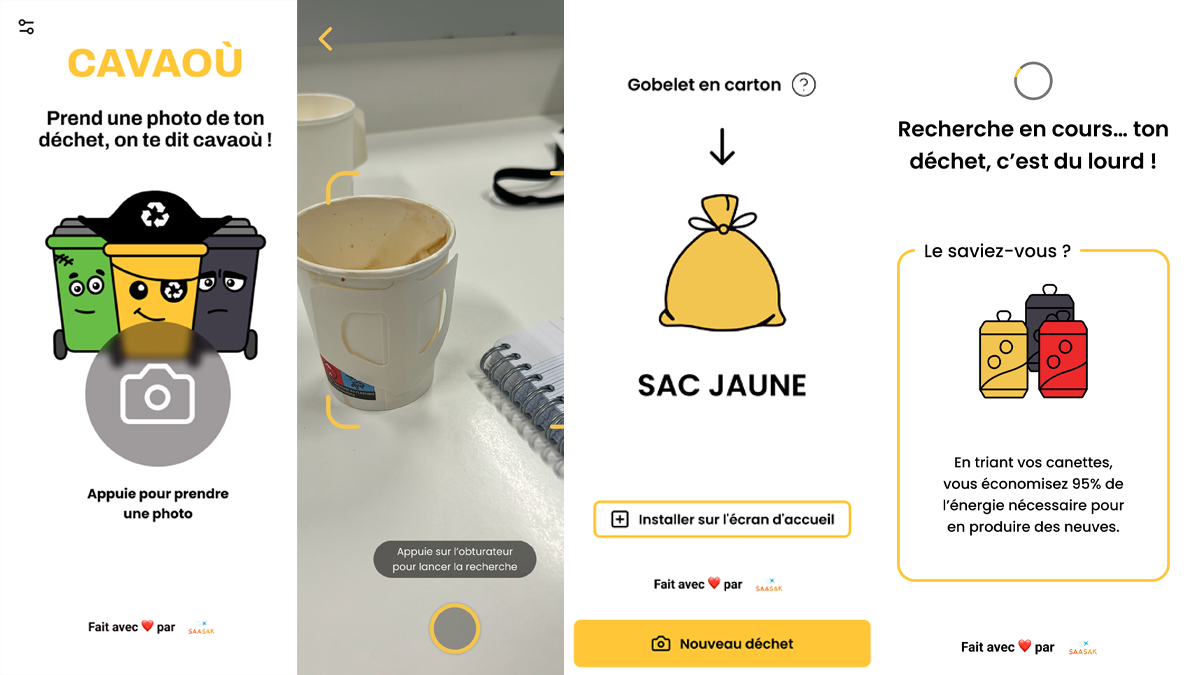
Pays de Montbéliard Agglomération (PMA), the 73-commune authority in France’s Doubs department, has rolled out a free digital sorting assistant called “Çavaoù?” to reduce the roughly 25% of sorting errors recorded in its yellow recycling bins in 2025. The tool, launched in early July 2026 as part of the authority’s 2026 environmental awareness programme, works on smartphones and via a web browser, requires no registration, and gives residents an instant, commune-specific instruction on where a given item belongs.
Photo Recognition Mapped To Local Sorting Rules, Not Generic Advice
The core function is deliberately narrow. A user photographs an item or types its name, and the Çavaoù app returns the applicable local instruction, directing the item to the yellow bin, residual household waste, or the nearest drop-off point.
The value for a public authority lies in localisation. Sorting rules differ from one collectivité to another, so a generic recycling guide is of limited use, whereas Çavaoù ties its answer to PMA’s own collection scheme. According to reporting by ICI Belfort Montbéliard, the app draws on a visual-recognition system and a regularly updated database able to identify thousands of items, and it also surfaces the location of recycling centres and collection points with GPS guidance.
The Vendor: A French Startup Positioning Itself As A “Yuka For Waste”
The rationale is financial as much as environmental. PMA has framed the app as one input among several intended to move its contamination rate below a 20% threshold. Contamination forces recyclable loads to be rejected and rerouted to incineration, adding technical and treatment costs on top of lost material value.
Çavaoù is not built in-house. The app is published by the French developer Saasak and marketed to local authorities as a white-labelled, territory-specific sorting assistant.
The same product is already in service at other French bodies, indicating a multi-client model rather than a one-off build for PMA. The Syndicat Mixte d’Aménagement du Val has described the tool as a “Yuka for waste,” citing an artificial-intelligence engine and a database of more than 2,000 products at the time of its own launch, while the Communauté d’Agglomération Saint-Avold Synergie adopted the app in late 2025.
Yellow Bins And Pay-As-You-Throw: The Policy Backdrop
The app lands on top of a broader reform that has already reshaped resident behaviour. Since introducing the incentive-based household waste fee (REOMI) on 1 January 2024 across all 73 communes, alongside the deployment of yellow bins, PMA says residual household waste has fallen by more than 35%.
Per-capita residual waste dropped from 240 kilograms per inhabitant per year to 132 kilograms last year, according to figures the authority shared with ICI Belfort Montbéliard, already beating the 150-kilogram target its local waste prevention plan had set for 2028. That progress reframes the app’s role: the volume problem is being solved by pricing and infrastructure, while contamination inside the recycling stream is the remaining bottleneck the app is meant to address.
Benchmarks: A 27% Refusal Rate Against a 20% Ceiling
Regional data underlines why PMA is targeting contamination specifically. In its reinforced collection rules issued in mid-2025, the authority noted that the 2024 average refusal rate at the SYTEVOM sorting centre in Noidans-le-Ferroux stood at 27%.
That compares with a national average of 24% and a maximum of 20% set by national packaging eco-organisation Citeo. PMA’s stated goal of falling below 20% is therefore an effort to reach the sector benchmark rather than to exceed it, which positions Çavaoù as a corrective tool for an authority still above the reference line.
Where Çavaoù Fits In France’s AI Waste-Sorting Push
The launch reflects a wider move by French operators to apply image recognition to the sorting problem, though PMA’s approach targets the resident rather than the bin. Kurrant reported in November 2025 that Veolia had begun deploying intelligent bins using optical-recognition cameras from the startup Lixo and an in-house AI system to analyse waste composition for business clients.
The contrast is instructive for other municipalities weighing options. Hardware-based systems such as Veolia’s measure and characterise waste at the point of disposal, typically for commercial users, whereas a consumer app like Çavaoù is a low-cost behavioural nudge aimed at households upstream. For an authority whose main leakage is resident confusion rather than commercial reporting, the software route carries a far lower capital cost, though its impact depends entirely on voluntary adoption.