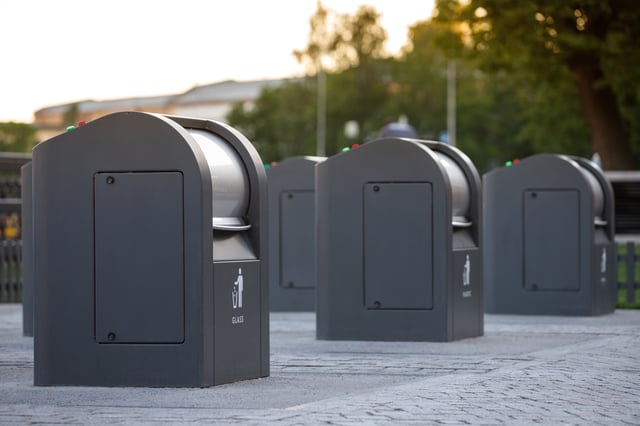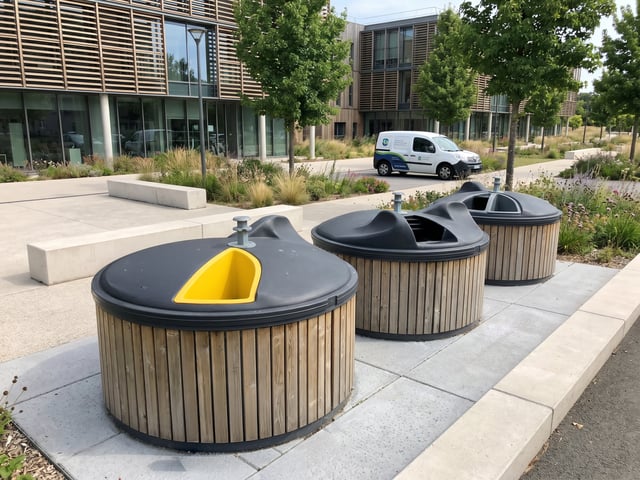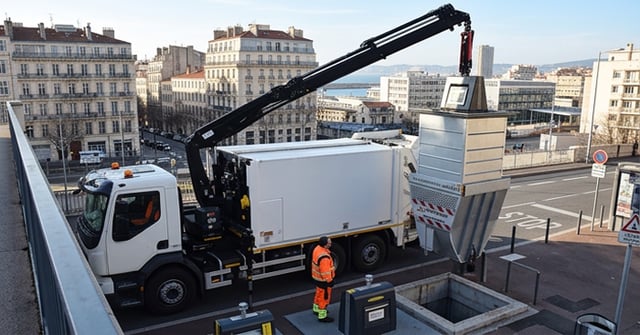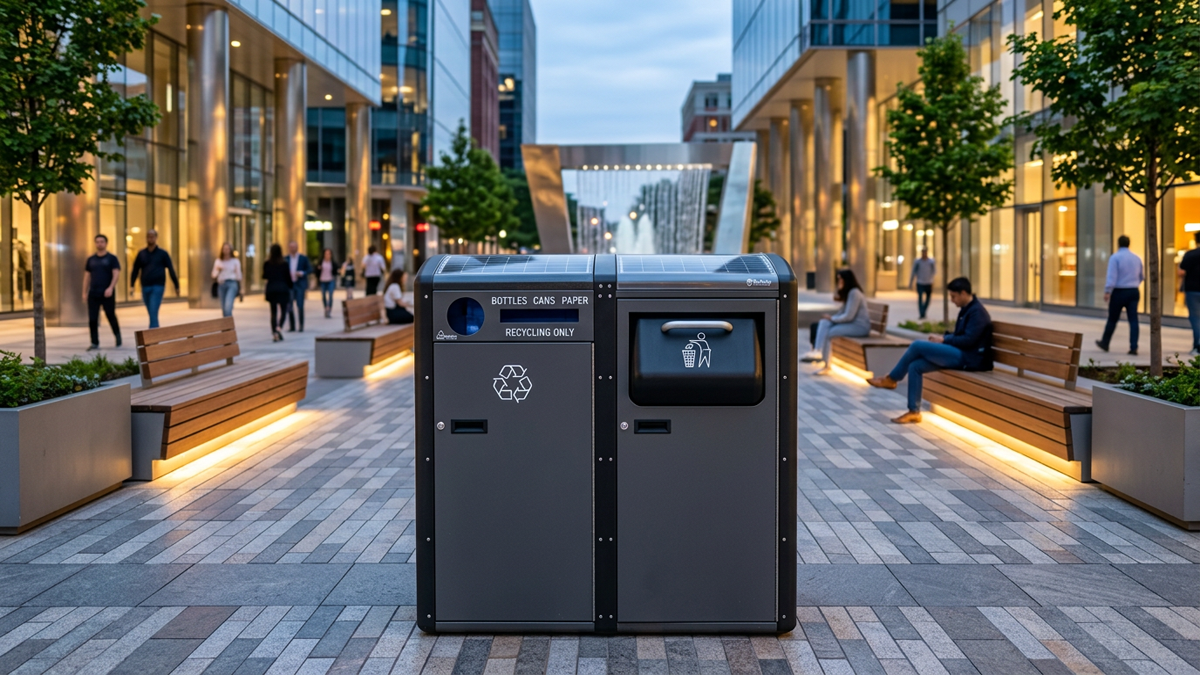
Dublin City Council is preparing a proposal to replace sections of its 3,500-strong public bin fleet with solar-powered Bigbelly compactors. The locked, fob-accessed units are intended to stop people tearing open bins and rubbish bags while scavenging for containers eligible under Ireland’s Re-turn deposit scheme, while also cutting how often crews need to empty bins across the city. The plan follows an earlier pilot that fitted anti-scavenging rims to some bins, and comes as council crews report spending hundreds of euro clearing up after bins are overturned in searches for deposits worth as little as 15 cent.
Rim-Based Deterrents Failed To Stop Bin Tampering
An earlier attempt to block access, rims fitted to the front of some bins, proved largely ineffective. Modified bins still ended up containing coffee cups, food waste and other rubbish left behind by people searching for containers. The core weakness of the existing fleet is structural. Overturned or torn-open bins generate clean-up costs of roughly €500 to €600 per incident for the recovery of a single container worth 15 cent.
Bin Fleet Scale And Daily Servicing Demands
Dublin City Council currently maintains about 3,500 public litter bins, which crews are required to empty at least once a day. High-footfall streets such as Grafton Street can require servicing five to six times daily.
Frequent emergency responses to ripped-open bags divert crews from other cleansing work and feed a public narrative that the city centre is dirty. The council has separately increased cleansing spending this year, including more than €4 million on a new road sweeper fleet and an expanded 24-hour cleaning regime, according to The Irish Times.
Give Take Return Pilot Set The Stage For This Proposal
The scavenging problem traces back to the February 2024 launch of Ireland’s Deposit Return Scheme, which introduced a refundable deposit of 15 cent on containers up to 500ml and 25 cent on larger containers up to 3 litres. Businesses in Dublin’s core reported rising litter almost immediately as people began tearing open refuse sacks and prising open bins to retrieve discarded containers.
In response, the council ran a pilot called Give Take Return, fitting surrounds able to hold about a dozen containers to roughly 80 of the 600 bins in the city centre, according to RTE. That approach has not resolved the underlying access problem, prompting the council to look at fully locked units instead.
How Bigbelly’s Locked Solar Compactors Would Work
Bigbelly units are solar-powered compactors that crush waste internally, giving each bin roughly five times the holding capacity of a standard litter bin, according to the company’s Irish distributor Future Street. Access panels are secured and can only be opened with a fob carried by council staff, directly addressing the manual-access weakness Kelly described.
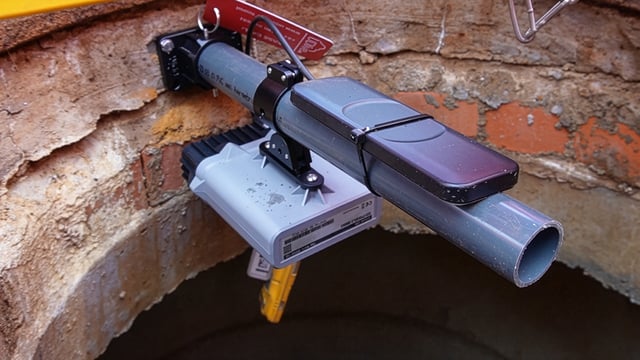
Fullness sensors feed data to Bigbelly’s cloud management platform, letting crews plan routes around bins that actually need emptying rather than fixed schedules. Dublin City Council has already tested the technology, installing 110 Bigbelly units across the Docklands between 2019 and 2022 as part of the wider Smart Dublin programme, an initiative that Dublin Inquirer reported delivered an 82 percent increase in collection efficiency in that pilot area.
Councillors Split Between Enforcement And Behaviour Change
Scavenging has intensified to the point where she has witnessed people climbing inside bins, and argued that a dedicated bottle-return bin could reduce mess without leaving people who rely on the deposit money empty-handed.
Deposit Scheme’s National Recovery Rates Frame The Scale Of The Issue
Ireland’s deposit scheme has pushed the national container return rate from 49 percent to more than 90 percent since launch, according to Re-turn, the not-for-profit body that runs the scheme on behalf of drinks producers. Re-turn says more than 3.2 billion containers had been returned as of mid-2026.
Even so, consumers left €60.1 million in deposits unclaimed last year, according to RTE, underscoring the financial incentive that continues to draw some people to public bins rather than official return points.