in Barcelona
 3 to 5 Nov 2026
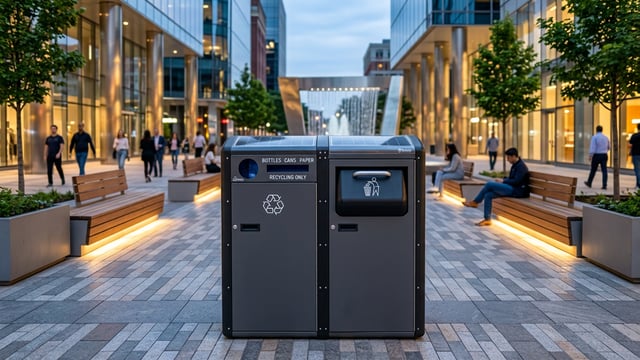
Belfast City Council is moving beyond its initial smart waste trial to deploy a broader network of solar-powered compactor bins across the city’s busiest pedestrian corridors, replacing 20 conventional litter bins with 13 advanced units equipped with real-time fill-level monitoring.
From Pilot to Programme
The expansion follows a trial at City Hall that produced results strong enough to justify a city-wide commitment. Under the new roll-out, three of the 13 incoming units are dedicated recycling compactors, marking a deliberate step to strengthen on-street recycling provision alongside general waste collection. The deployment is concentrated on routes where footfall is highest: Donegall Place receives the largest allocation with 14 bins replaced, while Donegall Square North absorbs four and Royal Avenue two. An additional unit is being installed on High Street, directly outside Centra.
The bins are supplied by Bigbelly, the US-headquartered company widely credited with pioneering the solar-powered public compactor. Each unit uses built-in solar panels to power an internal compaction mechanism capable of holding up to five times the volume of a standard bin, while onboard sensors transmit fill-level data in real time to cleansing operations teams via Bigbelly’s CLEAN management platform. Collections are triggered by actual need rather than fixed schedules, a shift that fundamentally changes how street-cleaning resources are deployed. Kurrant has previously explored Bigbelly’s origins and the technology’s global adoption in its smart cities coverage.
Operational Gains Validated by Data
The City Hall pilot generated quantifiable evidence for the efficiency case. Across the trial site, collection frequency dropped by more than 80%, with 10 smart bins requiring a single daily empty compared to 72 empties previously needed for the equivalent number of standard bins. Staff time spent attending bins fell from two hours and 24 minutes per day to 20 minutes, freeing crews to redirect effort toward complementary tasks including power washing and manual litter picking.
A parallel pilot covering Donegall Square, Donegall Place, and Royal Avenue produced consistent results. Twenty-six smart units replaced 50 conventional bins, reducing daily attendance time from three hours 20 minutes to 52 minutes. The council notes that fill-level reporting also provides longer-term intelligence: six months of collection data can inform decisions about bin placement, helping to match capacity to actual demand patterns rather than geographic assumptions.
Infrastructure Review as Backdrop
The Bigbelly deployment sits within a larger programme of litter bin infrastructure reform. The council is conducting a condition survey of more than 3,000 bins across the city, with findings intended to shape a long-term replacement and maintenance schedule. That process is expected to determine where further smart units may be justified and where standard infrastructure remains appropriate.
The enclosed design of the compactor units carries secondary benefits beyond operational efficiency. The sealed housing prevents wind-blown litter dispersal and removes accessible waste as a food source for birds and pest animals, a persistent issue with open-top bins in high-traffic urban areas.
This approach to data-driven municipal waste optimisation reflects a growing pattern in European cities, where sensor-based collection scheduling is being used to reduce vehicle kilometres and associated emissions without reducing service quality. Veolia’s deployment of AI-equipped smart bins across France, reported by Kurrant, illustrates the parallel trend toward intelligent waste characterisation alongside collection efficiency.