in Barcelona
 3 to 5 Nov 2026
The Ayuntamiento de Cartagena, a city of 220,704 residents in Spain’s Region of Murcia, published on 28 September 2026 an open tender worth €130,258.92 including VAT for smart sensors that will measure environmental conditions, weather and pedestrian flows in seven northern neighbourhoods. The contract has an estimated value of €107,652 before VAT and a six-month delivery period, is financed by EU regional development funds under the city’s RE-CREA plan, and closes to bids on 15 October, according to the Public Sector Procurement Platform notice.
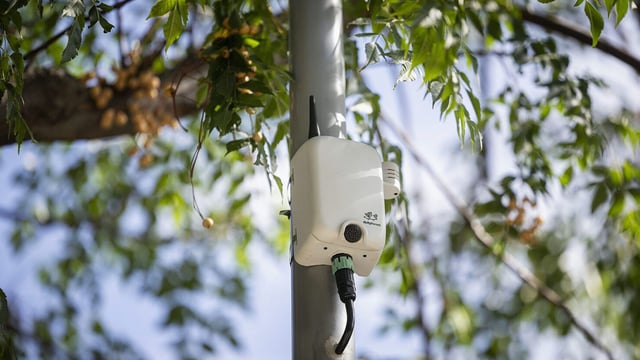
The tender, file SU2026/34, covers Los Barreros, Vereda de San Félix, Barrio Peral, Barriada Cuatro Santos, Ciudad Jardín, San Antón and Urbanización Mediterráneo. La Opinión de Murcia reported that around fifteen main devices will monitor air pollution, noise, weather and pedestrian movements. The newspaper said the data will feed the municipal smart city platform and a future digital twin of the area.
Price Discount Carries 34 Of 100 Points
The award formula gives 30 points to the technical report, 34 to a single discount on the unit prices in the price annex and 30 to improvements. The remaining 6 points go to the environmental label of the vehicle used, according to the tender documents in the Kurrant tender tracker.
The contract is a single lot under product code 35125100 for sensors, which the file justifies as one functional unit. The winner must lodge a 5% guarantee and employ at least one worker under 30 in a first job or on a training contract, and subcontracting is allowed.
Economic offers are due to be opened on 21 October. Bidders can lodge special appeals with the central contracts tribunal until 20 October.
The needs report, signed on 27 July by Cristina Mora Menéndez de la Vega, councillor for mobility and European projects, says the devices will supply environmental, weather and pedestrian-count data for sustainable mobility between neighbourhoods. The expenditure and specifications were approved by decree on 24 September, signed by Álvaro Valdés Pujol, councillor for economic development and contracting.
The documents reviewed do not list the pollutants to be measured, the counting technology or the connectivity. Those details sit in a technical specification that has not been published in full.
RE-CREA Plan Totals €14.8 Million Across Nine Projects
The sensor contract is the “Smart City para todos” action within the first project of the RE-CREA plan. The council values the plan at close to €14.8 million across nine projects, financed through Spain’s 2021-2027 multiregional programme for EU regional funds.
The first three works went to tender in July for more than €3.5 million. They include €1,999,831 to convert a former health centre in San Antón, €760,000 for a greenway in Barrio Peral and €769,325.45 for Parque Escipión in Los Barreros.
European funding for the plan totals €8.87 million, down from a first draft of about €20 million, according to a motion by the opposition group Sí Cartagena in April 2026. That implies a co-financing rate of about 60%.
“It is an example of how one should work with a city project that connects neighbourhoods and people, something the European Union values extraordinarily highly and that has allowed us to attract European funds to keep transforming Cartagena,” said Noelia Arroyo, Mayor of Cartagena, in the council’s press release of 26 July 2026.
An Existing FIWARE Platform And Digital Twin
Cartagena already runs a smart city platform built on the FIWARE open standard. Its 2022 low-emission zone tender required new systems to integrate with it, according to the tender record.
Libelium, the Zaragoza sensor maker, has supplied air-quality monitoring for the zone that measures nitrogen oxides, sulphur dioxide, carbon monoxide, particulates and noise, according to esmartcity. That account draws on vendor material.
Libelium’s own material describes sensors mounted on streetlights and linked over a LoRa metropolitan network, and a management platform handling 1,800 connected entities, according to Interempresas. Those figures are supplied by the vendor and have not been independently checked.
Mayor Arroyo presented the city’s first digital twin in November 2025. It draws on 17 pollution sensor stations, 12 licence-plate cameras and more than 300 devices covering traffic, air and pedestrians, esmartcity reported from the council’s presentation.
In June 2026 the city installed five Libelium pedestrian counters in the historic centre that detect WiFi and Bluetooth signals with anonymised identifiers, according to Murcia.com. The tender for those counters had an estimated value of €24,793, according to its record.
The Region of Murcia’s reference network has one urban background station in the city, at Mompeán, plus industrial stations at Alumbres and the Escombreras valley. Those stations recorded no limit-value breaches for nitrogen dioxide, sulphur dioxide or fine particulates in 2022, according to the regional annual report.
Murcia Municipalities Pay €5,000 To €12,500 Per Station
Smaller municipalities in the region are buying similar equipment through the regional SmartRegion platform. Kurrantly reported in September that Blanca connected two air-quality and noise stations for €25,030.99, about €12,500 each, with 60% of the cost covered by EU regional funds. SmartRegion itself was built by the regional Fundación Integra over about four years for about €800,000 and is designed to serve 45 municipalities.
Santomera has tendered five particulate, weather and noise stations connected over NB-IoT for about €24,741, according to its tender record. Torre Pacheco split a €99,173 tender in September into four environmental stations and four pedestrian counters, according to its own record.
If the fifteen-device figure reported by La Opinión de Murcia holds, Cartagena’s budget works out to roughly €7,200 per device before VAT, including installation.
The tender is open to any bidder and weights price at 34 points, so the question it leaves open is whether the winning hardware will report into the existing FIWARE platform and digital twin without custom integration. A second is whether low-cost sensors in the northern barrios will be calibrated against Mompeán, the only reference station in the urban zone.