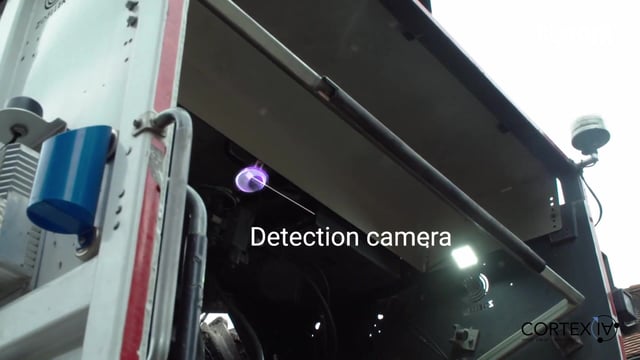
Around the world, we're seeing road fatalities going back to pre-pandemic numbers. And on many occasions, those deaths could have been prevented with a simple gesture like buckling up. According to the British government, in 2022, in the UK, about 21% of people killed on the road in cars weren't wearing their seatbelts. Distractions are a leading cause of accidents as well with phones being a part of the issue. In the UK, 16% of drivers admit to using their phone while behind the wheel. In the Devon and Cornwall area, to curb road fatalities, the Vision Zero South West Project was launched. Vision Zero South West is a collaboration of local authorities, the police service, the Fire Rescue service, the emergency responders... and our collective ambition is to reduce the number of people killed or seriously injured on our roads by half by 2030, and to eradicate road death by 2040. As part of that, we are keen to explore exciting new innovations to enable us to hold drivers to account and to bring a fear of detection, to change behavior. To do just that, the police have already installed speed cameras, license plate readers, and more recently, they tested out an AI solution by Australian company Acusensus that identifies drivers on their phones and/or not wearing a seatbelt. The solution is comprised of cameras mounted on a portable trailer that is placed on the side of roads. The trailers have two cameras, which are in an elevated position and they are using artificial intelligence software to detect if someone is not wearing a seatbelt or if they are holding a mobile phone. The computer detects the image, and then sends a photograph of the offense to a human being, based in another part of the country, who reviews it on behalf of the company. And it does one of two things. It either says, yes, you've got it right computer, in which case the information then is securely transmitted to the police to enable us to prosecute the offender, or it says, no, you got it wrong. And the software then machine learns, machine learning takes place so that the software becomes more intuitive over time. So initially there is a radar device which is used to trigger image capture. So you capture an image of the vehicle at exactly the right time because of the radar. And then there are a number of cameras which are pointing towards the vehicle. One of them at a very steep angle coming down like this, which allows it to look through the windscreen and tell if someone is holding a mobile phone by their lap. And then there is another camera which has more of a shallow angle, which allows you to see if someone is holding a phone to their ear. So these cameras are triggered by the radar and then in real time has artificial intelligence software, which runs on a graphical processing unit, very powerful image processing computer effectively, and that will in real time flag up if it thinks that a violation may have happened. Most of the work is done on site. The images are processed in the trailers and only those that have or might have caught someone on their phone or not wearing a seatbelt, are sent for analysis through cellular connectivity to AECOM, a partner of Acusensus. In August and September 2023, two trailers were installed in the Devon and Cornwall area, and used for eight weeks. In the first four, it had already detected 3500 seatbelt and mobile infractions. This solution was installed on two trunk roads, one with one lane and another with two. The main goal of the project is to change people's behavior, which is why, rather than leaving the solution fixed on a pole, it's on a trailer. The solution has been used in Australia’s New South Wales since 2019, and the state has seen the number of people who were distracted while driving go down by a factor of six. The trailers we're using, they are large, relocatable, fully self-contained trailers, so they have solar power and rechargeable batteries and a telescopic mast which carries the camera and the processing equipment and it holds it at exactly the right position above the road. So you get a really good clear image of the potential offending behaviors. And the idea of the trailers is that they can be put pretty much anywhere. So you don't need to have a a column or a bridge or a parapet. You can literally put the trailer at the side of the road at a safe location anywhere, and then monitor the behaviors that you're interested in. So we wanted the ability to be flexible in terms of our enforcement so what you don't want to do is leave something in situ for a period of time and then people get used to it being there and they behave for that small section of route, but not the wider thing. I think the unpredictable scene, the flexibility of the technology is what attracted us to it. As we've said in many videos, it's key to have a return on investment on smart solutions to help fund them. In this case, the return on investment is quite clear, and it's not from issuing tickets, as in the UK, the money from fines tends to go to the central government, which isn't the one driving the schemes. To pay for the solution, which has a subscription based model, meaning the police pay a certain amount a month to have the trailers deployed and transported as it's all included, the Devon and Cornwall police are using the money that they collect from individuals attending driver education courses. These courses are an alternative to the fine and points off the driver's license. Funding also comes from the costs awarded to the police following prosecution in court. So the money is that recovered from individuals who've been caught committing traffic offenses. The return on investment has allowed them to plan for a longer deployment. The police can't be everywhere. And these these cameras are there 24/7, and we've experienced no downtime with the software. So it's been working flat out and it's been just giving us an insight into the extent of the problem. The plan then is to deploy it throughout 2024 and we can move the trailers around according to intelligence where we know there are issues so we can mix it up between rural and urban routes, commuter routes in 2024 and then we've got the ability to increase that posture, carry on on a more permanent basis. But we wanted to put it in for a sustained period to evaluate whether it does have a long term impact on behavioral change. During our interview, Adrian told me that many UK local police authorities have asked him about the project, as they're looking to adopt traffic enforcement solutions, which means there are opportunities for these types of schemes. We've observed very clear ROIs in mobility in traffic enforcement, which is why we are seeing more and more smart projects in the field, as it can be easier to find the funding to keep them going and incorporate them into everyday decision-making, making projects more resilient.
How the UK’s South West is Harnessing AI for Safer Roads
Road fatalities are going back to pre-pandemic numbers and on many occasions, those deaths could have been prevented with a simple gesture, like buckling up or not looking at the mobile phone. In the Devon and Cornwall area in the UK, to make sure drivers are wearing their seatbelts and aren’t distracted behind the wheel, police deployed an AI-enabled solution by Acusensus that uses radar and cameras to catch rule breakers, find problematic areas and change driver behavior to make roads safer.
In this video we discuss this project, part of the scheme Vision Zero South West, with Adrian Leisk, Head of Road Safety at Devon and Cornwall Police, and Geoff Collins, UK General Manager for Acusensus.
View transcript auto-generated










📰 Latest News
🎬 Kurrant Originals
🎥 Recent Event Coverage


Featured Case Studies
Real client work behind the news. Strategy, M&A and engineering projects we've delivered for cities and utilities.

Stay in the Loop
Get smart cities and utilities insights delivered your way. Choose your channel
Join our WhatsApp Channel