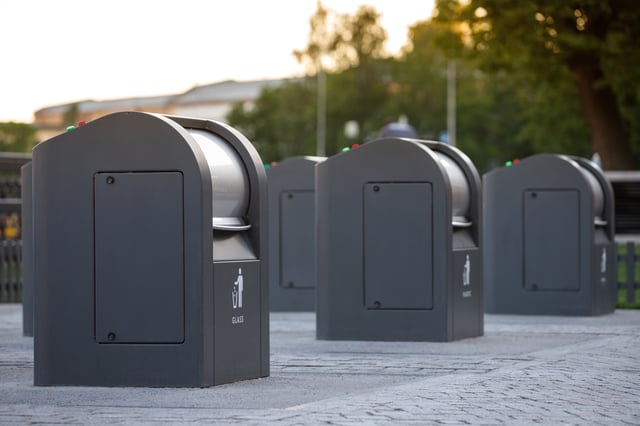
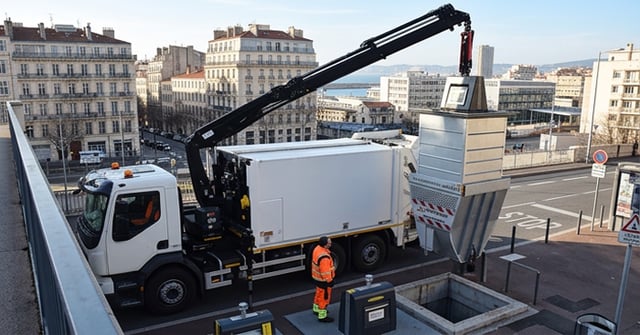
Sheffield City Council has rolled out 35 solar-powered compacting waste stations across the city centre, marking a notable step in its efforts to reduce diesel-fuelled collection runs and improve street cleanliness. The units, manufactured by US-based Bigbelly and distributed in Europe by Future Street, were installed in March 2026 under the city’s long-running Streets Ahead highways contract operated by Amey.
Off-Grid Compaction in a City Chasing Net Zero
Each station operates entirely off-grid using integrated solar panels that power an internal compaction mechanism. A photo-eye sensor inside the unit monitors fill levels in real time and triggers compaction automatically as waste accumulates. According to the council, the technology allows each bin to hold roughly five times the volume of a conventional street litter bin, which the council says reduces unnecessary collection trips by more than 80%.
The bins also feature LED indicators that signal their fill status to passers-by and transmit data wirelessly to waste management teams at Amey. Rather than dispatching crews on fixed schedules, collections are now triggered only when a bin actually needs emptying. The fully enclosed design should prevent access by pests and contains odours, while a foot-pedal opening mechanism eliminates the need for hand contact.
Why Sheffield, and Why Now
Sheffield declared a climate emergency in 2019 and has committed to reaching net-zero emissions by 2030, a target that independent analysis by consultancy Ricardo and engineering firm Arup identified as requiring a 95% reduction from the city’s 2019 baseline. Decarbonising the council’s own operations, including its vehicle fleet and those of key contractors, is a stated priority in the city’s published decarbonisation routemaps.
The council’s fleet, including vehicles operated by Amey and waste contractor Veolia, accounts for approximately 3% of the local authority’s total emissions. While modest in absolute terms, Sheffield’s routemap explicitly calls for the council to lead by example on vehicle emissions as a catalyst for wider behaviour change across the city.
Deploying smart bins that significantly reduce how often heavy diesel collection trucks need to circulate through the city centre aligns with that objective. It also complements other recent waste infrastructure investments, including the council’s separate rollout of larger 240-litre recycling bins to all households in March 2026, part of the UK government’s Simpler Recycling reform programme.
The Streets Ahead Contract and Amey’s Role
The bins were procured and installed by Amey under the Streets Ahead contract, a 25-year private finance initiative (PFI) agreement signed in 2012 that covers the maintenance and management of Sheffield’s roads, pavements, street lighting, and street furniture. The contract, valued at approximately £2.2 billion, has faced significant public scrutiny in recent years over road resurfacing quality and the controversial felling of thousands of street trees during its early phase.
The smart bin deployment represents a more forward-looking application of the contract’s scope. The council has not publicly disclosed the cost of the 35-unit installation, though reporting by The Sheffield Star notes that similar deployments by other UK councils have typically cost upwards of £4,000 per unit, with annual maintenance fees around £180 each. If those figures are indicative, the total capital outlay for Sheffield’s deployment would be in the region of £140,000.
Bigbelly’s Expanding European Footprint
Bigbelly, headquartered in Needham, Massachusetts, has been deploying solar compacting bins in public spaces since the mid-2000s. Its European operations are managed by Future Street, which reports operating more than 10,000 Bigbelly units across the continent through offices in Ireland, the UK, France, Germany, Italy, and Spain.
In the UK alone, Bigbelly units are already operational in London boroughs including Newham, Islington, and Croydon, as well as in cities like Leeds and Darlington. Croydon Council invested £1.3 million in a wider street cleansing programme that included Bigbelly installations and reported a reduction in bin collections from 10,000 to 2,600 per month. Future Street also recently deployed units at The Walton Centre NHS Foundation Trust in Liverpool and expanded installations in Malaga, Spain, where the city now operates more than 120 Bigbelly stations.
Kurrant has previously profiled the company’s origins in a feature on Bigbelly’s founders Jeff Satwicz and Jim Poss, who conceived the solar-powered compactor concept while students at Babson College and Olin University.
A Growing Market, but Questions Remain on ROI
The economic case for smart bins is not universally straightforward. The capital cost per unit is substantially higher than a conventional litter bin, and long-term savings depend heavily on collection frequency reductions materialising at scale. Councils that have adopted the technology generally report operational savings of 70-80% on collection logistics, though those figures are often cited by the vendor ecosystem and independent verification across UK local authorities remains limited.
For Sheffield, the 35-unit deployment is modest relative to the city’s total public waste infrastructure. Whether it expands to a wider rollout will likely depend on measurable performance data from this initial phase, particularly around collection frequency reductions and net cost savings once maintenance fees are factored in.