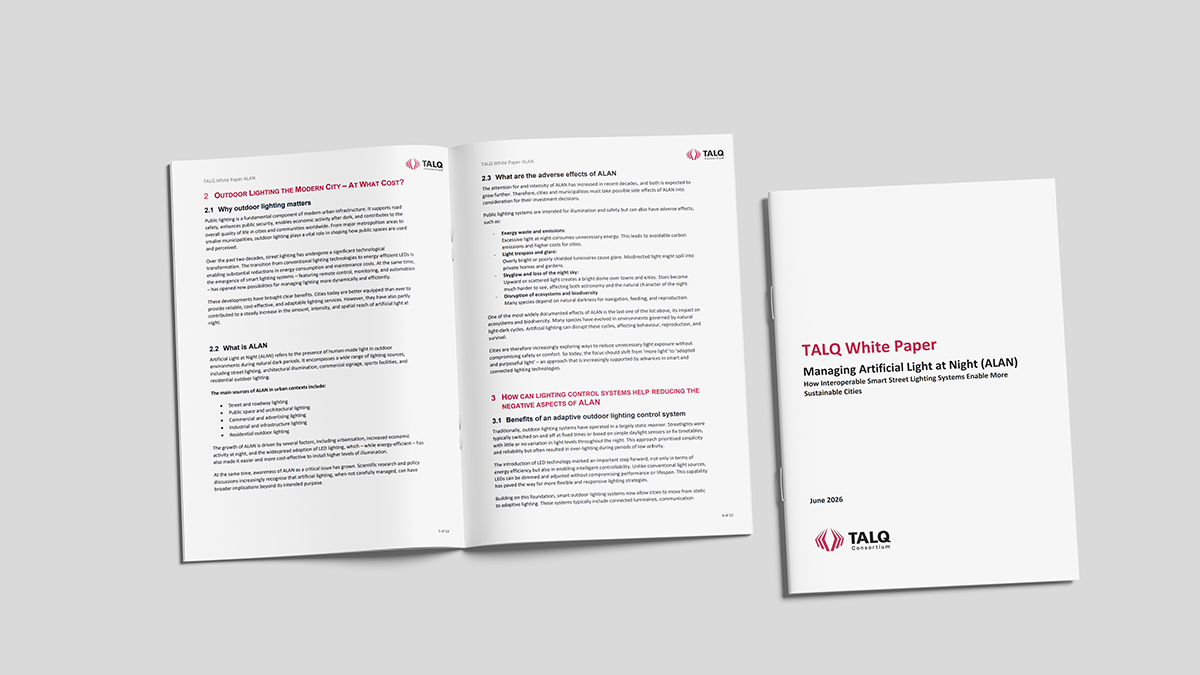
TALQ Consortium, the standards body behind the Smart City Protocol, published a white paper on June 16, 2026 addressing how cities can better manage artificial light at night (ALAN). While outdoor lighting remains essential for safety, mobility, and economic activity, growing evidence shows that excessive or poorly managed illumination carries unintended consequences for ecosystems, energy budgets, and urban quality of life. Interoperable smart street lighting systems, the paper argues, give cities the tools to introduce adaptive strategies and adjust light levels in real time rather than operating on fixed schedules.
ALAN Is Reshaping How Cities Think About Outdoor Lighting
ALAN is an increasingly recognised challenge for municipalities worldwide. A growing number of cities are re-evaluating how outdoor lighting is planned, operated, and integrated into broader urban systems, weighing public safety against the need to protect biodiversity and reduce unnecessary emissions. The core question the paper poses is deceptively simple: how do you dispense light more intelligently, providing the right light, at the right place, at the right time?
Light pollution is growing at an estimated 2.2 percent per year globally, with satellite data showing nighttime brightness increasing nearly 10 percent annually in the visual spectrum in some regions. DarkSky International estimates that at least 30 percent of all outdoor lighting in the United States is wasted, costing roughly $3.3 billion and generating 21 million tons of CO2 each year. A November 2025 study in Nature Climate Change, drawing on 86 monitoring sites across North America and Europe, found that ALAN measurably disrupts ecosystem carbon exchange by elevating nighttime respiration rates.
Adaptive Control Systems as the Practical Response
The white paper, titled Managing Artificial Light at Night (ALAN), explains how outdoor lighting control systems can reduce the negative effects of ALAN while preserving safety outcomes. Dynamic dimming, spectral adjustment, sensor-based response, and seasonal scheduling are among the capabilities covered. It also provides guidance for cities, utilities, and other stakeholders on integrating ALAN considerations into urban planning and procurement policy.
“With our latest paper we aim to support cities in finding flexible solutions to address the contradictory needs for public safety, protecting nature and acting in a sustainable and responsible way,” said Simon Dunkley, Secretary General of the TALQ Consortium, in the June 2026 press release. “Dynamic dimming and the variation of the light spectrum are only two examples out of a large bundle of options offered by smart adaptive lighting solutions.”
Interoperability Turns Capability Into City-Wide Strategy
Technology alone is not sufficient if a city’s lighting network runs on incompatible vendor platforms. The TALQ Smart City Protocol addresses this by providing a RESTful, JSON-based OpenAPI specification that allows a single central management software platform to control outdoor device networks from different manufacturers simultaneously. As Kurrantly News has previously reported, the February 2026 release of TALQ Protocol version 2.7.0 tightened alignment with the DALI Alliance and the Zhaga Consortium, creating a cleaner data pipeline from the luminaire level up to the city management platform. As of October 2025, the certification program covered 74 products from 47 vendors, with consortium membership at 82 companies across 24 countries.
The white paper is available as a free download from the TALQ Consortium’s website.