in Barcelona
 3 to 5 Nov 2026
The Gobierno de Hermosillo has switched on a remote streetlight management system covering 963 LED luminaires along the Solidaridad and Ganaderos boulevards, a pilot the Sonora state capital presented on July 12, 2026 as the second phase of a broader public lighting overhaul. Mayor Antonio Astiazarán Gutiérrez and Carla Neudert Córdova, director of the city’s Agencia Municipal de Energía y Cambio Climático (AMECC), reviewed the deployment alongside representatives of suppliers Signify and DLUZ. The city says it aims to reach 1,490 networked control nodes across additional sectors during 2026, framing the effort primarily as an energy cost measure in a country where street lighting is among the most expensive municipal electricity uses.
A Pilot Anchored To Two High-Traffic Arterials
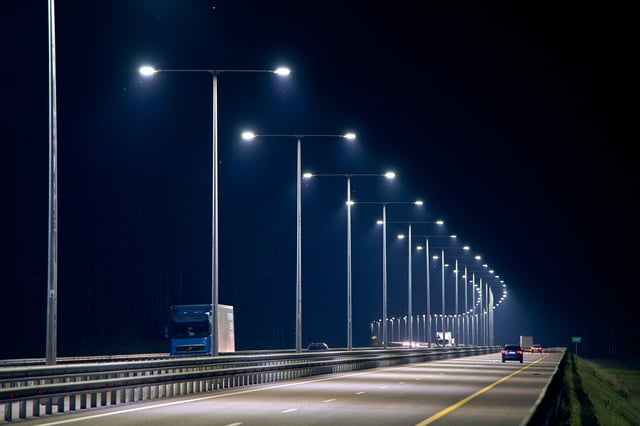
The first stage concentrates on Solidaridad and Ganaderos, two of Hermosillo’s busier boulevards, where the 963 fixtures now report status to a central software platform. Officials describe the system as capable of monitoring performance in real time, scheduling automatic on and off cycles, and flagging faults remotely so crews can respond without routine physical inspections.
Concentrating an initial rollout on major corridors is a common approach. It lets a municipality validate connectivity and software workflows on a bounded, high-visibility footprint before expanding.
How Telecells Convert Fixtures Into A Managed Network
The technical core is a telecell, or networked photocontrol node, fitted to each luminaire. These nodes communicate with a central management platform to form what the city calls an intelligent network, replacing standalone photocells that simply switch a lamp on at dusk.
The added capability that matters for operating budgets is dimming, which the municipality refers to as dimerización, reducing output during low-demand overnight hours rather than running every fixture at full power all night. Remote fault detection is the other lever, since it collapses the time between an outage and a repair and cuts the fuel and labor of patrol-based inspection.
Signify And DLUZ Supply The Control Layer
Signify, the Netherlands-based lighting group spun out of Philips, supplied technology for the pilot together with DLUZ. Signify markets its connected street lighting under the Interact City platform, which the company says manages lighting through map-based dashboards and has been deployed in over a thousand cities, with the firm repeatedly ranked a market leader in smart street lighting by analyst house Guidehouse Insights.
The company states that moving from conventional lamps to connected LED control can cut lighting-related energy use by up to 80 percent. DLUZ appears to act as the regional supply and integration partner on the project, though public detail on the company and on the specific platform configuration used in Hermosillo is limited.
Building On A Completed Sodium-To-LED Conversion
The remote management layer sits on top of a lamp replacement program the city says it has finished, moving its public lighting entirely to LED after retiring older high-pressure sodium fixtures. AMECC had earlier put Hermosillo’s stock at roughly 67,000 luminaires, of which about 65,500 were already LED by late 2022, according to reporting on the agency’s modernization plans.
The efficiency case is concrete, with the LED switch credited by Grupo Milenio with a 21 percent cut in the city’s electricity spending and a 35 percent reduction in consumption. remote management is intended to extend those savings through scheduling and dimming.
The Mayor Frames Lighting As An Energy Strategy
Astiazarán tied the pilot to a longer-running municipal push on energy, which in Hermosillo has also included residential solar programs. “I have always believed that it is going to be cheaper to save energy than to generate it, so many of the efforts we have made in the Municipal Government are about how we save energy, and one of the most expensive rates we have, not only in Mexico but in the world, is public lighting,” said Antonio Astiazarán Gutiérrez, Mayor of Hermosillo, at the program’s July 2026 presentation.
The city has not published a cost figure or contract value for the telemanagement deployment.
Mexican Cities Accelerate The Move To Remote Lighting Control
Hermosillo joins a wider wave of Mexican municipalities adopting remotely monitored and controlled street lighting, a shift market researchers link to sustainability targets, energy costs, and federal efficiency incentives. Analysts tracking the country’s lighting-as-a-service market describe public infrastructure as one of the strongest deployment opportunities, as cities replace aging equipment with systems that can be dimmed and diagnosed from a dashboard.
Street lighting is widely treated as an entry point to broader smart city buildout, since the pole network can later host sensors and connectivity.