FlexyGrid S.r.l., an energy flexibility aggregator with its registered office in Bolzano and its operating base in Rome, announced on 24 September 2026 that it has closed a €750,000 seed round. According to BeBeez, two thirds came from foreign private investors and one third from TechBricks, the Rome venture builder that conceived and co-founded the company.
The entire amount will fund the software platform that FlexyGrid uses to bid distributed batteries, chargers and industrial loads into the local flexibility markets that Italian distribution system operators are now testing.
The round follows a €500,000 pre-seed and grants from EIT Digital, the I-NERGY EU project and the Horizon 2020 Block.IS programme, according to BeBeez. That puts disclosed equity at €1,250,000 for a company formally incorporated in 2023.
An Asset-Light Aggregator Registered On The GME Flexibility Platform
FlexyGrid describes itself as a balancing service provider accredited with the Gestore dei Mercati Energetici (GME), the state-owned electricity market operator. According to Areti, GME runs the auction platform for Italy’s local flexibility markets, known as MLF, on behalf of the distribution companies.
That accreditation is distinct from qualification with Terna, the transmission system operator, which buys national balancing capacity through virtual aggregated units known as UVAM. The September announcement does not say whether FlexyGrid holds a UVAM portfolio on Terna’s dispatching services market.
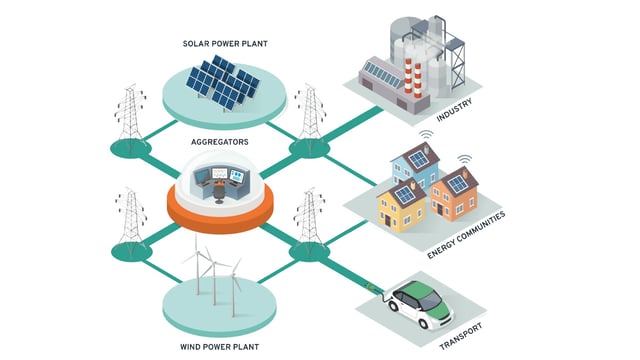
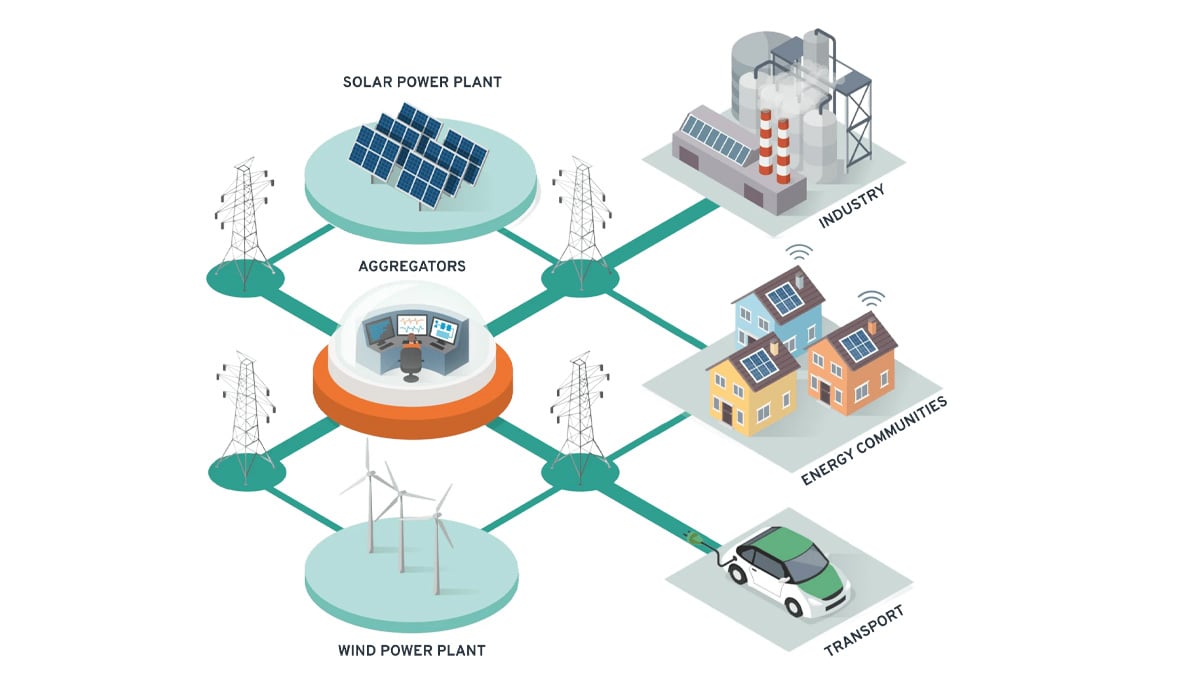
The platform aggregates storage systems, electric vehicle charging stations, heat pumps, photovoltaic plants and modular industrial loads, then bids their availability into flexibility and grid-service markets, according to Teleborsa.
The company says its optimisation runs on machine-learning models fed by IoT metering, with blockchain used to certify the measurement data. It owns no generation or storage assets and takes no market risk, routing revenue instead to the asset owners it enrols.
FlexyGrid names Edison and E.ON Italia among its clients and commercial partners, according to Startupbusiness. Neither the value of those contracts nor the megawatts under management has been disclosed, and the customer claims are company-supplied and unaudited.
Three Distribution Pilots Under ARERA Resolution 352/2021
The regulatory opening for aggregators of this type is ARERA resolution 352/2021/R/eel, which launched experiments with local flexibility markets, as set out in Unareti’s MiNDFlex documentation. The aim is for distribution operators to buy congestion relief from customers instead of reinforcing cables and substations.
FlexyGrid says it is accredited on all three active pilots. RomeFlex is run by Areti in Rome and Formello, MiNDFlex by Unareti across Milan and parts of Lombardy, and EDGE by E-distribuzione at national scale.
Enel describes the EDGE and RomeFlex schemes as paying customers a fixed availability fee plus a variable fee for each activation.
Areti states that RomeFlex was approved under ARERA resolutions 372/2023 and 121/2024/R/eel, then extended by resolution 527/2025 through 2026 and beyond. ARERA resolution 140/2026 of 28 April 2026 widened MiNDFlex to Unareti’s entire network and added reactive power as a tradeable service.
The company is also finalising entry to LiveGrid, the pilot that AcegasApsAmga presented in Trieste on 10 September 2026. LiveGrid remains in public consultation, and the utility plans to study an extension to Gorizia in 2027.
Kurrantly previously reported on the same utility’s grid digital twin project with Siemens in Trieste, which forecasts congestion on the network that LiveGrid is designed to relieve through market procurement.
What The Pilot Auctions Have Actually Cleared
Volumes in the pilots remain small and prices have swung widely, based on auction results compiled by the research institute RSE.
RomeFlex auctions between 2023 and 2026 accepted between 3.0 MW and 37.4 MW. Average availability prices ranged from €25,508 to €77,965 per MW per year, and average activation prices from €173.37 to €307.20 per MWh.
MiNDFlex auctions in 2024 and 2025 accepted between 9.1 MW and 112.8 MW. Average availability prices ran from €30,000 to €485,929 per MW per year, a spread consistent with thin participation setting the price in individual sessions.
GME had organised 61 auctions across two pilot projects by September 2026, according to Servizi a Rete. That is a small number of clearing events for any aggregator to build a revenue record on.
For scale, Terna’s Lightbox reported that by December 2021 more than 220 UVAM units totalling about 1,280 MW across 1,072 delivery points had been awarded to 17 balancing service providers. Distribution-level flexibility is meant to complement that national market, not replace it.
Hydrogen Storage Grant And A Pre-Series A Target Of €3 Million
FlexyGrid says it secured more than €1.1 million from the Ministry of Environment and Energy Security under the National Recovery and Resilience Plan for HyFLEX. The project combines hydrogen power-to-power storage with flexibility in distributed self-consumption schemes, and its total cost is €3.24 million, as reported by BeBeez.
Project material from the University of Molise lists the university as project leader, with FlexyGrid and Hybitat as partners. Funding comes from PNRR Mission 2, Component 2, Investment 3.5 under a decree dated 13 December 2024, and the work targets renewable energy communities in inland southern Italy.
The company was also selected by Lazio Innova to join the Lazio region’s collective stand at Smart City Expo World Congress 2026 in Barcelona in November.
It plans a pre-Series A round of about €3 million in the first quarter of 2027 to expand into further Italian flexibility markets and selected European countries.
“We are the operator that combines full regulatory accreditation with a multi-market software platform, and this allows us to be a neutral enabler for utilities, ESCos, storage developers and large industrial users,” said Cristian Cavazzuti, Chief Executive Officer at FlexyGrid, in the company’s September 2026 press note, as published by La Mia Finanza.
The Revenue Question Behind The Accreditations
Accreditation on three pilots is an entry ticket open to any provider that meets each operator’s registration rules, so it says little about commercial traction. The figure that will shape FlexyGrid’s pre-Series A valuation is the one the announcement omits: how many megawatts it has actually cleared in RomeFlex, MiNDFlex and EDGE auctions, and whether pilot-stage availability payments can support an asset-light model once ARERA turns these experiments into permanent rules in the integrated dispatching code.