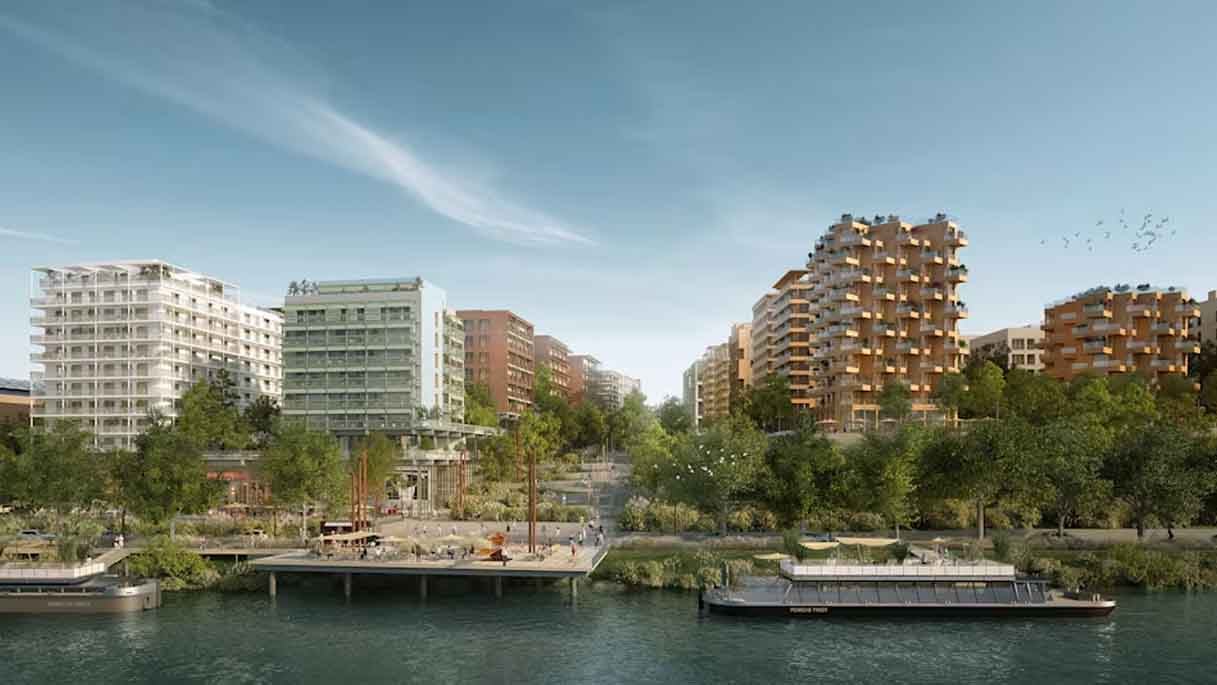
Paris Olympic Village Testbed for Future-proof Cities
The Paris 2024 Olympics brought some 11 million visitors to the French capital, all ready to watch the biggest show in sports. The city had been preparing for the Games for years, an event that would see smart city and utility solutions claim a position as enablers of the capital’s 2050 vision. Paris police used AI-enabled cameras for safety as well as crowd monitoring. And managers relied on sensor technology and innovation to operate one of the Games' key locations: the Olympic Village in the Seine-Saint-Denis department.
In this video we interview Michele Dominici, in charge of innovation at the Olympic Delivery Authority Solideo, to discuss how they developed the Olympic Village to be future-ready, which smart city and utility solutions they deployed, and how these became enablers of the vision.
View transcript auto-generated
The Paris 2024 Olympics brought some 11 million visitors to the French capital, all ready to watch the biggest show in sports. The city had been preparing for the Games for years, an event that would see smart city and utility solutions claim a powerful position. Paris police used AI-enabled cameras for safety as well as crowd monitoring. And managers relied on sensor technology and innovation to operate one of the Games’ key locations: the Olympic Village in the Seine-Saint-Denis department. The City of Love set out to create a residence for athletes for the games, but also, a neighbourhood for the future, an area that would still be functional in 2050. All through Solideo, the Olympic Delivery Authority that oversaw the infrastructure works for the games, a revamp of the area and an innovation budget of 48 million euros, 1% of the 4.8 billion euros allocated for the Olympics. That allowed any stakeholders, or in the construction process of the Olympic structures, to ask us for financial aid in building innovations that would be sustainable and reproductible, meaning that we don't want to make a demonstration out of the Olympic Village. We wanted to help innovative solutions grow and become viable through the Olympic Village. So we wanted it to be a place for experimentation. And thus the Innovation and Ecology Fund was there to help people with ideas and projects create and build new prototypes and install them in the Olympic Village to create new offers, new products. Future proofing the Olympic Village meant Solideo had to focus on environmental issues. Water and energy were key in the buildings. To save water, in one of the buildings, they created a system that reuses 100% of the wastewater generated, which is cleaned on-site and used for irrigation for example. This reduced potable water consumption by 60%. To save energy in the buildings, instead of deploying regular AC, they used a geothermal system in which water is used to cool and heat the homes. They also deployed solar panels with IoT devices to monitor them. Buildings were made smart with the use of air quality sensors to analyze CO2 or pollutants and a digital twin to optimize resources. All this, inside. But Solideo was also in charge of the outdoor space, and with 2050 temperatures in mind, heat islands became a major focus when planning the village. So the first solution we installed in the public space is called Cool Ground, which is a system that allows to cool the floor by using rainwater reservoir that are stored water during the winter. And then during the summer you can use a permeable paving made from crushed seashells. The water that you stored during the winter you make it flow inside this paving. And the evaporation creates a cooling. So, for this, the temperature and also the the feeling of heat is always reduced. To understand the environment in the village and know when these actions are needed, Solideo deployed two years ago temperature, humidity, air quality sensors by KUNAK… the data of which is analyzed, in partnership with the research alliance Institut Pierre-Simon-Laplace, and combined with satellite data for a complete view of the village and even the behaviour of wind. When talking about heat islands, green spaces, and particularly trees, are essential to curb their effects. But trees need to be well watered to absorb heat and release the evaporation that cools the environment. So Solideo installed a smart irrigation solution by Urbasense to know when water is needed and exactly where, saving water while keeping plants happy. With an innovative company which installed several tens of sensors all over the Olympic Village, inside the soil to, see the moisture and the humidity of the soil, but also, with an innovative technology based on data, they can identify where the roots of the trees are located depending on the growth of the tree. and thus, you can provide just the necessary water to reach the roots, not more, not less. Biodiversity also plays a role in the future-proof neighbourhood. The project saw the installation of biodiversity sensors like Birdz’s LEKO, which, through sound and artificial intelligence, can monitor and recognize the different species of animals, whether birds or insects, in the area and give details of the state of wildlife. This project is set to lead to the deployment of smart and adaptive lighting to protect the wild neighbours of the Olympic Village. Michele told me there were some 100 sensors deployed just outdoors, the data collection of which is managed by VerticalM2M’s IoT platform that then feeds into ATOS’ smart city platform, with the end goal of sending all the information to the different city departments and organizations like AIRPARIF, who will take the necessary steps to face the environmental problems. We acquired a platform to collect all the data coming from different sensors. As I said, it was the moisture sensors in the ground, weather sensor, air quality, even biodiversity sensors, have been installed to follow the development of biodiversity. All this is aggregated in a unified platform that is used by the researchers in particular, and in the future we want to use more use cases, to promote this data coming from the sensors. The Olympic Village project is an example of a combination of good city resiliency and sustainability practices and digital tools. The digital tool is an enabler, but not the star of the show, it would be useless on its own. It proves how solving a problem needs to be the focal point of a digital tool, not just deploying solutions for the sake of having fancy technology. Although the Olympic works are not perfect, many athletes complained about how hot it was in their rooms and ended up buying portable AC machines, Olympic Villages are a perfect place to test smart solutions, especially considering the great budgets that go into them. For the Paris Olympic Village they reused infrastructure that was already there, so the technology deployed and tested will work in most cities and not just new ones designed specifically to face environmental issues. Solideo is still testing solutions and working on a transition as well as business models for different stakeholders, to try and make the area thrive and not let the budget and solutions go to waste.


📰 Latest News
🎬 Kurrant Originals

🎥 Recent Event Coverage

🎯 Featured Case Studies
Real client work behind the news — strategy, M&A and engineering projects we've delivered for cities and utilities.
Stay in the Loop
Get smart cities and utilities insights delivered your way. Choose your channel
Join our WhatsApp Channel