Editor’s note: This article has been updated following outreach from Derq to include clarification on what the SENSE platform does and does not do. The system is not a facial recognition or licence-plate recognition technology and is not designed to identify individuals.
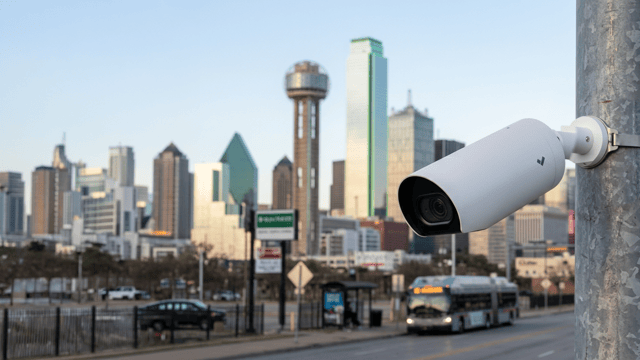
Houston City Council voted on May 13, 2026 to spend $350,000 on 10 AI-powered video detection cameras to be installed along the Almeda corridor, a stretch of road that will link FIFA fan events in East Downtown to NRG Stadium during the 2026 FIFA World Cup. The approval marks the city’s second procurement of AI camera technology in a short period, and it drew a pointed warning from at least one council member about the risks of mass surveillance.
A Corridor Under Pressure
Almeda Road runs through the southern part of Houston and connects several of the city’s key cultural and residential districts to the stadium area. During the tournament, which runs from June 14 to July 4 at the venue temporarily renamed Houston Stadium, the route is expected to carry significant volumes of fan traffic, particularly on the six noon-kickoff match days. Houston’s host committee projects that the tournament will draw roughly 500,000 visitors to the city and generate an estimated $1.5 billion in regional economic impact.
The corridor has 10 traffic lights in sequence, making it a logical candidate for coordinated signal management. The city’s council agenda identified those 10 signalised intersections but did not specify which ones would receive the cameras or when installation would be completed.
Derq Technology Procured Through MoboTrex
City procurement documents identify the video detection system as Derq, sourced through MoboTrex, LLC, a North American supplier of intelligent transportation system equipment. Derq, an AI-focused intelligent transportation company, markets its SENSE platform as a tool for real-time detection and classification of vehicles and pedestrians, adaptive signal coordination, and predictive intent modelling. The company states on its website that the platform can anticipate road user behaviour up to two seconds ahead of a potential violation, feeding that information to traffic operators and signal controllers to reduce congestion and prevent collisions.
Derq and MoboTrex have clarified that the system is not a facial recognition or licence-plate recognition platform and is not designed to identify individual drivers, pedestrians, or cyclists by name or personal identity. Its stated purpose is to analyse roadway movement patterns and safety events, not to collect personally identifiable information or issue violations. Derq is also SOC 2 Type II certified, a data security and operational standard relevant to the privacy debate that has surrounded the Houston purchase.
MoboTrex, which builds and services American-made smart mobility and traffic management equipment for departments of transportation and system integrators, has an established customer base across the United States. This is not Houston’s first engagement with AI-assisted traffic infrastructure: the council approved more than $715,000 in April 2026 to deploy an autonomous traffic management platform across various city intersections, positioning the Almeda camera purchase as part of a broader technology push tied to World Cup readiness.
A Second AI Camera Purchase Raises Governance Questions
The vote did not pass without friction. Councilmember Alejandra Salinas used the session to raise concerns that went beyond traffic management.
“This, I believe, is the second set of AI cameras that we will be voting on to install, and while they do pose potentially great benefits to something like traffic management, they also pose a great risk of mass surveillance,” Salinas said during the council session, as reported by ABC13 Houston.
The concern reflects a wider pattern of public unease in Houston around surveillance technology. The city’s council approved a $178,000 agreement in 2024 to expand a Houston Police Department camera network, and a separate vote on license-plate reading cameras from Flock Safety also divided public opinion. The current Almeda purchase arrives in that context, with residents and elected officials asking who controls the data collected by AI-enabled street cameras, how long that data is retained, and whether it can be accessed by agencies beyond the traffic department.
Cybersecurity Risk Cited Alongside Privacy Concerns
Academic scrutiny added a technical dimension to the debate. Kailai Wang, an assistant professor of industrial and systems engineering at the University of Houston, told reporters that AI-based systems, while more capable than the fixed-cycle red-light cameras many cities still rely on, introduce new attack surfaces. Wang warned that unauthorised access to signal control systems could allow bad actors to manipulate intersection timing, create traffic hazards, or disrupt the grid during major events precisely like the World Cup.
Wang’s concern aligns with a broader pattern in smart city deployments globally. Kurrant has documented how Amsterdam halted plans for AI-adaptive traffic signals following intervention by the Dutch Data Protection Authority over insufficient privacy and cybersecurity impact assessments. The Houston situation echoes that dynamic, with scrutiny arriving after the vote rather than being formally embedded in the procurement process.
Neither MoboTrex nor the city of Houston responded to media requests for additional detail on data handling protocols or the specific intersections targeted for installation at the time of publication. MoboTrex has since provided clarification on the system’s data handling scope, as noted above.
Event-Driven Procurement in a Global Context
The Houston purchase is a relatively small deployment by the standards of national and international programmes. For comparison, Greece’s Ministry of Digital Governance launched a €93.8 million AI traffic camera network of 1,000 units earlier in 2026, a scale that reflects both the size of the national road network and the regulatory infrastructure needed to govern mass deployment. Kurrant has tracked that rollout in detail, including early enforcement data showing thousands of violations recorded within days of activation.
At the municipal scale, cities across the United States are increasingly reaching for AI-powered camera systems to address targeted operational problems. Dallas approved a $2.6 million contract to mount AI cameras on refuse trucks for code enforcement. Philadelphia deployed AI cameras on trolleys to combat illegal parking that disrupts transit operations. Bangkok’s city administration used AI signal control to achieve travel time reductions of up to 41 percent at 74 intersections, an outcome Kurrant examined earlier this year. These deployments illustrate both the performance potential and the governance variation that characterises AI traffic technology at the city level.
Transportation Pressure Mounts as the Tournament Nears
Houston is one of 16 host cities for the 2026 FIFA World Cup, which spans the United States, Canada, and Mexico, and is expected to be the largest edition of the tournament in history. The city will stage seven matches, including knockout rounds, at Houston Stadium between June 14 and July 4. METRO, the regional transit authority, committed $10 million in service upgrades for the tournament window, including higher frequency on the METRORail Red, Green, and Purple lines and expanded bus service across entertainment corridors.
Officials introduced the Green Corridor concept, a 14-mile integrated loop of rail and pedestrian paths connecting the EaDo Fan Festival, downtown Houston, and NRG Stadium, as the primary car-free travel spine. Despite that investment, congestion on road corridors like Almeda remains a planning concern, particularly given that six of the seven matches kick off at noon, concentrating inbound and outbound traffic into predictable two-hour windows. June hotel bookings are reportedly running more than nine percent ahead of the same period in 2025, and July bookings are up by around 11 percent, according to local hospitality data tracker Houston First.
Whether the Derq cameras will be operational by the time the first match kicks off on June 14 remains unclear. The city has not disclosed an installation timeline, and with the tournament weeks away, the procurement’s practical impact on World Cup traffic management may be limited regardless of the technology’s stated capabilities.