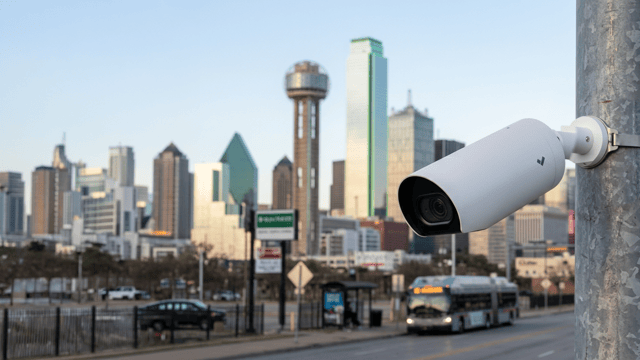
Virginia became one of the first states in the country to permit AI-powered cameras to automatically detect and issue civil citations for stop sign and crosswalk violations when Senate Bill 84 took effect July 1, 2026. Signed by Governor Abigail Spanberger earlier this year, the law allows localities to install cameras capable of issuing citations to drivers who disregard stop signs or fail to yield to pedestrians at crosswalks, particularly in school and work zones. Participation is optional, with local governments retaining full discretion over whether and where to deploy the systems.
SB84 Extends Virginia’s Automated Enforcement Authority Beyond Speed Cameras
Virginia has long permitted automated traffic enforcement, but until now that authority had been confined to speed cameras. SB84 expands that framework to cover automated detection of drivers who run stop signs or fail to yield to pedestrians at crosswalks, particularly in school zones. The legislation passed the General Assembly and received the governor’s signature on April 13, 2026.
The statute caps civil penalties at $100 and directs that any citation proceeds beyond what is needed to operate the enforcement systems be deposited into a local fund dedicated exclusively to traffic safety planning, bicycle and pedestrian safety, and systemic safety initiatives eligible under the Virginia Highway Safety Improvement Program. The bill also requires local law enforcement agencies to conduct a public awareness program before implementing or expanding these systems, and instructs the Supreme Court of Virginia to develop a standardized summons for violations captured by the authorized devices.
Program Is Fully Violator-Funded, With No Upfront Cost to Localities
Company officials say participation in the program is voluntary and local governments must choose whether to implement the technology. The program is structured as fully violator-funded, meaning citation revenue covers the cost of the cameras, with any surplus directed toward traffic safety uses under the legislation. That model is intended to remove a financial barrier to adoption for localities operating under constrained budgets, though it has also drawn scrutiny from critics who argue it creates a structural incentive to maximize citation volume rather than behavior change.
How Obvio’s Solar-Powered System Processes Violations
One company preparing to deploy the technology in Virginia is Obvio, whose solar-powered cameras can detect stop sign violations and failure-to-yield incidents. Company officials say the systems can also identify distracted driving and speeding, though only violations authorized under state law can be enforced.
The AI determines violations such as a driver blowing through a stop sign or entering a crosswalk with a pedestrian present. If a violation is detected, the system uploads a 30-second footage clip to the cloud for human review, and officers must approve a citation before it is sent. Footage that does not contain a violation is overwritten on the device almost immediately. The company says the AI also blurs the faces of anyone not involved in the traffic citation, and limits data collection to the specific hours of operation rather than recording continuously.
Virginia Traffic Study Documented Widespread Non-Compliance at Stop Signs
The enforcement framework is grounded in documented patterns of non-compliance. An Obvio-conducted study across 24 Virginia intersections found that roughly two out of three drivers are not stopping at stop signs. At a single all-way stop in Vienna, at Tapawingo Road and Ware Street SW, observers recorded 84 drivers running the intersection within a 20-minute window.
Virginia’s roads recorded 138 pedestrian deaths in 2025, according to Drive Smart Virginia, a state traffic safety organization. A Virginia Department of Transportation analysis further found that crashes involving pedestrians increased 43 percent in the state between 2020 and 2024.
Maryland Deployment by Obvio Produced a 70 Percent Reduction in Four Months
Virginia’s law follows a Maryland precedent that produced measurable results. Instances of vehicles running through stop signs in school zones dropped nearly 70 percent across five Prince George’s County communities after Obvio’s cameras were deployed, according to data released by the company in November 2025. The program emerged after a 2023 tragedy in which two children were struck and killed while walking to Riverdale Park Elementary School, galvanizing local leaders to act.
According to Obvio, the average daily volume of stop sign violations at the outset of the Prince George’s County program was 1,400. Officials in participating towns said the technology produced compliance rates that traditional enforcement could not replicate at comparable cost or scale. “Even if I put a cop at every stop sign, we’re not going to get a 50% reduction in violations like I’m getting now,” said Dan Franklin, police chief of Morningside, Maryland.
Obvio Has Raised $22 Million to Scale Nationally
Obvio announced a $22 million Series A funding round in June 2025, led by Bain Capital Ventures, with participation from Khosla Ventures and Pathlight Ventures. The company said it would use the capital to expand nationally and grow its team. Co-founders Ali Rehan and Dhruv Maheshwari previously worked together at Motive, where they built AI camera technology for commercial fleet safety, before applying the same computer vision approach to public intersection enforcement.
Lawmakers in North Carolina, Pennsylvania, and Delaware are also reviewing legislation that would authorize similar automated stop sign enforcement programs. The Virginia law’s passage positions the state alongside Maryland as an early regulatory template for other jurisdictions weighing AI-based intersection enforcement.
Privacy Architecture Sets Obvio Apart From Broader Surveillance Platforms
A persistent objection to AI camera systems is the scope of data they collect. Privacy concerns have emerged as one of the primary criticisms of AI-backed cameras. Obvio has structured its system to limit data retention to violation events only, contrasting with license plate reader platforms that upload all captured footage to centralized databases regardless of whether a violation occurred.
The company states that footage not associated with a violation is automatically blurred or deleted, and only the information necessary to process a citation is shared with municipalities and law enforcement. Law enforcement must review and approve each citation before it is issued, maintaining a human decision layer in the enforcement chain. Whether those safeguards satisfy civil liberties standards will likely be tested as localities begin opting into the program in the coming months