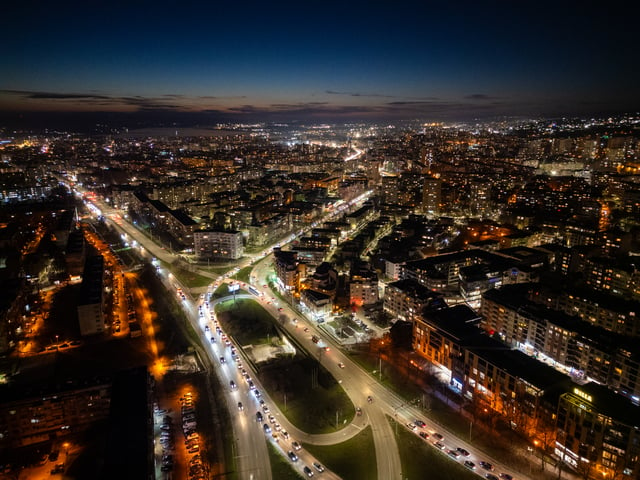
Bucharest City Hall has secured General Council approval for the technical and feasibility framework underpinning the first phase of a large-scale intelligent traffic signal programme, which will eventually cover 547 intersections and pedestrian crossings across the Romanian capital. The initial phase, advanced at the proposal of Mayor Ciprian Ciucu, covers 92 locations and will deploy 305 AI-enabled cameras and 1,500 sensors, with an implementation timeline of 14 months from the start of installation and commissioning.
A Phased Rollout Designed for City-Wide Scale
The project is structured in four consecutive phases. The first two, now formally greenlit through the approval of feasibility studies and technical-economic indicators, cover the 92-intersection sensor and camera deployment and the construction of a dedicated command centre. The command centre will be housed on the ground floor of the building that hosts the Bucharest Integrated Emergency Situations Centre, a co-location that signals the city’s intent to integrate traffic operations with emergency response infrastructure. That construction phase carries an eight-month timeline.
The remaining two phases, announced alongside the Council vote, will extend the programme to an additional 185 intersections, followed by a final tranche of 270 more locations. At full build-out, the system would make Bucharest one of the larger European capital cities to operate a unified, AI-managed traffic signal network at this scale.
What the Technology Does at Each Intersection
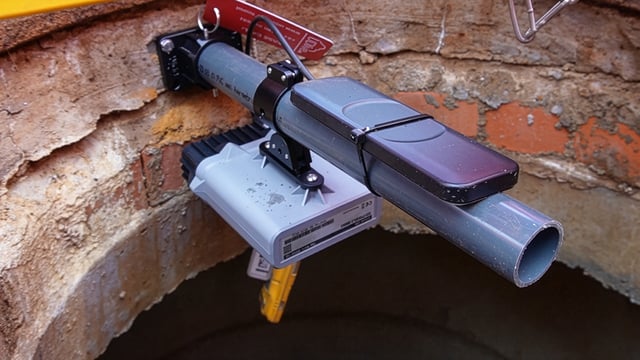
Each modernised intersection will be equipped with magnetometric sensors embedded directly in the asphalt surface as well as sensors mounted on poles, AI-enabled video cameras, traffic control automation hardware, and pedestrian-facing interfaces including push-button panels and acoustic devices for accessibility.
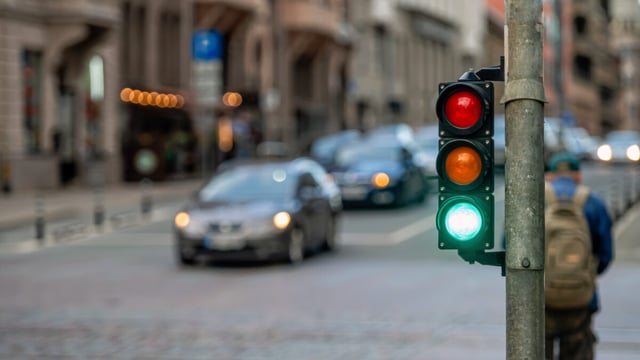
“It will be a complex AI system that synchronizes traffic lights, adjusts signal timing based on the number of cars, and independently makes decisions according to traffic levels,” Bucharest City Hall stated in its public announcement.
The system is specifically designed to give priority to public transport vehicles, allowing buses and trolleybuses to move through signalised junctions more efficiently and maintain schedule adherence. The stated objectives also include a measurable reduction in vehicle emissions across affected corridors.
Building on Earlier PNRR-Funded Infrastructure
This is not Bucharest’s first attempt at intelligent traffic management. Under the National Recovery and Resilience Plan (PNRR), the city had previously contracted works across 85 intersections along five radial routes out of the city centre, including Colentina Road, Alexandria Road, Iuliu Maniu Boulevard, the Bucharest-Targoviste Road, and Berceni. That earlier programme, with a total project cost of approximately €25 million split between non-refundable EU funds and municipal budget, also included the expansion of existing traffic centre capacity and the modernisation of around 185 additional intersections under a broader Bucharest Traffic Management System (BTMS) framework.
The current initiative approved by the General Council represents a distinct programme from that earlier PNRR tranche, and the city has indicated that future phases may draw on additional non-refundable financing mechanisms. The investment figure for the newly approved phase has not been disclosed in the available official documentation.
The Wider Urban Mobility Context
Bucharest’s traffic congestion problem is well-documented. With a metropolitan area of more than two million residents, the city experiences average speeds falling to between 10 and 20 kilometres per hour during peak periods, according to research published in the journal Urban Science drawing on TomTom corridor data. The same research, which modelled the impact of adaptive signal control across Bucharest’s north-western congestion zone, found that demand-responsive signal timing could meaningfully flatten peak-hour speed declines compared to fixed-time signal control, lending academic support to the city’s current direction.
The deployment also fits a broader pattern of European cities investing in AI-based signal management to address congestion and emissions simultaneously. Barcelona has similarly moved to deploy AI-driven smart traffic lights across 200 key intersections as part of its sustainable mobility strategy, targeting a 20% reduction in congestion. Elsewhere in the region, Western Romania received €34.12 million in Smart Region programme funding that includes smart city mobility components, underscoring a national shift toward digital urban infrastructure.
No vendor or technology integrator has been publicly named for the Bucharest programme at this stage. The approval of feasibility studies typically precedes a formal procurement process, meaning contract awards are likely several months away.