Spanish pipeline inspection specialist Aganova has secured a strategic contract from Ens d’Abastament d’Aigua Ter-Llobregat (ATL), the Catalan government-owned utility responsible for drinking water production and bulk supply across Catalonia, to conduct an advanced inline inspection of 74.83 kilometers of large-diameter transmission pipelines. The two-year project, awarded following a competitive tender in which Aganova earned the highest technical score, covers the Xarxa Nord and Xarxa Sud networks, two backbone segments of the infrastructure that delivers treated water to more than 100 municipalities and nearly five million residents in the Barcelona metropolitan area and surrounding regions.
A Network Under Growing Pressure
ATL occupies a singular position in Catalonia’s water governance architecture. Established under Decree Law 4/2018, the public entity draws from the Ter and Llobregat rivers, operates multiple treatment plants, and manages the bulk transmission infrastructure that feeds downstream municipal distributors. The Ter drinking water treatment plant alone carries a treatment capacity of eight cubic meters per second and, under normal conditions, provides roughly two-thirds of the Barcelona metropolitan area’s supply.
The system’s scale brings proportional risk. Catalonia ranked among the top Spanish regions for water losses in urban supply networks as recently as 2020, according to national statistical data. The broader context is stark: the European Investment Bank committed up to €260 million to ATL infrastructure improvements in late 2024, citing the need to modernize management, minimize losses, and strengthen resilience against intensifying drought cycles that have tested the region’s reservoirs repeatedly in recent years.
Where Surface-Level Detection Falls Short
For large-diameter transmission mains, conventional acoustic leak detection performed from the ground surface runs into hard physical limits. Burial depth, pipe diameter and material, and the distances between access points all degrade signal quality to the point where meaningful data is difficult or impossible to gather. This challenge is especially pronounced on strategic trunk mains, where the consequences of an undetected failure are measured not in drops but in millions of liters per day.
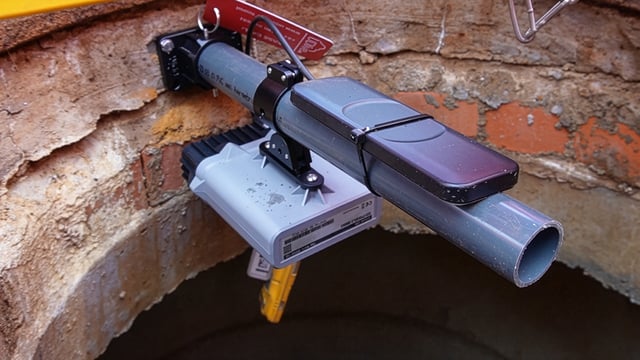
Aganova’s approach bypasses those constraints entirely by moving the sensor inside the pipe. The company’s wireless, acoustic, free-swimming inspection technology, the same platform the company has deployed across projects with Uisce Éireann in Dublin, with SEDIF across the Paris region, and with utilities in Brazil and the UAE, uses a neutrally buoyant spherical sensor that travels with the water flow, continuously scanning the pipe wall through 360-degree acoustic monitoring. The device can traverse up to 35 kilometers in a single deployment without interrupting service, capturing leak signatures, air pocket locations, and early indicators of structural deterioration. The ATL contract is not a new commercial relationship for Aganova. The two organizations previously collaborated on inspection work in 2015 and again in 2019, establishing a track record that informed ATL’s confidence in the technical proposal this time around.
Inline Inspection as an Asset Management Tool
Beyond leak detection, the diagnostic data collected during the 24-month project is intended to feed directly into ATL’s asset management decision-making. Identifying structural anomalies, air pockets, and deteriorating pipe sections with precise geolocation allows utilities to prioritize capital expenditure toward segments at highest risk, rather than applying replacement budgets across an entire network based on age alone. For a system operating under the scrutiny of EIB financing and a regional government focused on drought resilience, that kind of evidence-based planning carries material value.
The operational continuity aspect matters equally. Because the inspection is conducted while the network remains live, ATL avoids the service disruptions, revenue losses, and logistical complexity that would accompany any equivalent assessment requiring shutdowns. For a transmission system supplying millions of people, that constraint is not optional, it is a baseline requirement.
Aganova’s Expanding Footprint in Water Infrastructure Diagnostics
The ATL contract arrives during a period of deliberate international expansion for Aganova. In mid-2025, the company signed a five-year agreement with SEDIF to inspect approximately 800 kilometers of large-diameter feeder pipes across the Paris region’s 8,000-kilometer distribution network. Earlier, a partnership with Amazon Web Services, Sabesp, and Uniacque extended the company’s reach into Brazil and northern Italy. Kurrantly News previously reported on Aganova’s collaboration with Microsoft and the Mancomunidad de Aguas del Sorbe near Madrid, one of the earlier deployments that demonstrated the technology’s applicability within Spain’s water-stressed central regions, as well as on the São Paulo initiative targeting 64 kilometers of transmission mains with Amazon and Sabesp.
The company has also recently opened Aganova Labs, a controlled facility dedicated to testing and validating new pipeline inspection technologies before field deployment, a move that signals a transition from field-services provider to a more structured R&D operation. Aganova has been tracking water savings since 2016 and reports millions of cubic meters saved globally across its project portfolio.
Water Loss in Context
Spain’s non-revenue water rate has historically hovered around 24 percent of distributed volumes, according to national survey data. Across transmission networks specifically, losses tend to be concentrated in high-pressure trunk mains where detection has historically lagged. The urgency is heightened by climate dynamics: Catalonia has moved in and out of official drought emergency phases repeatedly since 2022, with the Ter-Llobregat reservoir system serving some six million people oscillating between recovery and stress with little margin for operational inefficiency.
Against that backdrop, the case for systematic, data-driven transmission main inspection has shifted from a best-practice aspiration to a near-operational necessity. The Aganova-ATL project represents one of the more substantial commitments to that approach within the Iberian Peninsula’s water sector to date.