in Barcelona
 3 to 5 Nov 2026
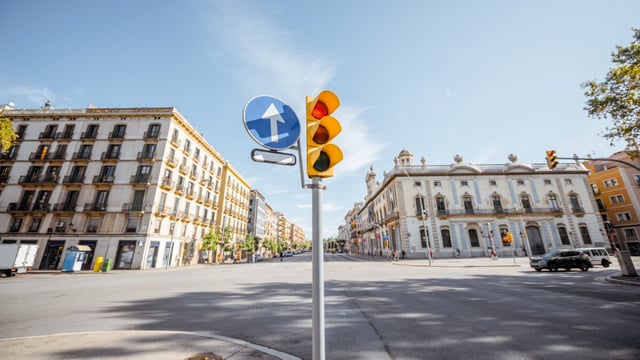
The Barcelona City Council, together with Fira de Barcelona and the Mobile World Capital Barcelona foundation, announced on 3 November 2026 that Kapsch and Acisa will each receive €100,000 to run four-month pilots of artificial intelligence applied to traffic signal control, with the trials planned for 2027. The selection came out of the latest challenge of the Barcelona Innova Lab Mobility, which received 26 proposals from companies and organisations in 14 countries, 19 of them international.
First Deputy Mayor Laia Bonet presented the result at Tomorrow Mobility, held during the Smart City Expo World Congress at the Fira venue in L’Hospitalet de Llobregat, according to Business Insider España. The pilots will run on corridors or zones with several intersections, and the winning companies must adapt part of the existing infrastructure and install the sensors needed to collect traffic data.
Two Approaches: Reinforcement Learning per Junction Versus a Corridor Digital Twin
The first project, Matcab, is proposed by Kapsch and uses reinforcement learning, a technique in which decisions improve through simulation and repeated experience. Each intersection gets its own agent that adjusts signal timing to local demand, while all junctions are coordinated so that congestion is not simply displaced from one area to another, according to Barna Diario.
Matcab can be configured with different regulation objectives and switched between them, including priority for pedestrians, priority for public transport and emergency modes for ambulances and fire services. It is designed to integrate with the signal infrastructure already in place. The total project budget is €358,185, of which the council contributes €100,000.
The second project, Mobia, is proposed by Acisa and builds a digital twin of the road network to predict how traffic will evolve and to coordinate the signals of a whole corridor. The twin receives real-time data from sensors and from vehicle-to-infrastructure communication, known as V2X, and feeds a central platform running multi-agent AI that changes signal cycles across intersections.
Mobia’s configurable priorities include pedestrian protection, public transport flow and reduced pollutant emissions. It requires minimal intervention on existing infrastructure and keeps the current regulation system as the reference against which results are assessed. Its total budget is €177,865, with the council funding €100,000.
Funding Split and Procurement Structure
Together the two awards commit €200,000 of municipal money against combined project budgets of €536,050, which implies that the companies and their partners carry €336,050 of the cost. That split is a calculation from the published budgets, and it shows the council paying 28% of Matcab and 56% of Mobia.
The pilots form what the council calls phase 0: an experimental stage intended to evaluate the technologies and draw conclusions before any wider deployment in the city. The work is carried out with the Universitat Politècnica de Catalunya (UPC), which in November 2025 signed an agreement with the council to study how AI could improve traffic signal management, according to Ara.
That UPC study, led by the university’s School of Civil Engineering with the Center for Research and Technology Hellas of Greece as collaborator, has four phases: assessing the current signal system, analysing strategies used elsewhere, designing proposals for Barcelona under the Urban Mobility Plan, and producing a short- and long-term roadmap. The pilots therefore sit between the academic assessment and any procurement of a city-wide system.
A Lab That Is Adding Transport Operators
On the same day, Transports Metropolitans de Barcelona (TMB) and the Autoritat del Transport Metropolità (ATM) were formally added as partners of the Barcelona Innova Lab Mobility, which until now has been driven by the council, Fira de Barcelona and Mobile World Capital Barcelona. The addition of the bus and metro operator and the metropolitan transport authority brings in the entities whose vehicles most depend on signal priority.
Business Insider reports the trials as taking place at the end of 2027, while Barna Diario describes them as running during 2027, so the exact calendar will depend on when the sensor installation in the test zones is completed. A minimum duration of four months per pilot means results would arrive no earlier than the first half of 2028 if the trials start late in 2027.
Both pilots will be judged against the performance of the existing signal plans on the same corridors, and Mobia’s design explicitly keeps that baseline running. The measure that will decide whether either system moves beyond phase 0 is therefore the change in journey times and public transport delays on instrumented corridors, compared against the current regulation, over a trial window of just four months.