in Barcelona
 3 to 5 Nov 2026
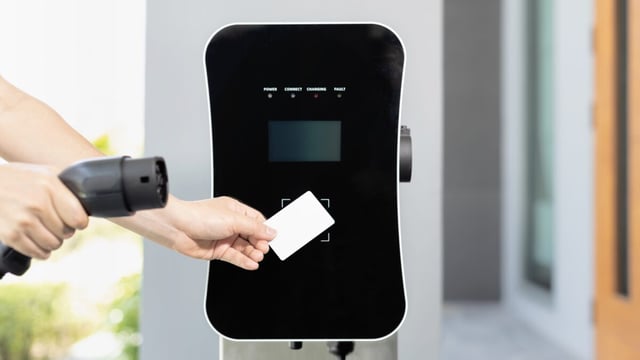
Operators of publicly accessible charging points rated at 50 kW or more that were installed before 13 April 2024, along the trans-European transport network (TEN-T) or in safe and secure truck parking areas, must equip them with a bank card reader or contactless payment device under the EU’s Alternative Fuels Infrastructure Regulation (AFIR), La Tribune Auto reported on 25 November 2026. France alone had 202,804 publicly accessible charging points on 12 October 2026, according to Avere-France, the national electric mobility association, and the ecological transition ministry.
Why: Charging Without A Subscription
AFIR, which has applied since 13 April 2024, aims to let drivers charge on an ad hoc basis without signing up with an operator or downloading an app. Since that date, every new public charging point of 50 kW or more has had to accept card or contactless payment.
The 2027 deadline extends the rule to part of the installed base. Fast chargers on the TEN-T road network and in safe and secure parking areas are covered. Chargers below 50 kW are excluded from the retrofit.
For charge point operators, this means fitting payment terminals to older DC hardware, or replacing units where a retrofit is not possible.
Price Rules At The Charger
AFIR also sets how ad hoc prices are charged. At points of 50 kW or more, the price must be based on the energy delivered per kWh, and operators may add only a per-minute occupancy fee to discourage long stays, according to the European Commission’s AFIR questions and answers. The price must be shown at the charging station itself, and a digital reference alone is not enough.
Solal Botbol, chief executive of Beev, a French company that installs chargers and supplies electric vehicles to businesses and individuals, told La Tribune Auto that the rules make charging simpler but will not lower prices. He put the cost of public fast charging at about €0.55 per kWh at around 50 kW and €0.69 per kWh at 150 kW or more. That compares with €0.1589 per kWh for off-peak home charging on France’s regulated tariff, Beev’s own calculations show.
ISO 15118-20 For New Installations
From the same date, new and renovated charging points, public and private, must support the ISO 15118-20 vehicle-to-charger communication standard, under Commission Delegated Regulation (EU) 2025/656 of 2 April 2025. The standard is the basis for Plug & Charge, where the car identifies itself when plugged in and the session starts without a card or app, provided the vehicle and the driver’s charging contract support it.
What Happens Next
The card payment retrofit and the ISO 15118-20 requirement both take effect on 1 January 2027. In France, the Avere-France count of 12 October 2026 put the publicly accessible network at 202,804 points.