in Barcelona
 3 to 5 Nov 2026
From 1 July, residents of Suffolk, Virginia, will no longer separate recyclables from household waste. Everything goes into one bin. The shift, announced by the Southeastern Public Service Authority (SPSA), marks the most visible step yet in a sweeping change to how eight communities across South Hampton Roads manage more than 430,000 tonnes of municipal solid waste each year.
A Regional Landfill Crisis Driving the Overhaul
The move is not purely philosophical. SPSA manages waste for roughly 1.2 million residents across Chesapeake, Franklin, Isle of Wight County, Norfolk, Portsmouth, Southampton County, Suffolk, and Virginia Beach. Until 2024, around 80% of the material it collected was incinerated at the Wheelabrator facility in Portsmouth, which produced steam energy as a byproduct. When that plant closed, SPSA found itself sending an additional thousand or so tonnes per day to its Regional Landfill in Suffolk, a site constrained by surrounding wetlands and already projected to reach capacity around 2060 even with an expansion currently in progress.
That left the authority with two unpleasant options: secure costly long-haul disposal agreements, or find a fundamentally different approach to what gets buried.
How AI Sorting Works in Practice
SPSA chose the latter, signing a 20-year, $450 million agreement in November 2025 with Commonwealth Sortation LLC, a subsidiary of Colorado-based AMP Robotics Corporation. The deal guarantees that at least half of the waste SPSA collects will be diverted from the landfill, with the goal of extending the site’s operational life to 2095.
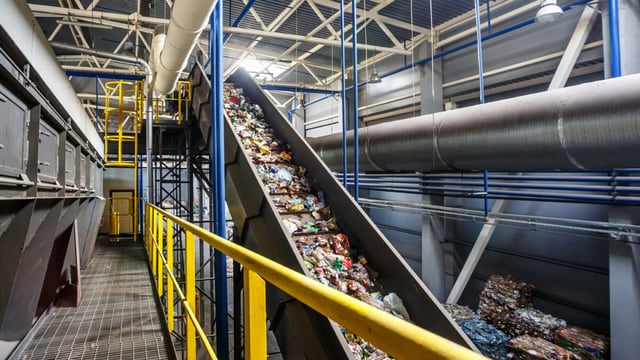
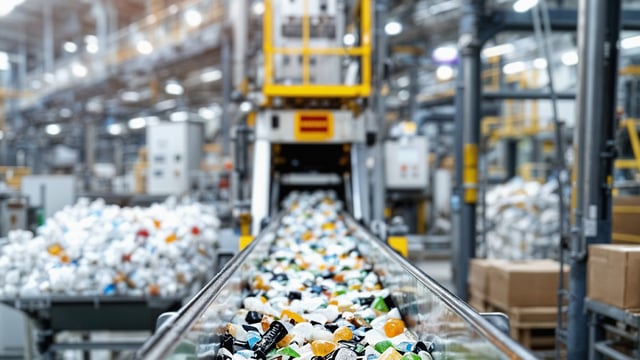
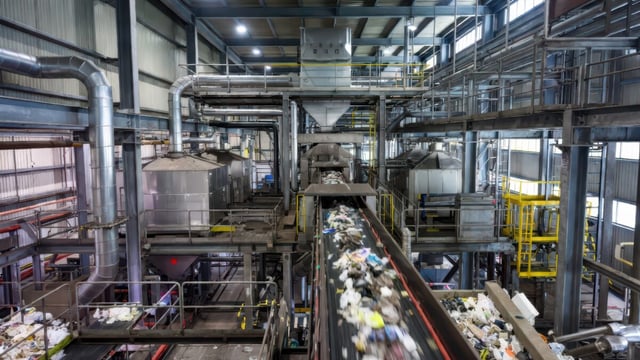
Under the new arrangement, household waste collected in Suffolk will be taken first to an SPSA transfer facility, then transported to AMP’s processing plant in Portsmouth. There, material passes through a mechanical bag-opener before moving onto a conveyor system where high-speed cameras and AI-powered classification technology identify and separate recoverable items from the residual waste stream. Metals, plastics, and other materials with commodity value are extracted for recycling. Organic material, including food scraps and yard waste, is processed in a kiln and converted into biochar, a carbon-sequestering substance with applications in construction materials, fertiliser, and landfill odour management.
“These high-speed conveyor belts take the garbage, move it really fast, throw it over a waterfall and little jets of air push out the stuff we want,” said Matanya Horowitz, founder of AMP, during a tour of the Portsmouth facility on 2 April 2026.
Performance Testing and Early Results
The Portsmouth plant has already undergone formal acceptance testing. During a three-day assessment in late January 2026, reviewed by independent firm SCS Engineers, the facility processed over 500 tonnes of municipal solid waste. Around 360 tonnes of recyclable or organic material were recovered, a diversion rate well above the 50% minimum required under the contract. SPSA confirmed the results fulfilled the system’s contractual performance terms.
At that point, the facility was processing approximately 10% of the region’s total waste volume. A further capacity expansion was scheduled for July 2026, targeting around 20% of the regional stream. At full build-out, including a planned second facility on Victory Boulevard at the site of the former Wheelabrator plant, the system is expected to handle roughly four times its current capacity under the broader $450 million agreement.
The plant currently processes 108,000 tonnes annually. An estimated 22,000 tonnes of recyclables per year are expected from the combined operation, broadly equivalent to what the region’s existing blue-bin system currently captures.
Suffolk Is Not the First
Portsmouth was an earlier adopter. That city began routing waste from both bins through AMP’s facility ahead of the Suffolk rollout, in effect already operating without a functional separation requirement for residents. The rollout in Suffolk follows the same logic: once an AI facility can sort the mixed stream more efficiently than kerbside separation can, the public-facing collection model changes accordingly.
AMP has broader experience to draw on. The company’s AI platform has catalogued more than 200 billion items across its deployments and has processed some 2.9 million tonnes of recyclables. It currently operates more than 400 AI systems across facilities in North America, Asia, and Europe. Kurrant previously covered AMP’s $91 million Series D funding round, which the company raised to accelerate deployment of its mixed-waste sorting systems, including the Portsmouth facility.
AMP has also signed a separate agreement with Google to prevent 200,000 metric tonnes of CO2-equivalent from entering the atmosphere by 2030 through biochar carbon credits, as well as exploring biochar’s potential to offset methane emissions from landfill organic decomposition.
Funding Structure and What Residents Need to Know
The $450 million contract is structured so that AMP contributes approximately $200 million in capital investment and recovers costs through the sale of recyclables, biochar, and carbon credits. SPSA’s $100 million share is drawn from the waste-processing fees its member communities already pay, avoiding direct rate increases for municipalities or residents.
From 1 July, Suffolk residents can place all waste, including items previously sorted for recycling, into a single bin. Residents who still wish to separate recyclables manually can continue to do so; SPSA says collection containers will remain available at the transfer station. Hazardous materials, including batteries, paint, and chemicals, are explicitly excluded from the new arrangement and must continue to be disposed of through designated drop-off programmes.