in Barcelona
 3 to 5 Nov 2026
Rematics B.V., a computer vision start-up based in Herk-de-Stad in the Belgian province of Limburg, announced on 27 May 2026 that it has secured a strategic investment of €2 million from MOBA Mobile Automation AG, the family-owned German machine control and waste identification group headquartered in Limburg an der Lahn, to take its truck-mounted contamination detection system beyond the Benelux.
The deal formalises a commercial tie-up that MOBA disclosed on 4 May 2026, under which the German group became the exclusive European distributor of the Rematics camera system, rebadged as MAWIS.AI VIEW inside its own waste management software, while Rematics keeps product development, sales and installations in Belgium, the Netherlands and Luxembourg.
A Camera Unit That Inspects Every Bin At The Moment Of Tipping
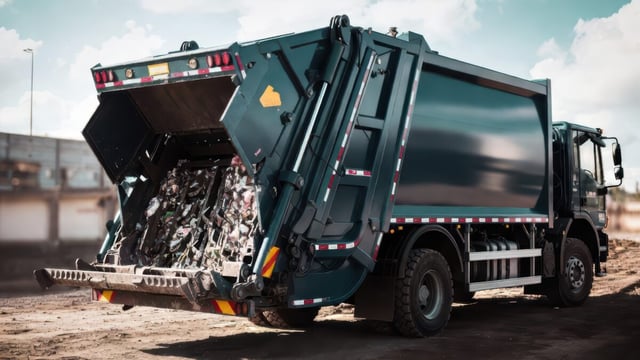
The Rematics product, sold as Daisy4Truck or D4T, pairs a camera with adaptive lighting and an onboard computing unit on the refuse collection vehicle, so that the contents of each bag or container are analysed in real time as they fall into the hopper, with results passed to a cloud platform for reporting.
Building in this space?
Kurrant Ventures backs start-ups digitalising cities and utilities, and opens doors to the operators that buy from them.
- Latitudo 40
- GoodVision
- Meersens
- Cortexia
According to Rematics’ announcement of the investment, the system classifies waste fractions, flags non-conforming material and detects hazardous items such as batteries, gas cylinders and fire extinguishers, and the company states that a truck can be fitted in under four hours.
Those hazardous items are the operational argument for the technology, since batteries crushed in a compaction body are a recognised cause of vehicle and depot fires, while contamination data at the level of a single emptying gives collectors and municipalities objective evidence of sorting behaviour on each street or round.
When integrated into MOBA’s MAWIS platform, each detection can be matched to an individual emptying through the MAWIS.IDENT bin identification module, which links the camera output to the container and weighing records that operators already hold for billing.
From A Valipac Proof Of Concept To Five Benelux Customers
The idea originated at Valipac, the Belgian producer responsibility organisation for industrial and commercial packaging, which ran a test phase and proof of concept with Belgian software firm ACA Group before deciding to sell the project, according to trade publication dVO.
Rematics was incorporated in 2023 by ACA Group, MyCSN, a company of the Limburg investment holding Nuhma, and chief executive Bram Peetermans, and its first live deployments went into service at the end of 2024.
In September 2025 the company announced an agreement with Limburg.net, the intermunicipal waste company for the province of Limburg, to equip that operator’s entire collection fleet with the camera system by the end of 2025, following a pilot.
Limburg.net’s interest is tied to its Optimo collection model, in which a single truck collects several waste streams from households on the same day in differently coloured bags, so that cameras counting bags by colour on each round give the operator data to adjust routes and target awareness campaigns by street.
By the time of the MOBA announcement, Rematics listed Limburg.net, the German-owned collector Remondis, Gielen, Afval Alternatief and the Dutch collector Milieu Service Nederland as customers running the system in production.
Why A German Weighing And Identification Group Is Buying In
MOBA was founded in 1972 and is run by second-generation owner and chief executive Volker Harms, with 17 subsidiaries across Europe, the Americas, Asia and Australia, and its core business is machine control for road construction, earthmoving and cranes.
Its waste management division supplies on-board weighing, bin identification and billing software for refuse collection vehicles under the MAWIS brand, so a camera that grades the contents of each emptying adds a quality layer to a data chain that already records which container was lifted and how much it weighed.
Under the partnership, MOBA takes responsibility for the international rollout outside the Benelux, and Rematics reported commercial interest well beyond its home market.
“We are currently receiving requests from the UK to Singapore,” said Bram Peetermans, CEO of Rematics, in the company’s 27 May 2026 announcement of the investment.
In its 4 May release, MOBA positioned MAWIS.AI VIEW as a response to new legal requirements, in particular the tightened German Biowaste Ordinance, and as a way to identify potentially hazardous items such as batteries early in the collection process.
Regulatory Pressure On Both Sides Of The Border
In Germany, the amended Bioabfallverordnung that applied from 1 May 2025 limits plastic in biowaste from household organics bins to 1%, according to the German waste management association BDE, and places the main burden of analysis and corrective measures on municipalities, which creates demand for evidence collected at the bin rather than at the treatment plant.
In Flanders, the regional target is a maximum of 90 kilogrammes of residual household waste per inhabitant per year by 2030, against an average of 123 kilogrammes in Limburg, according to a sampling campaign reported by VRT on 26 May 2026 in which Limburg.net hand-sorted bags from 11 municipalities into 40 categories.
Manual sampling of that kind gives a statistically useful snapshot from a few dozen bags, whereas a camera on each truck produces a continuous record across every collection, which is the trade-off operators weigh when assessing the cost of fitting a fleet.
Competing Approaches Already On European Roads
Rematics enters a market where several operators were already testing camera-based contamination detection on collection vehicles before the MOBA deal.
In France, Veolia has had four camera-equipped trucks built with start-up Lixo operating in the Bordeaux metropolitan area since February 2026, analysing commercial waste from about 2,000 businesses, while Mauges Communauté, an authority of about 120,000 residents in Maine-et-Loire, began piloting a camera from Grenoble start-up Ficha on one collection truck in February 2026.
In North America, the City of Tacoma launched a two-year pilot with Canadian firm Prairie Robotics funded by a $1.8 million grant from the US Environmental Protection Agency to reduce contamination in curbside recycling.
Most of these deployments are vendor-led or operator-led pilots, whereas the MOBA route places the detection module inside a software suite that collection companies already use for weighing and bin identification, which shortens procurement for existing MAWIS customers.
What The Rollout Will Be Measured On
The commercial test for the partnership will be whether German and other European municipalities subject to biowaste purity rules adopt MAWIS.AI VIEW on fleets already running MAWIS identification and weighing, because that installed base, rather than new greenfield sales, determines how quickly a €2 million investment translates into trucks fitted outside the Benelux.