in Barcelona
 3 to 5 Nov 2026
Las Rozas Innova, the municipal innovation and technology company of Las Rozas de Madrid, has begun a live urban sensing pilot with the Belgian lighting group Schréder and the backing of the Ayuntamiento de Las Rozas, installing three SENSE ONE multisensor devices across the historic centre to measure mobility, parking occupancy, environmental variables and pedestrian activity. The devices will be collecting data until February 2027 in a municipality of just under 100,000 residents. The stated purpose is to validate whether a small number of strategically placed sensors can generate planning-grade data on how the centre is actually used, before any decision on wider deployment.
Three Devices, Four Streets And A Seven-Month Evidence Window
The footprint is deliberately minimal. Three units across a compact old-town grid is not a network, and Las Rozas Innova has framed it as a validation exercise rather than an operational rollout, with the results intended to inform a possible future extension to other zones of the city. The seven-month window matters more than the device count. It spans a full autumn and winter cycle plus the Christmas retail period, which is when a low-density suburban centre such as Calle Real sees its sharpest swings in footfall and kerbside demand.
What The Sensor Measures And How It Classifies Road Users
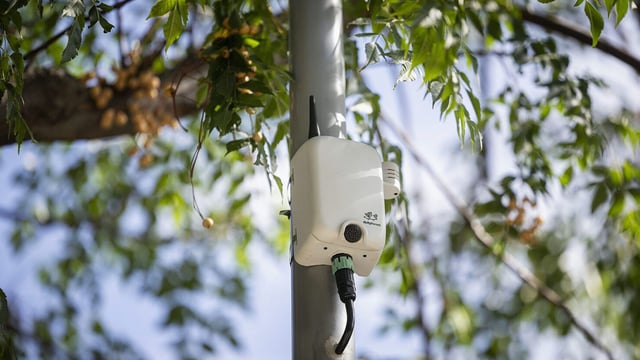
According to the product documentation published by Schréder, SENSE ONE consolidates sensing functions normally split across separate devices, covering traffic, parking, air quality, noise, crowd dynamics and climate in one housing. It supports up to 16 tracking zones with multimodal object classification, and mounts via Zhaga or NEMA interfaces on existing lighting columns rather than requiring new poles or civil works.
In Las Rozas the configured use cases are parking bay and loading zone occupancy, counting and classification of vehicles, pedestrians and personal mobility vehicles, circulation flows, travel speeds and the use of crossings. The output includes heat maps, footfall patterns and real-time parking turnover figures.
That last set is the commercially interesting one. Turnover and occupancy data on unregulated kerbside is the input municipalities need before they can price, restrict or reallocate it, and it is currently the weakest dataset most Spanish town halls hold.
Edge Processing Is A Procurement Argument As Much As A Privacy One
The devices process data locally rather than shipping raw feeds to external servers, applying anonymisation at source and transmitting over encrypted cellular links with over-the-air update support. Schréder markets this as privacy by design, and in a GDPR jurisdiction it removes a large part of the legal review that camera-based counting normally triggers.
It also changes the cost model. Local inference cuts bandwidth and cloud processing charges, which is what makes a lighting-mounted sensor viable in a municipality that has no appetite for a dedicated fibre or edge compute build.
The trade-off is auditability. Once classification happens on the device, the municipality is buying the vendor’s model performance on trust unless the contract specifies validation against ground truth, and no such provision has been made public for this pilot.
Schréder Acquired The Edge AI Behind SENSE ONE Five Weeks Before The Las Rozas Install
SENSE ONE is powered by EdgeMachines, an Australian specialist in low-power urban sensing and edge AI that Schréder acquired on 8 June 2026 after a year-long commercial partnership. The company states that data streams from the sensor feed its Schréder EXEDRA platform, which now delivers real-time traffic, occupancy, parking and environmental insight to more than 20 cities across Europe, Australia and New Zealand.
Reference deployments cited by the vendor include Logan in Australia, tracking vehicle speed and counting pedestrians and vehicles for road safety, and Oeiras City Council in Portugal, monitoring crowd management and air quality while publishing real-time parking availability. Las Rozas is an early Spanish entry on that list.
The acquisition timing is the relevant market signal. Schréder is converting a lighting install base into a sensing channel, and pilots like Las Rozas are how that channel gets validated in each national market.
Las Rozas Uses Pilots As A Substitute For Capital Programmes
The municipal company has built a pattern of short, vendor-funded validations rather than large procurements. Recent examples include an IoT and cloud pilot with Libelium and AWS monitoring air pollutants and noise, and a LiDAR beacon trial with Fundación ONCE and Singular Things aimed at protecting pedestrians with disabilities at unsignalised crossings, in a city that operates without traffic lights.
The pilot will allow Las Rozas to “learn about and validate an innovative Smart City technology,” said José de la Uz, Mayor of Las Rozas and president of Las Rozas Innova, in the municipal company’s press release of 14 July 2026, translated from Spanish.
Las Rozas currently presides over the Red Española de Ciudades Inteligentes and lists Schréder among the partners on its stand for the Smart City Expo World Congress 2026 in Barcelona in November. The pilot’s results are likely to surface there.
The Regional Data Layer Is Being Built Around Deployments Like This
The pilot sits inside a Madrid region that is assembling the infrastructure such sensors ultimately feed. Kurrant’s coverage of Madrid’s Gemelo de Gemelos digital twin, built under a €1 billion 2023 to 2027 digitalisation strategy, shows the capital treating federated sensor ingestion as the prerequisite for a live urban model rather than a static one.
For neighbouring municipalities, the practical question is interoperability. Schréder states EXEDRA exposes TALQ, MQTT and REST interfaces, which is the minimum condition for a small municipal dataset to be worth anything beyond the vendor’s own dashboard.
Neither Las Rozas Innova nor Schréder has published a contract value, a cost per device, or the commercial terms under which the sensors were supplied, which leaves the pilot’s unit economics unverifiable and its scalability case untested.