in Barcelona
 3 to 5 Nov 2026
The Oregon Department of Forestry (ODF) has commissioned a new Multi-Mission Aircraft (MMA) carrying an AI-enabled sensor suite designed to detect emerging wildfires faster, track fire behaviour in real time, and extend aerial intelligence to a broader range of emergency scenarios across the state. The $13.23 million investment, announced in March 2026, marks one of the most significant upgrades to ODF’s aviation programme in the agency’s history.
A Generational Shift in Aerial Surveillance
The new platform replaces a Partenavia P.68 Observer that logged more than three decades of service with ODF. Its successor is a de Havilland Twin Otter airframe priced at $7.8 million, selected for its superior endurance, range, and payload capacity relative to the aircraft it retires. The additional $5.4 million covers the integration of advanced mission systems, converting the aircraft from a conventional survey plane into a full aerial intelligence platform.
At the core of the sensing package is the TK-8 Smart Sensor developed by Overwatch Imaging, a Hood River, Oregon-based company that has deployed its systems across six continents for wildfire mapping, disaster response, and search and rescue. The TK-8 captures imagery simultaneously across five spectral bands: visible RGB, near-infrared (NIR), short-wave infrared (SWIR), mid-wave infrared (MWIR), and long-wave infrared (LWIR). This multispectral coverage gives operators the ability to characterise fire conditions, identify hotspots obscured by smoke, and generate georeferenced orthomosaics of active fire perimeters in near real time.
How the Detection System Works in Practice
The aircraft’s onboard AI processes imagery at the edge rather than transmitting raw feeds to a ground station for analysis, compressing the time between observation and actionable intelligence. During wildfire detection patrols, crews cross-reference lightning strike data and weather forecasts with live sensor readings to locate new ignitions, often before they become visible to the public or ground-based observers. Once a new fire start is confirmed, dispatch centres are notified so suppression resources can mobilise.
The Overwatch Imaging system includes Automated Sensor Operator (ASO) software, which automates key imaging tasks that would otherwise require continuous human attention in the cockpit. The TK-8’s horizon-to-horizon scanning capability allows a single aircraft to survey large territories during a single sortie, a practical advantage given Oregon’s geographic scale and the concentration of lightning activity in its eastern and southern regions.
Night Operations as a Strategic Priority
One capability that ODF officials have emphasised is the aircraft’s night vision functionality. Crews equipped with night vision goggles can identify the visual signatures of early-stage fire starts, including the faint flicker of a new ignition that would otherwise be invisible to the naked eye from altitude. Combined with the TK-8’s thermal imaging, this night-operations capability is intended to close the detection gap that has historically existed between sunset and the point at which a fire becomes large enough to generate visible smoke columns.
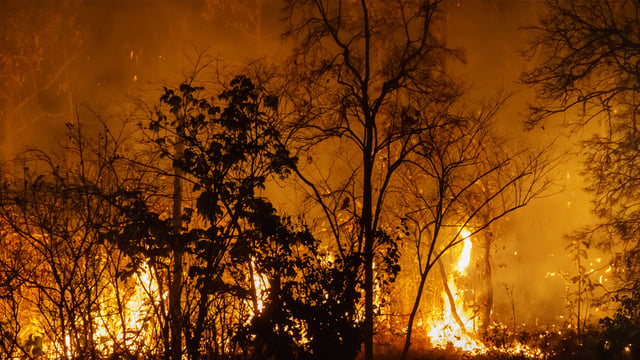
This matters operationally because many ignitions in Oregon’s high-risk zones occur during thunderstorm activity at night, when lightning strikes dry vegetation and smouldering fires can grow unchecked for hours before discovery. Earlier aerial detection during these windows translates directly into faster initial attack response, which is the most cost-effective phase of wildfire suppression.
All-Hazards Role Beyond Wildfire
ODF has designed the MMA’s mission profile to extend well beyond fire season. The aircraft’s geospatial intelligence capabilities make it suitable for flood mapping, severe storm damage assessment, and search and rescue coordination. In these contexts, the TK-8’s ability to rapidly produce georeferenced data products and transmit them to incident management teams provides the same situational awareness advantage it offers during wildfire response.
The platform will also support Air Tactical Group Supervisor (ATGS) coordination, a function that involves directing aerial firefighting resources from the air during active incidents, and can transport personnel and equipment when logistical needs arise. ODF indicated the MMA is intended to strengthen interoperability across state agencies and local emergency management teams during complex multi-agency responses.
Funding Structure and Deployment Timeline
The $13.23 million total cost was funded primarily through $12 million in bonds approved by the Oregon Legislature in 2023, with the remaining $1.23 million drawn from additional sources not individually specified in ODF’s public announcement. The aircraft will be permanently based at Prineville Airport in central Oregon, a location chosen for its ability to reach all regions of the state with relative speed, particularly the lightning-prone terrain of eastern and southern Oregon.
As of March 2026, the aircraft remained in California completing final integration and testing. ODF stated that pilots and aerial observers would complete several weeks of training before the platform enters full operational service ahead of the 2026 fire season.
Where This Fits in the Wider AI Wildfire Intelligence Landscape
Oregon’s aerial upgrade reflects a broader shift in public agency wildfire strategy toward earlier, technology-assisted detection at scale. Agencies across the western United States have been testing and deploying a range of AI-based systems in recent years, from fixed camera networks to satellite-based tools.
The ALERTWest network, developed in part by the University of Oregon’s Oregon Hazard Lab, spans roughly 1,200 AI-equipped cameras across western states providing continuous monitoring for emergency responders and the public. In California, Rancho Palos Verdes deployed Pano AI cameras for early ignition detection, while Maui’s fire departments integrated ground-based AI smoke sensors by N5 following the 2023 wildfire disaster. At the satellite level, Google’s FireSat initiative is developing a constellation capable of detecting fires as small as 5×5 metres within 20 minutes of ignition.
ODF’s investment in a crewed, sensor-intensive fixed-wing platform occupies a distinct operational niche within this ecosystem: unlike fixed cameras or satellites, it can be repositioned across the state on demand, loiter over large territories, and deliver multispectral intelligence to ground commanders with minimal latency. The Overwatch Imaging TK-8 has been deployed in comparable roles internationally; Korea Forest Aviation equipped firefighting helicopters with TK-8 sensors in 2024, with crews reporting that real-time multispectral imagery enabled more effective night suppression during an active wildfire in South Jeolla Province.