in Barcelona
 3 to 5 Nov 2026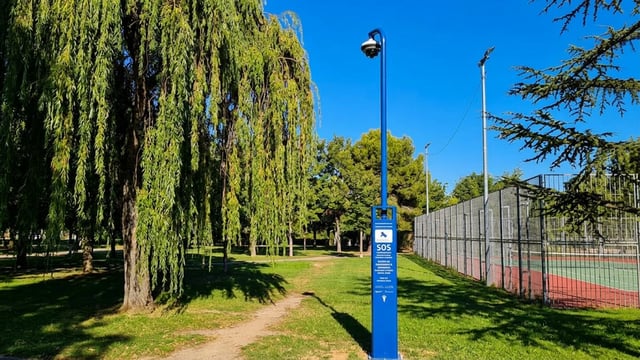
The Ayuntamiento de Rivas Vaciamadrid confirmed on 7 August 2026 that it has completed the installation of seven new SOS alarm posts across the municipality, taking the city’s total from two to nine. The units, sited in parks, streets and pedestrian corridors in the Madrid-region city of roughly 103,000 residents, connect users directly to the Local Police control room and are intended primarily to reduce exposure to gender-based violence in public space, though any resident in an emergency can use them. Three posts were paid for from the municipal budget at a cost of 22,318.41 euros; the remainder were funded through the city’s Smart Tourism Destination programme, financed by EU Next Generation funds.
From A Single Pilot Column In 2019 To A Nine-Unit Municipal Network
Rivas installed its first SOS post in June 2019 at the Parque de Asturias roundabout, following a participatory mapping exercise in which women marked locations where they had experienced violence or felt unsafe. A second unit followed next to the post office car park on calle Electrodo, leaving the city with two operational posts for more than five years.
That new posts distribution favours green space and pedestrian routes over commercial centres, consistent with the participatory siting method the council describes.
What Happens Between The Button Press And The Police Response
Pressing the button generates a priority alarm at the Local Police control centre while an acoustic and visual siren activates at the post itself, opening a real-time voice channel with officers.
An integrated camera streams live video, allowing the control room to assess severity, dispatch medical or municipal services as required, and filter out false alarms.
That video verification step is the operational difference between a call box and a modern emergency pillar, since it lets dispatchers triage before committing a patrol.
The posts operate continuously, are built to withstand weather exposure, and are described by the council as meeting applicable cybersecurity standards and data protection rules.
The council also notes a deliberate design compromise: the units are clearly identified and signposted, but styled to blend into the streetscape rather than signal permanent alarm.
Why Existing Fibre And Radio Assets Made This A Low-Marginal-Cost Addition
The posts are connected through the municipal fibre optic network and integrated into the Local Police video surveillance systems, meaning no separate backhaul was required.
Rivas has been building that substrate since 2004, when it began deploying a metropolitan fibre ring linking municipal buildings, a programme originally delivered with Indra that industry accounts put at over 200 kilometres of fibre.
The city subsequently added a TETRA network in 2005, and in 2016, the SUCCESS eLTE system.
Local Police also operate an AI-assisted licence plate recognition network at municipal entry and exit points, presented at the 2020 Congreso Ciudades Inteligentes by the council alongside Avigilon, Huawei and Eurocop.
Roughly 7,440 euros per municipally funded post buys a camera-equipped emergency pillar only where fibre, a control room and a video management platform already exist.
Tourism Funds Paying For A Public Safety Asset
Four of the seven posts fall under Rivas, Destino Turístico Inteligente, the city’s participation in the national Smart Tourism Destination scheme promoted by the Secretaría de Estado de Turismo and managed by SEGITTUR under the Recovery, Transformation and Resilience Plan.
The council awarded the wider DTI solution in December 2025 at 1.9 million euros, fully financed by Next Generation EU, with workstreams covering a mobility digital twin, intelligent traffic signals and event crowd management.
Safety is one of four declared pillars of that programme, which is how street-level alarm hardware ends up on a tourism budget line.
That funding route matters for replicability. Next Generation disbursement windows are finite, and cities that have used tourism envelopes to seed permanent safety infrastructure will need recurrent municipal budget to maintain, replace and cyber-patch these assets afterwards.
Siting Decided With The Municipal Women’s Council Rather Than Crime Data Alone
Locations were selected in coordination with the Consejo Municipal de Mujeres, including a joint site visit to candidate positions.
The council frames the decision within what it calls feminist urban planning, prioritising lived experience of public space over incident statistics.
Rivas has run a specialised municipal gender violence service since 2005 as part of the Comunidad de Madrid regional observatory network, staffed by a social worker, a psychologist and a lawyer.
Fixed Street Furniture Versus App-Based Personal Safety
The Rivas approach contrasts with the software-first model many European cities have adopted. Manchester City Council, for instance, deployed the WalkSafe personal safety app in September 2024, using resident reports on lighting, harassment and crime to inform street lighting, licensing and patrol decisions, as Kurrant reported.
“What the app allows women to do is to report it on the app,” said Joanna Midgley, Deputy Leader of Manchester City Council, in an interview published by Kurrant in January 2025, describing how the council then identifies patterns across the city.
The trade-off is straightforward. Apps generate continuous perception data at near-zero hardware cost but depend on a charged, unstolen phone; fixed posts cost capital and civil works but function when the phone does not, which is the scenario most gender violence protocols are designed around.
National Demand Signals Behind Municipal Investment
Spain’s Delegación del Gobierno contra la Violencia de Género records 1,524,412 relevant calls to the 016 helpline between September 2007 and 30 June 2026, including 62,302 in the first half of 2026 alone.
Roughly 21,200 women were active users of the ATENPRO mobile teleassistance service as of April 2026, alongside about 4,379 active electronic restraining order monitoring devices nationally.
Those figures describe demand for state-run, victim-linked services; municipal SOS posts address a different gap, serving people who are not registered with any protection scheme at the moment they need help.