 in Barcelona
 3 to 5 Nov 2026
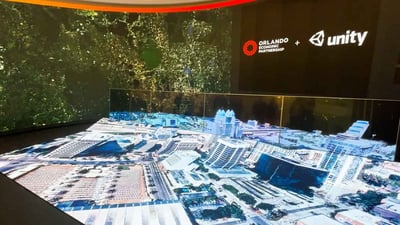
When virtual reality became commercial in the mid-2010s, in the times of Uptown Funk or the Breaking Bad finale, it turned into such a hype. Everyone wanted a VR set for video games. But, the hype didn’t just stop there, it also reached the smart city and utility world. You could see VR at all the smart city and utility events. And to this day, we continue to see it. Whether at Distributech, Vivatech or SCEWC, we always see various players offering VR... So, with all this buzz surrounding VR, let’s check, is it a game changer or a tech fad for cities and utilities? Virtual reality is an immersive, interactive simulation experience that uses near-eye displays and pose tracking to give the user freedom to move and see inside a virtual world, as well as alter it. It is a very attractive and visual solution, but the thing is, at the moment, there aren’t many smart city and utility projects that benefit immensely from VR There are different ways VR can be used in the smart city and utility world. VR can be used just as a visualization tool. For example, the Orlando region digital twin has a VR function for staff and visitors to visualize the 3D model and the data in a more first-hand manner. But in this case, the star is the digital twin itself. The VR is just something extra. There are two other uses that can add value: Training and planning. In cities, it is used in urban planning and design or for simulations like training for emergency response or maintenance. It gives planners the chance to act out something in the virtual world and understand what steps need to be taken to ensure efficiency, proper planning, as well as safety before doing it in the real world. It can prevent many mistakes. In the utility world, more of the same. Training, planning and simulations. Maintenance, building and repair simulations, training in dangerous places, like high-voltage areas, equipment operation… We’ve seen utilities like SRP in the US turn to VR to train staff on how to find utility locations. But in an increasingly international world, it can also be used to gather experts in the virtual world. The 3D content you’ve got to be very careful on your use cases because sometimes it's pretty useless, but sometimes it could be really useful if, for example, you can access on the physical sites, and you have distance operators that can of help. You can work with two, ten people on the same 3D model of a building, for example. But you can do you can do that, of course, in a different country with someone else. And that's not just, a video call because that's being physically present. Iter Organization, an international nuclear project with Japan, South Korea, China, India, Russia, the EU and the US, is building the world’s largest fusion device to create energy. And to do that, they’ve bet on VR as one of the planning tools.. We're using it for assembling the machine. So we're using it for construction or for, simulation of assembling, simulation of works before we start the work, because for us, it's very important that everything is adjusted with the highest precision that we can get. This example can be applied to cities and utilities. Where and how to build by first running a simulation. But, virtual worlds have not had the greatest track record. The metaverse was a flop and VR is not an important tool in the industry at the moment. Training is the main use case for VR in cities and utilities for now. For industry players it can be great for selling products, it can be a good sales pitch to show what they do, but it won’t improve their product. In the case of simulations, or predictions, like simulating floods, the most important part will be the digital twin. It seems like in many cases, VR is just an extra to digital twins. So the focus should be on replicating the city or utility. For now, VR is still a tech fad in the industry, but in the future, who knows, maybe an AI simulation could predict what will happen.
VR for Smart Cities, Utilities: Bop or Flop?
When virtual reality became commercial in the mid-2010s, it turned into a hype. Everyone wanted a VR set for video games. But, the hype didn’t just stop there, it also reached the smart city and utility world. You could see VR at all the smart city and utility events. And to this day, we continue to see it. Whether at Distributech, Vivatech or SCEWC, we always see various players offering VR... So, with all this buzz surrounding VR, let’s check, is it a game changer or a tech fad for cities and utilities?
In this episode we interview Yann de Couëssin, Unity Developer, and Julia Ponomareva, Communication Officer at Iter Organization, to see how VR is used in the smart city and utility world and if it’s proving useful.
View transcript auto-generated








Similar Picks


📰 Latest News
🎬 Kurrant Originals
🎥 Recent Event Coverage

Featured Case Studies
Real client work behind the news. Strategy, M&A and engineering projects we've delivered for cities and utilities.


Stay in the Loop
Get smart cities and utilities insights delivered your way. Choose your channel
Join our WhatsApp Channel