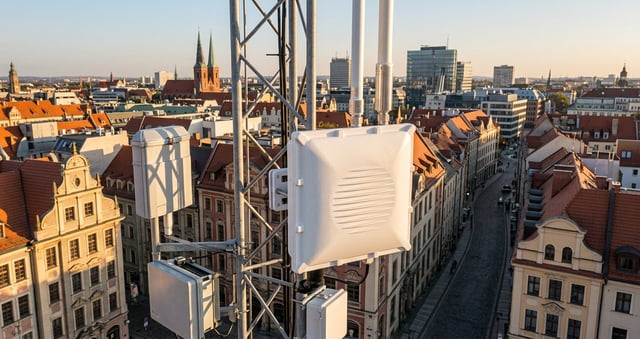
The Georgia Department of Transportation (GDOT) is expanding its lidar-based traffic infrastructure across the Atlanta metro area for the second time in less than a month. Three weeks after selecting Aeva’s CityOS platform for a 30-intersection passive analytics deployment, GDOT has now contracted Ouster and its regional distributor Southern Lighting & Traffic Systems to deploy the BlueCity traffic signal management system at more than 30 additional intersections, including sites near downtown’s Mercedes-Benz Stadium, ahead of the 2026 FIFA World Cup. The two awards are distinct in both technology and function, pointing to a broader multi-vendor ITS build-out underway across the region.
From Six Intersections to a Metro-Wide Network
The current phase builds on a foundational pilot that placed Ouster’s BlueCity platform at six downtown Atlanta intersections along a high-traffic pedestrian corridor near the Georgia World Congress Center. The expanded deployment brings the total footprint across the metropolitan area to more than 36 locations, with Ouster reporting 700 or more contracted BlueCity sites globally across intersections, mid-blocks, and highways.
GDOT’s expansion choice reflects both the results of the initial rollout and the broader traffic demands anticipated for a summer tournament that will bring hundreds of thousands of international visitors to one of the fastest-growing cities in the United States. Atlanta is among the eleven US cities hosting FIFA World Cup 2026 matches, with games scheduled at Mercedes-Benz Stadium.
How the Technology Works at the Intersection Level
BlueCity integrates directly into GDOT’s existing traffic signal controllers, removing the need for infrastructure overhauls at each site. The platform pairs Ouster’s 3D digital lidar sensors with edge-based AI perception software to generate a continuous, real-time picture of intersection activity. The system classifies road users, including motor vehicles, cyclists, and pedestrians, and uses that data to make dynamic actuation decisions, adjusting signal timing based on observed conditions rather than fixed schedules.
Unlike camera-based or radar detection systems, lidar captures spatial depth data using laser pulses, enabling object tracking regardless of ambient lighting conditions or adverse weather such as rain or fog. This all-conditions operability is a critical factor for agencies managing high-pedestrian corridors where safety events can occur at any hour.
Beyond signal control, the Atlanta deployment is configured to generate vehicle-to-everything (V2X) safety alerts for connected vehicles. Roadside units broadcast real-time positional and behavioral data to on-board units in equipped vehicles, enabling proactive hazard warnings for situations such as a pedestrian entering a crosswalk or a cyclist approaching an intersection from a non-standard direction.
NEMA Certification and Federal Compliance
BlueCity holds system-level NEMA TS2 certification as a detection solution for traffic actuation, a standard set by the National Electrical Manufacturers Association for traffic control assemblies. It was the first lidar-based traffic solution to achieve this certification, and notably uses Buy America-compliant lidar components, which aligns with federal procurement requirements under the Bipartisan Infrastructure Law. This compliance status broadens its eligibility for state transportation agency contracts and federally funded projects.
A Pattern of State-Level Transportation Deployments
The Atlanta expansion adds Georgia to a list of states where GDOT-equivalent agencies have selected BlueCity for large-scale rollouts. Ouster has secured deployments of more than 100 intersections each in Utah, where it worked with distributor Econolite following a competitive state procurement assessment, and in both Chattanooga and Nashville in Tennessee.
The Chattanooga deployment, announced in January 2025 under a $2 million contract, covered more than 120 downtown intersections and was cited at the time as the largest lidar-based traffic and pedestrian safety installation in the United States. That project involved Southern Lighting & Traffic Systems and the Center for Urban Informatics and Progress (CUIP) at the University of Tennessee Chattanooga, the same distributor now active in the Atlanta rollout. Chattanooga’s pilot phase at 12 intersections recorded a full elimination of near-miss incidents on one high-risk city block following the installation of a new crosswalk identified through BlueCity data, according to the university’s research team.
Nashville’s deployment was separately supported by a US Department of Transportation SMART Grant under the Bipartisan Infrastructure Law, which allocated $100 million annually from 2022 to 2026 for demonstration projects focused on advanced smart community transportation technologies.
World Cup Infrastructure as a Long-Term Asset
GDOT’s framing of the Atlanta deployment goes beyond the tournament itself. The agency’s deputy commissioner has described the broader infrastructure programme as intended to remain fully operational after the World Cup concludes, with resurfacing, signal upgrades, and lighting improvements all designed as lasting contributions to the city’s traffic environment. The lidar network fits within this logic: a system procured under event pressure that delivers ongoing safety and operational data for city planners and traffic engineers after the final whistle.
Ouster’s financial profile lends context to the pace of BlueCity adoption. The company reported full-year 2025 revenue of $169 million, a 52% increase year-on-year, with lidar sensor shipments exceeding 25,000 units.