in Barcelona
 3 to 5 Nov 2026
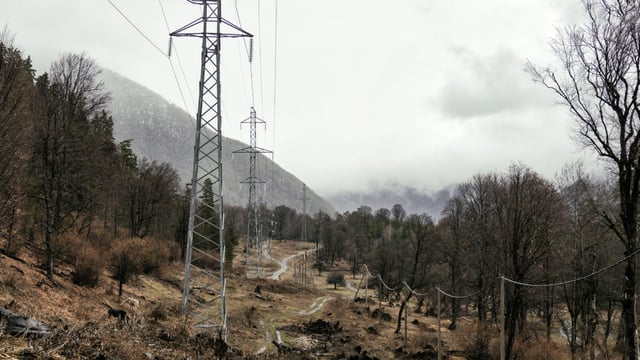
Red Eléctrica, the Redeia subsidiary that owns Spain’s high-voltage transmission grid and operates the national electricity system, announced on 6 November 2026 that it has completed a Dynamic Line Rating installation on the 220 kV Pobla-T Sesué line. The line crosses the Pyrenees between the provinces of Huesca and Lleida, and crews fitted 35 spans with conductor-mounted inclinometers and 14 towers with weather stations while it stayed energised.
The project, published through EuropaWire under a Zaragoza dateline, is one of the measures listed in Spain’s current transmission grid planning. It replaces the fixed seasonal rating of the line with one calculated from measured weather, so operators can load the circuit closer to its real thermal limit at any given hour.
Thirty-Five Spans Instrumented Across Seven Pyrenean Municipalities
The inclinometers sit directly on the conductors across 35 spans in La Pobla de Segur, Conca de Dalt, Tremp, Sopeira, Arén, Isábena and Foradada del Toscar. They measure the mechanical behaviour of the line, the tilt and sag that reflect conductor temperature and therefore how much current a span can carry before clearances are breached.
The 14 weather stations are mounted on 14 towers in six of those municipalities and run autonomously on solar panels. They record ambient temperature and solar radiation, and use ultrasonic sensors for wind speed and direction, the variable with the largest cooling effect on an overhead conductor and the hardest to predict in mountain valleys.
Data from both sets of devices travels over NB-IoT cellular connectivity to Red Eléctrica’s dynamic operation platform. There, machine-learning calculation algorithms convert the readings into a real-time ampacity value for the line, according to the company.
Red Eléctrica made no change to the route, the number of towers, the conductors or the maximum operating temperature. The entire installation was carried out live-line, so supply to consumers continued throughout the works.
A Programme Built On More Than 750 Devices
The company says it has now deployed more than 750 Dynamic Line Rating devices across Spain, the same figure it cited in a July 2024 announcement. In that release it said the technology could raise the flows that safely run through certain overhead lines by up to 30% under optimal conditions, a company estimate rather than a measured fleet average.
That programme was developed with Elewit, Redeia’s technology platform, together with Amazon Web Services and Telefónica Tech. It formed part of the initiatives in Spain’s 2021-2026 Electricity Planning.
Miguel de la Torre, Head of System Development at Red Eléctrica, said in the July 2024 release that “incorporating these devices into the transmission grid will allow us to make better use of the existing grid”.
In February 2025 the company extended the approach to the Balearic Islands. There it installed 19 weather stations and 55 sensors on three 66 kV lines on Ibiza and Mallorca.
Red Eléctrica has also tested a sensorless model with Portuguese software company Enline on four lines since 2021. Enline reports an average transmission gain of 21.1% and accuracy above 95% against physical sensors, according to Eurelectric, and secured ABB venture backing in March 2026.
The Pyrenees project adds to a wider digitalisation effort at the operator, which has adopted Dassault Systèmes’ 3DEXPERIENCE platform to build digital twins of its transmission assets.
Why A 220 kV Mountain Corridor Suits Dynamic Rating
Static seasonal ratings assume conservative combinations of high ambient temperature, strong sun and low wind. On a mountain corridor such as Pobla-T Sesué, those assumptions understate capacity for most hours of the year, when altitude, valley winds and cooler air give conductors more thermal headroom.
The corridor runs through the Pallars and Ribagorza areas of the central Pyrenees, a zone with a long history of hydroelectric generation. Extra transfer capability on windy or cool days is directly useful for moving that output, and new solar capacity, toward demand centres.
Red Eléctrica operated 46,074 circuit kilometres of transmission lines at the end of 2025, of which 43,656 km were overhead, according to its 2026 corporate brochure. It invested €1.42 billion in the Spanish transmission grid during 2025, according to Redeia’s 2025 results.
Brussels And Madrid Both Point To Grid-Efficiency Tools
The European Commission’s Action Plan for Grids, published on 28 November 2023, promotes dynamic line rating among its smart-grid and network-efficiency measures. The same plan estimates that €584 billion of investment in electricity grids is needed this decade, which frames sensors costing a fraction of a new line as a way to defer construction.
Spain’s proposed 2025-2030 transmission planning was opened to public consultation in October 2025. It foresees about €13.1 billion of transmission investment and around 6,800 km of new lines, and includes dynamic line rating on selected corridors, according to a summary by RE Global.
European Operators Report Gains Of 20% To 40%
Belgium’s transmission operator Elia has used dynamic line rating with Ampacimon since 2008 and lists 30 lines in its rollout. Ampacimon reports that the technology raised flows on eight Belgian interconnectors with France and the Netherlands by 30% to 40% by the winter of 2014-2015, a vendor-reported figure.
In the United Kingdom, National Grid and LineVision have extended monitoring to more than 170 miles of conductor, with capacity gains above 20% according to LineVision. Norwegian sensor maker Heimdall Power reports an average capacity increase of 25% across its installations.
France’s RTE installed its first drone-mounted Ampacimon sensor in Haute-Vienne in March 2026, according to Ampacimon. The method removes the need for line crews to work on energised conductors.
The Pobla-T Sesué line will be measured against the up-to-30% headroom Red Eléctrica has set for its programme and the 20% to 40% results reported in Belgium and the United Kingdom. The deciding factor will be how well wind readings from 14 towers represent conditions across all 35 instrumented spans, because the most sheltered span in a narrow Pyrenean valley sets the rating for the whole circuit, a constraint that will scale with every corridor added under Spain’s 2025-2030 planning.