 in Barcelona
 3 to 5 Nov 2026
it seemed bizarre three years ago. Teachers at one Bessemer Elementary School had to wear face masks to class today. Tests found dangerous species of mold and fungus so everybody moved into this half of the building. We do have some teachers who do have on face masks because they feel like the quality of the air in here is not good. Now face masks are coming. I have a mask right here. I put a mask on when I think I need it. COVID-19 has put the world on edge. People in fear of dirty air. Do you think we can categorically state that there is a link between death rates and air pollution when it comes to coronavirus? It is early research, but this is compelling evidence. And because the virus is airborne, indoor environments like school buildings are especially worrisome. We have... systematically neglected our heating, ventilating and air conditioning or HVAC systems in many of our buildings, maybe especially in our schools. But the rise of micro sensors could give us the data we need to take action. The only way to know what we breathe is to measure it and to measure it with full picture. We are not relying on one -off and spot measures in order to make some recommendations on the long term. Yet they lack regulation as some studies question their accuracy. Could a new experiment in Paris schools change that? The purpose is to optimize the efficiency of ventilation to better take into account the health of young children. Paris' struggle with air pollution is no secret. In 2016, the city declared... a state of alert when smog became so thick that the Eiffel Tower was barely visible. Then there was this study in 2018 that basically said living in Paris for a year is like smoking 183 cigarettes. But perhaps one of the biggest wake -up calls for the state was this. A woman who used to live in the suburban area of Seine -Saint -Denis north of Paris filed a complaint against the French government. A lawsuit in 2019 that found France didn't do enough to protect a woman and her daughter from the health effects of air pollution. Whenever a citizen commits an offense, there is a penalty. So there's no reason why the state shouldn't face up to its responsibilities. Paris is now on a mission to reverse the bad press, the mayor aiming to create the first breathable city with initiatives like this. You might have heard about the low emission zone that Paris... set up since 2015. The city also works on public spaces and rebalancing public spaces for pedestrian cycles or public transportation. The focus has now turned to its schools because, quite simply, that's what the people want. Every year, citizens in Paris have the opportunity to decide how 5 % of the city's budget will be spent. And this year... that meant investigating the dirty air in schools. Marion Gouet pilots projects for the city of Paris that are directly connected to air quality. Her latest project, which is currently in the installation phase, will test two solutions across 23 classrooms over the next year. The first aims to better ventilate classrooms within old buildings that don't have a ventilation system. Sensors are used inside and outside the schools to measure the air quality in real time. In a context where the occupants do not open the windows enough. Where they do, where they open the windows in winter, they can flow too much cold air, which is bad for the search of better energy efficiency in buildings. The second solution studies the efficiency of a ventilation system in a new school, where micro-sensors allow for that system to alter the airflow based on the... changing pollutants. This pollution can come from outside air or inside. For example, high levels of carbon dioxide or even pollution from noise, temperature and light. This is the CO2 temperature, humidity and VOC sensor. It's also coupled with particulate sensor, particulate matter sensor. Yan Pui San works with NanoSense, the company behind the sensors you're seeing here. We don't stop at CO2 because CO2 CO2 is one of the pollutants that doesn't have any health impact. It only impacts productivity. And we wanted to also protect the health of the children and to monitor the comfort. By doing continuous measurements, we are able to see some evolution. Gene Gabriel is a co -founder and CEO of Pando2. His software solution brings to life the data collected for the sensors by providing real-time alerts and recommendations. that are in line with France's air quality regulations. Based on the CO2 levels, which allows us to calculate automatically confinement indices, we are also able to correlate those measures with temperature and humidity. And we have just developed an index that gives the risk of contagiosity of the COVID -19. for instance, at the moment, but for any other virus based on those three parameters. So we are therefore able to indicate the level of risk and contagiousness in a room based on different and various parameters. Traditional large -scale sensors like the ones used by federal agencies are expensive. They also require regular maintenance and use more energy. In contrast, low-cost, low-cost, low-cost devices are high-cost services. micro sensors are much cheaper. Indoor sensors cost as little as $250 and outdoor sensors start at around 2000. These sensors aren't as accurate as your large scale counterparts, but they can provide concentrated data across more locations in a way traditional sensors can compete. But the industry still struggles to regulate these sensors with critics saying that the findings could mislead the public without a proper understanding of the sensor data quality and In a push to change that, a French non -profit by the name of Airparif tests these sensors every year to learn how they are improving. Nanosense was among the winners in 2019 after being tested over a four -month period in Paris on the basis of 44 parameters and 15 pollutants. Airparif's latest report notes that there's been a 30 % improvement in accuracy when comparing the best performances of fixed indoor air sensors from their 2018 study. Projects like the one discussed in this report will aim to bring the industry even more answers on the effectiveness of the sensors, along with another experiment from 2019 involving Bloomberg Philanthropies. That one placed 150 sensors in Paris schools and daycares. The findings are still being analyzed. For more information on those projects, be sure to stick with Current Insights.
Originals Environmental Monitoring
Paris Aims to Tackle Air Pollution in Schools With Micro Sensors
Air quality monitoringEnvironmental MonitoringParis
In this video
-
 Marion Guiet
Smart City Project Officer, City of Paris
-
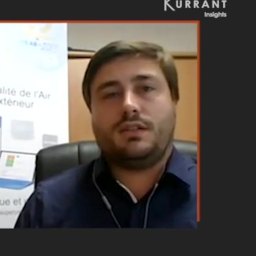 Yann Poisson
R&D Engineer, NANOSENSE
-
 Jean-Gabriel Winkler
Co-Founder & CEO, Pando2
About this video
Schools worldwide are facing a significant challenge with indoor air pollution, an issue that has gained heightened importance during the COVID-19 pandemic. The city of Paris is addressing this problem through an innovative project that integrates cutting-edge technology to improve air quality in classrooms. This initiative involves installing Nanosense sensors, which monitor various air quality parameters. The collected data is then processed by Pando2's advanced software, providing actionable insights and real-time recommendations to optimize airflow and reduce pollutant levels.
This project is a prime example of how microsensor technology can be leveraged to create healthier indoor environments, particularly in educational settings. Key figures in this endeavor include Yann Poisson, an R&D Engineer at Nanosense; Jean-Gabriel Winkler, Co-Founder and CEO of Pando2, overseeing the software's deployment; and Marion Guiet, the Program Manager for Smart City initiatives at the City of Paris, coordinating this project.
The significance of this project extends beyond just the technical aspects. It highlights the role of collaboration between engineers, scientists, city planners, and educational institutions in tackling global health challenges. The project is particularly relevant for policymakers, city managers, educators, environmental scientists, urban planners, and technology enthusiasts, especially those interested in smart city initiatives and public health.
By showcasing the practical application of technology in real-world scenarios, this project serves as a model for other cities and institutions looking to improve indoor air quality in the wake of the pandemic.
Read the transcript machine-generated
More in Environmental Monitoring
See all 4:25
The Tech Behind Tsunami Alerts: How AI and Sensors Save Lives
 4:32
Exposomes: Where Smart Cities, AI, and the Scientific Community Meet
 7:24
The Evolution of Smart Cities and Utilities in the US
 5:50
Cleveland Turns to Air Quality Sensors to Tackle High Asthma Rates
 7:15
How AI-Enabled Cameras and Predictive Analytics Helped Fight LA Fires
 6:13
Austin Energy Steps Up Wildfire Prevention with Vision AI
Latest news in environmental monitoring
All news- Slovak Road Administration Renews Vaisala Road Weather Station Maintenance20 Nov 2026
- ISPRA Awards CAE a Contract To Run Italy’s National Tide-Gauge Network20 Nov 2026
- Spain Centralises Data From Over 4,000 Hydrological Sensors In GOTA Water Observatory20 Nov 2026
- Jerusalem Completes Vehicle LiDAR Pilot To Build Digital Records Of Public Trees17 Nov 2026
Kurrant advisory
Planning a environmental monitoring project? Talk to Kurrant.
Behind these interviews is Kurrant's advisory team, working with utilities, cities and the companies that serve them.
- Strategy AdvisoryKurrant is actively involved in resolving the challenges that cities, utilities and industry players are facing.
- M&A AdvisorySmart city and utility expertise for successful deals, turning insights into strategic gains.
- Engineering & ProcurementBetter engineering and procurement decisions, by identifying and developing digital and IoT solutions across use cases.
Or write to us: contact@kurrant.com
Send us a message